
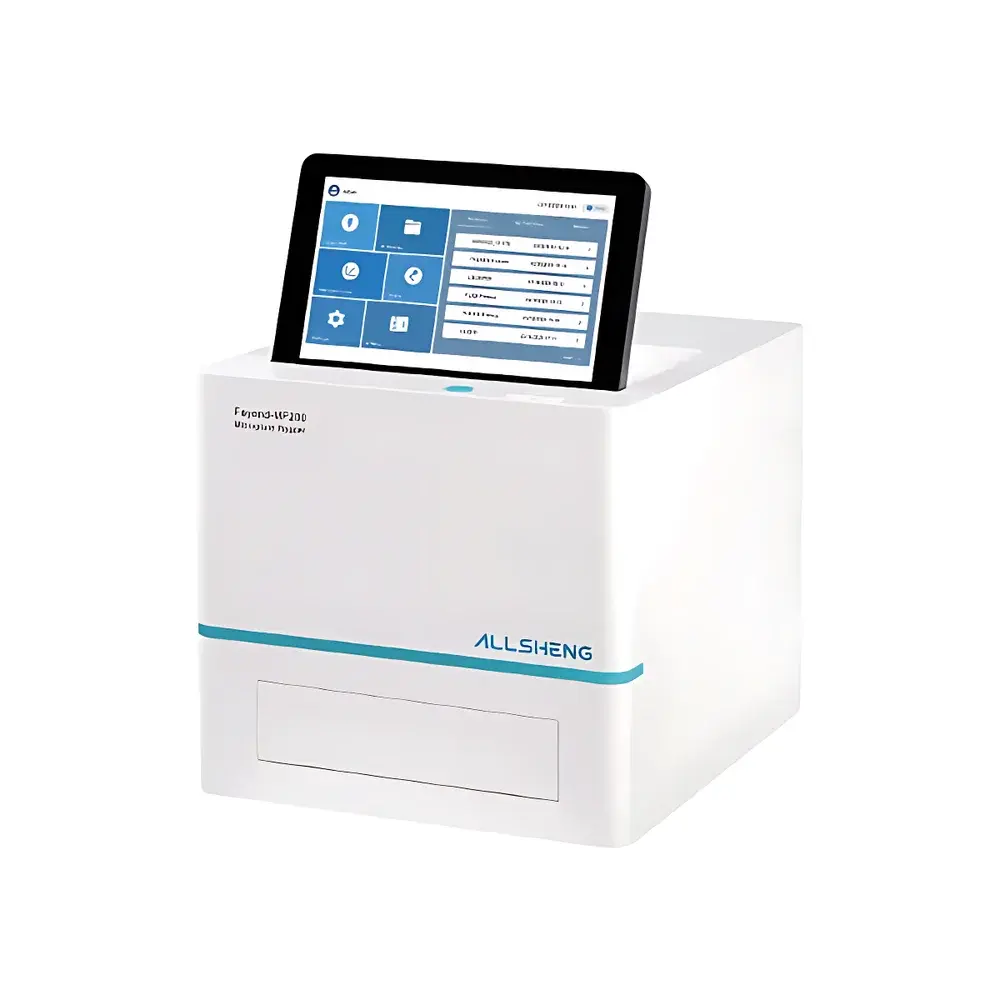
Allsheng Feyond-MF200/MF280 Dual-Mode Microplate Reader
| Brand | Allsheng |
|---|---|
| Origin | Zhejiang, China |
| Model | Feyond-MF200 / Feyond-MF280 |
| Absorbance Range | 190–1000 nm (1 nm step) |
| Absorbance Accuracy | ±(1.0% + 0.003 OD) @ 0.0–2.0 OD |
| Absorbance Precision (CV) | <1.0% (standard mode), <0.5% (high-precision mode) |
| Wavelength Accuracy | ±2 nm |
| Wavelength Repeatability (SD) | ≤0.2 nm |
| Spectral Bandwidth (FWHM) | ≤2.5 nm |
| Optical Density Resolution | 0.0001 OD |
| Linear Range (R²) | ≥0.999 @ 0.0–3.0 OD |
| Stray Light | ≤0.1% @ 220 nm |
| Read Time (96-well plate) | <15 s (A1→H1, fast mode) |
| Fluorescence Detection | Top-read mode, Xenon lamp excitation, PMT detection |
| Standard Filter Sets | 470/525 nm, 523/564 nm, 624/692 nm (up to 8 filter positions) |
| Fluorescence LOD | ≤2 pM (96-well black plate, optimized conditions) |
| Dynamic Range | ≥6 decades |
| Plate Compatibility | 6–384-well standard and micro-volume plates |
| Incubation Temperature Range | RT+4°C to 45°C |
| Temp. Uniformity | ≤1.0°C @ 37°C |
| Temp. Accuracy | ±0.5°C @ 37°C |
| Agitation Modes | Linear, orbital, dual-orbital |
Overview
The Allsheng Feyond-MF200 and Feyond-MF280 are dual-mode microplate readers engineered for high-fidelity absorbance and fluorescence intensity (FI) measurements in life science laboratories. Built upon a dual-optical-path architecture, the platform separates UV/Vis/NIR absorbance and top-reading fluorescence detection into parallel, independently optimized optical channels—minimizing cross-talk and maximizing signal integrity. Absorbance measurements rely on a high-stability xenon flash lamp coupled with dual photodiode (PD×2) detection, enabling precise quantification across a broad spectral range (190–1000 nm, 1 nm step resolution). Fluorescence detection employs a high-gain photomultiplier tube (PMT) with configurable excitation/emission filter sets, delivering low-noise, high-dynamic-range signal acquisition essential for low-abundance analyte detection. Both models support standardized microplate formats from 6- to 384-well, including specialized micro-volume plates, and integrate temperature-controlled incubation (RT+4°C to 45°C) with tight thermal uniformity (≤1.0°C at 37°C) and accuracy (±0.5°C), ensuring assay reproducibility under physiologically relevant conditions.
Key Features
- Dual-optical-path design isolates absorbance and fluorescence optical trains, eliminating spectral interference and enhancing measurement fidelity.
- UV/Vis/NIR absorbance capability spanning 190–1000 nm with ≤2.5 nm FWHM bandwidth and ±2 nm wavelength accuracy—validated per ISO 15197 and ASTM E275 for spectrophotometric performance.
- High-sensitivity fluorescence detection with ≤2 pM limit of detection (LOD) on black 96-well plates under optimized settings, supporting quantitative analysis of low-expression proteins, second messengers, and reporter gene assays.
- Three preinstalled filter pairs (470/525 nm, 523/564 nm, 624/692 nm) and expandable to eight filter positions for multiplexed endpoint or kinetic assays without manual intervention.
- Integrated plate agitation with linear, orbital, and dual-orbital modes ensures homogeneous mixing during kinetic reactions—critical for enzyme kinetics and cell-based binding assays.
- Onboard temperature control with real-time monitoring and active PID regulation meets GLP-compliant incubation requirements for ELISA, cell viability, and metabolic activity assays.
Sample Compatibility & Compliance
The Feyond-MF200/MF280 accommodates standard SBS-format microplates (6–384-well), ultra-low-volume plates (e.g., u-Nano plate, AS-19011-02), and opaque or clear-bottom assay plates. It supports both endpoint and kinetic read protocols across diverse biological matrices—including serum, plasma, cell lysates, and whole-cell suspensions. The instrument complies with IEC 61010-1 for laboratory equipment safety and is designed to operate within environments aligned with ISO/IEC 17025 quality management systems. Its optical calibration traceability is supported by the ABS optical performance verification plate (AS-19011-03), enabling routine verification against NIST-traceable standards. For regulated environments, the optional ReaderLT-II software (AS-19111-01) provides audit trail, electronic signature, and user access control compliant with FDA 21 CFR Part 11 requirements.
Software & Data Management
ReaderLT-II software (sold separately) delivers a validated, Windows-based platform for instrument control, protocol development, data visualization, and export. It supports multi-parameter kinetic profiling, spectral scanning, well-mapping, and automatic curve fitting (e.g., sigmoidal, exponential decay). Raw data are stored in vendor-neutral CSV and XML formats, facilitating integration with LIMS and third-party analysis tools such as GraphPad Prism or Python-based bioinformatics pipelines. The software includes built-in QC modules for OD linearity validation (R² ≥0.999 over 0–3.0 OD), wavelength accuracy checks, and fluorescence gain calibration—ensuring continuous compliance with internal SOPs and external regulatory expectations (e.g., USP , CLSI EP17-A2).
Applications
- Enzyme-linked immunosorbent assays (ELISA) and colorimetric protein quantification (e.g., BCA, Bradford).
- Cell proliferation, cytotoxicity, and apoptosis assays (e.g., MTT, CCK-8, Caspase-Glo).
- Calcium flux and cAMP signaling studies using fluorescent dyes (e.g., Fluo-4, Fura-2, GloSensor).
- Reporter gene assays (luciferase, GFP variants) and protein–protein interaction screening via FRET.
- Microbial growth kinetics and antimicrobial susceptibility testing (AST) in 96-well format.
- High-throughput screening (HTS) workflows requiring rapid (<15 s/96-well) and reproducible (CV <0.5%) absorbance reads.
FAQ
What plate formats does the Feyond-MF200/MF280 support?
It accepts all standard SBS-compliant microplates from 6- to 384-well, including half-area, black/clear-bottom, and ultra-low-volume plates (e.g., u-Nano plate AS-19011-02).
Is the instrument compatible with FDA 21 CFR Part 11 requirements?
Yes—when used with ReaderLT-II software (AS-19111-01), it provides full audit trail, role-based access control, and electronic signatures meeting Part 11 criteria.
Can I perform spectral scanning in absorbance mode?
Yes—the system supports full-spectrum scans from 190–1000 nm at 1 nm increments, with post-acquisition peak identification and baseline correction.
Does the fluorescence module support bottom reading?
No—fluorescence detection is top-read only; however, the optical path is optimized for minimal focal drift and high Z-position repeatability.
How is temperature uniformity verified across the plate?
Thermal mapping is performed per ISO 22196 and CLSI EP23-A guidelines using calibrated thermocouple arrays; uniformity is guaranteed ≤1.0°C at 37°C across all wells.
Is there an option for automated liquid handling integration?
Yes—the MSS-2 automatic dispenser (AS-19011-04) enables synchronized reagent addition and kinetic reading, reducing hands-on time and pipetting variability.
Related Products




