
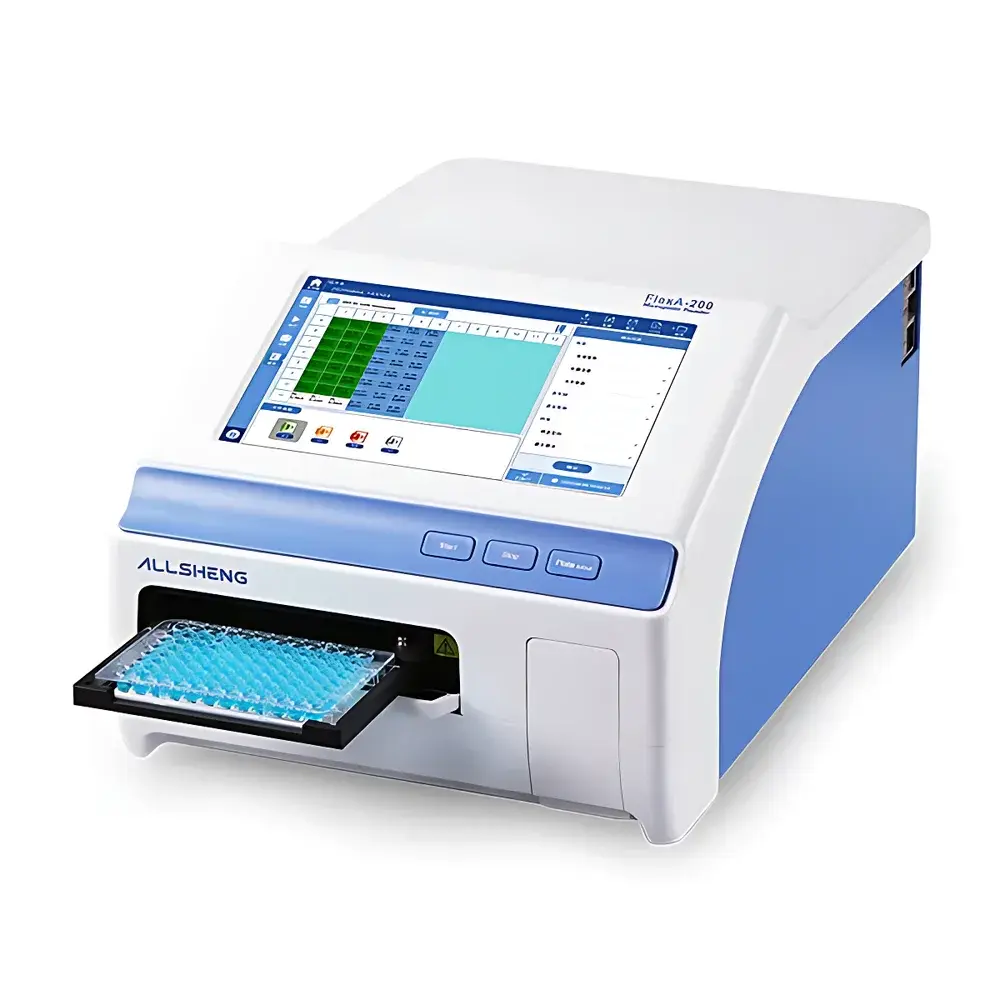
Allsheng FlexA-200 Microplate Reader
| Brand | Allsheng |
|---|---|
| Origin | Zhejiang, China |
| Model | FlexA-200 |
| Detection Principle | Absorbance (UV-Vis) |
| Wavelength Range | 200–1000 nm |
| Wavelength Accuracy | ±2 nm |
| Wavelength Repeatability | ±0.2 nm |
| Optical System | Grating-based monochromator with 1 nm step resolution |
| Read Range | 0–4.0 OD |
| Bandwidth | <2.5 nm |
| Photometric Accuracy @450 nm | ±(1.0% + 0.003 Abs) for 0–2.0 Abs |
| Photometric Precision @450 nm | CV < 0.5% (precise mode), CV < 1.0% (fast mode) |
| 96-well Plate Read Time | ~8 s (fast), <28 s (precise, endpoint) |
| Temperature Control Range | Ambient +4 °C to 45 °C |
| Temp. Uniformity & Accuracy | ±0.5 °C at 37 °C |
| Detector | Dual silicon photodiodes (sample + reference beam) |
| Display | 10-inch capacitive touchscreen (Android OS) |
| Onboard Storage | 16 GB (≥20,000 assay files) |
| Connectivity | 1× USB-B, 2× USB-A, 1× Ethernet |
| Dimensions (W×D×H) | 300 × 500 × 260 mm |
| Net Weight | 15.5 kg |
Overview
The Allsheng FlexA-200 Microplate Reader is a high-performance, dual-beam absorbance microplate reader engineered for precision quantification and kinetic analysis in life science laboratories. It employs a grating-based monochromator system with continuous wavelength selection from 200 nm to 1000 nm in 1 nm increments—enabling flexible endpoint, kinetic, and spectral scanning assays across UV, visible, and near-infrared ranges. Designed for compliance with routine QC, ELISA, cell viability, enzyme activity, and nucleic acid/protein quantification workflows, the FlexA-200 integrates a thermally regulated incubation chamber (up to 45 °C), programmable linear shaking, and dual-silicon photodiode detection with real-time reference channel compensation. Its optical architecture eliminates drift-induced error through automatic self-calibration of lamp intensity, grating position, and detector alignment at startup—ensuring long-term measurement stability and inter-day reproducibility required for GLP-compliant environments.
Key Features
- Dual-beam optical path with dedicated reference photodiode ensures signal stability against source fluctuation and environmental drift.
- Flash xenon lamp with >1×10⁹ flash lifetime provides broad-spectrum output and eliminates warm-up delays typical of tungsten-halogen sources.
- Onboard 10-inch capacitive touchscreen interface running Android OS enables fully standalone operation—no PC required for routine assays.
- Integrated temperature-controlled incubation (ambient +4 °C to 45 °C, ±0.5 °C uniformity at 37 °C) supports cell-based assays and enzymatic reactions requiring thermal regulation.
- Programmable linear shaking with three speed settings optimizes mixing prior to or during kinetic reads without cross-contamination risk.
- u-Nano microvolume plate compatibility (AS-19011-02) enables direct quantification of 2–4 µL nucleic acid or protein samples—eliminating dilution steps and reducing reagent consumption.
- User permission hierarchy (Admin, Standard User, Guest) enforces data integrity and audit readiness per FDA 21 CFR Part 11 principles.
Sample Compatibility & Compliance
The FlexA-200 accommodates standard 96-well and 384-well microplates—including clear, white, black, and UV-transparent formats—with or without lids. Its optical design meets ISO 15197:2013 and CLSI EP17-A2 guidance for photometric performance validation. The instrument supports ASTM E2597-17 (standard practice for verification of microplate reader performance) and includes traceable calibration tools such as the ABS Optical Performance Verification Plate (AS-19011-03). Built-in software logs all user actions, parameter changes, and calibration events with timestamps—facilitating internal audits and regulatory submissions under GxP frameworks. Data export options include CSV, TXT, Excel, and PDF, while optional FTP upload enables centralized storage aligned with laboratory IT infrastructure policies.
Software & Data Management
Two complementary software environments are provided: the embedded Android-based firmware for rapid assay execution and the desktop ReaderLT-II application for advanced protocol development and statistical analysis. ReaderLT-II features protocol simulation, multi-parameter curve fitting (4PL, 5PL, linear, log-log), QC flagging (Westgard rules), and customizable report templates compliant with ISO/IEC 17025 documentation requirements. All onboard data are stored in encrypted SQLite format on the 16 GB internal memory, supporting ≥20,000 assay records with full metadata (user ID, timestamp, plate map, raw OD values, processed results). Export functions include batch reporting, trend charting, and integration-ready CSV outputs compatible with LIMS and ELN platforms. Audit trails capture operator login/logout, method edits, and result overrides—meeting ALCOA+ data integrity criteria.
Applications
The FlexA-200 serves core applications in academic research, clinical diagnostics support labs, and biopharmaceutical quality control. These include quantitative ELISA (IgG, cytokine, hormone assays), MTT/XTT-based cytotoxicity screening, β-galactosidase and luciferase reporter gene assays, Bradford/Lowry/BCA protein assays, dsDNA/ssDNA/RNA quantification via A260/A280 ratios, and kinetic monitoring of NAD(P)H-dependent dehydrogenase activity. Its spectral scanning capability supports custom dye characterization and interference assessment in complex matrices. The u-Nano module extends utility to early-stage drug discovery where sample scarcity demands minimal volume usage without compromising accuracy.
FAQ
Does the FlexA-200 support wavelength scanning across the full 200–1000 nm range?
Yes—it performs continuous monochromatic scans at 1 nm resolution, enabling spectral profiling of dyes, enzymes, and biomolecules.
Can the instrument store and recall standard curves between experiments?
Yes—the onboard “Standard Curve Library” allows saving and reusing calibration curves, reducing setup time and improving inter-assay consistency.
Is the FlexA-200 compliant with FDA 21 CFR Part 11 requirements?
While not certified out-of-the-box, its user authentication, electronic signature support, and immutable audit trail functionality provide the technical foundation for Part 11 compliance when deployed within validated lab IT systems.
What microplate formats are supported for temperature-controlled assays?
All standard flat-bottom, U-bottom, and V-bottom 96-well and 384-well plates—including opaque and low-evaporation variants—are compatible under active incubation conditions.
How does the dual-beam optical system improve measurement reliability?
By simultaneously measuring sample and reference channels, it compensates for lamp intensity decay, ambient light fluctuations, and optical path inconsistencies—yielding lower CVs and higher day-to-day reproducibility.




