
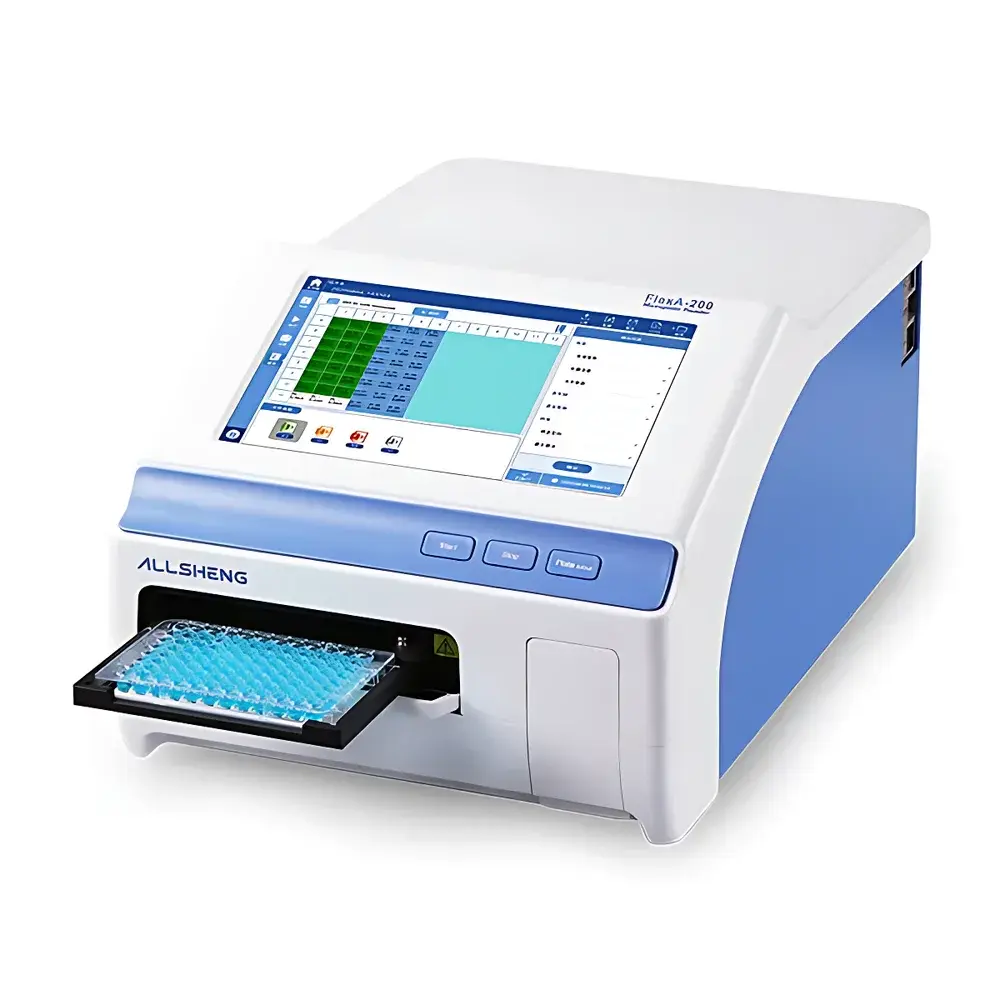
Allsheng FlexA-200HT Microplate Reader with Cuvette Module
| Brand | Allsheng |
|---|---|
| Origin | Zhejiang, China |
| Model | FlexA-200HT |
| Detection Principle | Absorbance (UV-Vis) |
| Wavelength Range | 200–1000 nm |
| Wavelength Accuracy | ±2 nm |
| Wavelength Repeatability | ±0.2 nm |
| Optical System | Grating-based monochromator, dual-beam with reference channel |
| Spectral Resolution | 1 nm step |
| Absorbance Range | 0–4.0 OD |
| Linearity (at 450 nm) | R ≥ 0.999 [0.0–3.0 Abs] |
| Absorbance Accuracy (at 450 nm) | ±(1.0% + 0.003 Abs) [0–2.0 Abs], ±2.0% [2.0–2.5 Abs] |
| Absorbance Precision (CV) | <0.5% (precise mode), <1.0% (fast mode) |
| 96-well Plate Read Time | ~8 s (fast), <28 s (precise, endpoint) |
| Temperature Control Range | Ambient +4 °C to 45 °C |
| Temp. Uniformity & Accuracy | ±0.5 °C at 37 °C |
| Incubation | Integrated plate and cuvette chamber |
| Vibration | Linear, 3-speed adjustable |
| Detector | Dual silicon photodiodes (sample + reference) |
| Bandwidth | <2.5 nm |
| Light Source | Xenon flash lamp (>1×10⁹ flashes lifetime) |
| Display | 10-inch capacitive touchscreen (Android OS) |
| Onboard Storage | 16 GB (≥20,000 assay records) |
| Connectivity | 2× USB-A, 1× USB-B, 1× Ethernet |
| Dimensions (W×D×H) | 300 × 500 × 260 mm |
| Weight | 15.5 kg |
Overview
The Allsheng FlexA-200HT Microplate Reader with Cuvette Module is a high-performance, dual-mode absorbance detection platform engineered for quantitative and qualitative analysis in life science laboratories. It operates on the principle of ultraviolet–visible (UV-Vis) absorbance spectroscopy, utilizing a grating-based monochromator and a stable xenon flash lamp to deliver precise, reproducible measurements across a broad spectral range (200–1000 nm). Unlike conventional filter-based readers, the FlexA-200HT enables full-spectrum scanning at 1 nm resolution, supporting endpoint, kinetic, and spectral acquisition modes. Its integrated dual-beam optical architecture—featuring a dedicated reference photodiode—compensates for source intensity drift and environmental fluctuations in real time, ensuring long-term signal stability and inter-run comparability. Designed for compliance-critical workflows, the instrument supports GLP/GMP-aligned data integrity practices through audit-trail-capable software, user-level access control, and traceable calibration routines.
Key Features
- Dual-mode operation: Simultaneous support for standard microplate formats (96- and 384-well) and standalone cuvette-based assays via a dedicated, temperature-controlled cuvette compartment.
- Integrated incubation: Onboard heating module maintains temperature from ambient +4 °C to 45 °C with ±0.5 °C accuracy and uniformity at setpoints—critical for enzyme kinetics and cell-based assays requiring thermal stability.
- High-fidelity optics: Grating monochromator with <2.5 nm bandwidth and dual silicon photodetectors ensures minimal stray light and optimal signal-to-noise ratio, particularly at low absorbance (<0.1 OD) and high dynamic range (up to 4.0 OD).
- Robust calibration framework: Automatic self-calibration at startup verifies lamp output, grating position, detector response, and optical alignment—reducing operator dependency and ensuring metrological consistency.
- Touchscreen-native interface: 10-inch capacitive Android display with intuitive graphical workflow builder; supports method templates, real-time plate mapping, and on-device result visualization without external hardware.
- Modular software architecture: Embedded firmware and PC-based ReaderLT-II software share identical analysis logic and parameter definitions—enabling seamless transition between standalone and networked operation.
Sample Compatibility & Compliance
The FlexA-200HT accommodates standard ANSI/SLAS-compliant microplates (including opaque, clear, and UV-transparent variants) as well as 10-mm-pathlength quartz or plastic cuvettes. Its cuvette module includes independent thermal regulation and direct path-length input—eliminating manual correction factors during concentration calculation. For nucleic acid and protein quantification, the optional u-Nano microvolume plate enables accurate measurement of 2–4 µL samples without dilution, leveraging surface tension retention and path-length normalization algorithms. From a regulatory standpoint, the system supports FDA 21 CFR Part 11 readiness via electronic signatures, role-based permissions (Admin/User/Guest), password-protected method locking, and immutable audit logs. All onboard data—including raw absorbance values, curve-fitting parameters, and QC metrics—are timestamped and exportable in CSV, Excel, TXT, or PDF formats. Instrument validation documentation (IQ/OQ protocols) and optical performance verification plates (e.g., ABS reference standards) are available upon request to facilitate laboratory qualification under ISO/IEC 17025 or CLIA frameworks.
Software & Data Management
The FlexA-200HT employs a dual-software strategy: an embedded Android-based operating system for immediate, offline use and ReaderLT-II for advanced experimental design and statistical reporting. Both interfaces support identical analytical functions—including blank subtraction, 4-/5-parameter logistic curve fitting, qualitative classification (cut-off index), kinetic rate derivation, and spectral deconvolution. The onboard “Standard Curve Library” allows users to store and recall validated calibration curves across experiments—reducing revalidation burden and improving inter-assay reproducibility. Data security is enforced via hierarchical user accounts: Admins configure access rights, enforce password policies, and manage session timeouts; individual users retain private assay histories; Guest mode permits rapid protocol execution without authentication. Raw datasets and processed reports can be exported via USB or transmitted directly to a designated FTP server—enabling centralized data archival and integration with LIMS environments. All software modules comply with ICH M10 guidance on bioanalytical method validation by preserving original acquisition metadata and processing history.
Applications
The FlexA-200HT serves as a core analytical tool across academic, clinical, and industrial life science settings. Typical use cases include ELISA and other immunoassays (e.g., cytokine profiling, infectious disease serology), enzymatic activity assays (e.g., LDH, ALP, β-galactosidase), cell viability and cytotoxicity screening (MTT, XTT, resazurin), nucleic acid quantification (DNA/RNA purity via A260/A280 ratios), protein concentration determination (Bradford, BCA), and small-molecule binding kinetics. Its cuvette capability extends utility to purified enzyme characterization, ligand titration studies, and reference material verification where discrete sample handling is preferred. In quality control labs, the instrument supports USP <85> endotoxin testing (chromogenic LAL), pharmacopeial dissolution testing, and stability-indicating assays requiring strict wavelength fidelity and thermal control.
FAQ
Does the FlexA-200HT support kinetic assays with programmable interval timing?
Yes—the instrument allows user-defined measurement intervals from 5 seconds to 24 hours per cycle, with up to 1,000 readings per well and automatic background subtraction at each timepoint.
Can the cuvette module perform temperature-controlled kinetic measurements?
Yes—cuvette incubation is independently regulated and synchronized with read cycles; temperature remains stable within ±0.5 °C during extended kinetic runs.
Is wavelength calibration traceable to NIST standards?
While the FlexA-200HT performs automated internal wavelength verification using built-in holmium oxide and didymium filters, formal NIST-traceable calibration requires optional third-party service or certified reference materials (e.g., NIST SRM 2034).
How does the dual-beam design improve measurement robustness compared to single-beam systems?
By continuously sampling both sample and reference beams, the system dynamically corrects for lamp intensity decay, optical misalignment, and ambient temperature-induced drift—resulting in lower CVs and reduced need for frequent recalibration.
Are software updates provided free of charge for the lifetime of the instrument?
All firmware and ReaderLT-II software upgrades released during the standard 2-year warranty period are included at no cost; extended update coverage is available under annual maintenance agreements.



