
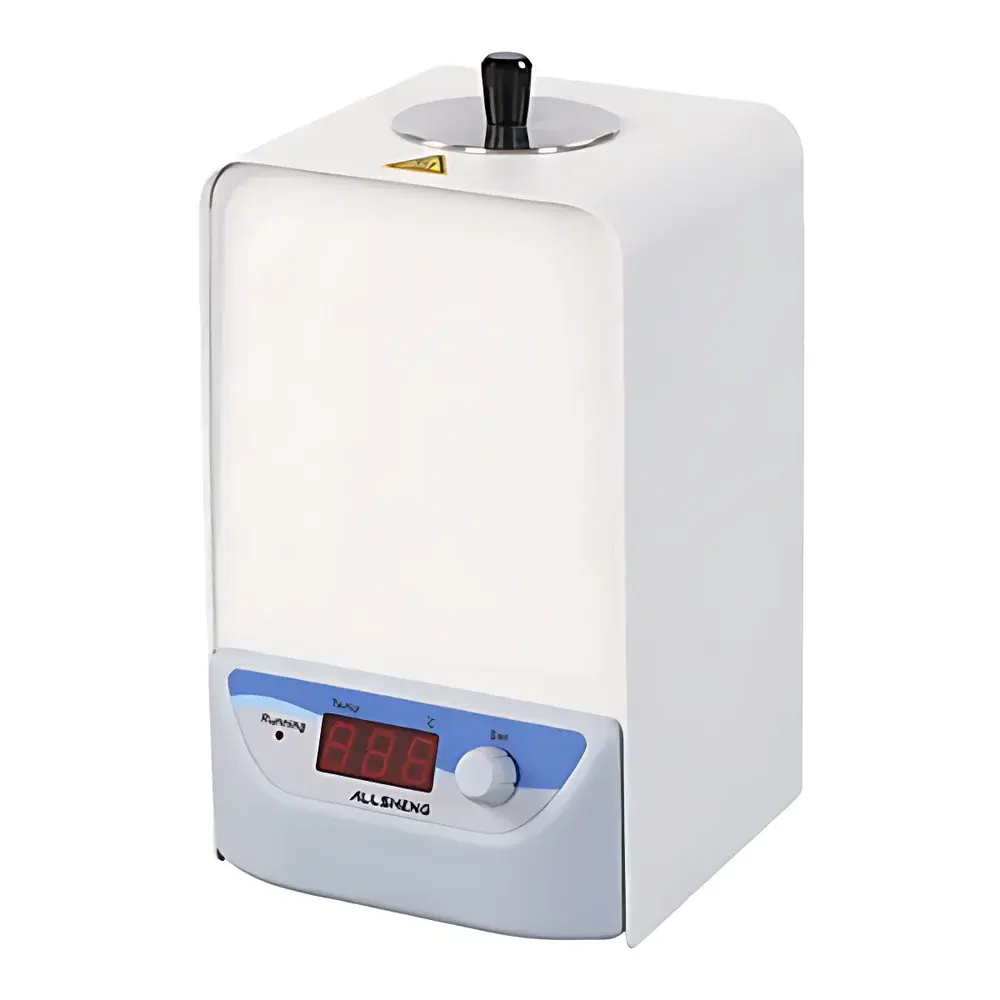
Allsheng GBS-5000B Glass Bead Sterilizer
| Brand | Allsheng |
|---|---|
| Origin | Zhejiang, China |
| Model | GBS-5000B |
| Convection Type | Natural Convection |
| Temperature Range | 100°C to 300°C |
| Temperature Control Accuracy | ≤ ±5°C |
| Temperature Uniformity | ≤ ±5°C |
| Heating Power | 250 W |
| Internal Chamber Dimensions (W×D×H) | 145 mm × 130 mm × 215 mm |
| Bead Capacity | 300 g (Φ3 mm glass beads) |
| Warm-up Time to 300°C | ≤ 25 min |
| Net Weight | 2.5 kg |
| Voltage Input | AC 100–120 V / 200–240 V, 50/60 Hz |
Overview
The Allsheng GBS-5000B Glass Bead Sterilizer is a compact, dry-heat sterilization device engineered for rapid, non-chemical decontamination of small, heat-resistant laboratory instruments. It operates on the principle of conductive thermal transfer: high-purity borosilicate glass beads (Φ3 mm) are heated to precise, stable temperatures—up to 300°C—and maintained within a stainless-steel chamber. When metallic or glass tools (e.g., inoculation loops, forceps, scalpels, needles, or microtome blades) are immersed in the agitated bead bed for 8–10 seconds, surface microbes—including vegetative bacteria, mycobacteria, and bacterial endospores—are inactivated through instantaneous protein denaturation and membrane disruption. Unlike steam-based autoclaves, this method eliminates moisture exposure, preventing oxidation, corrosion, or residual water contamination—critical for precision surgical tools and sensitive microbiological workflows.
Key Features
- Stainless-steel sterilization chamber with integrated high-efficiency heating element and dual-stage thermal protection (over-temperature cutoff + redundant thermostat)
- Digital LED display showing real-time chamber temperature; intuitive rotary knob for precise setpoint adjustment (1°C increments across 100–300°C range)
- Three-mode status indicator: blinking LED (heating phase), steady LED (temperature stabilization), off (standby or power-off)
- Compact footprint (130 × 145 × 215 mm) and lightweight design (2.5 kg) enable placement on biosafety cabinets, laminar flow hoods, or benchtops without spatial compromise
- Natural convection architecture ensures uniform thermal distribution without forced-air fans—minimizing airborne particulate disturbance and mechanical wear
- Optimized thermal mass and insulation deliver consistent bead-bed stability, supporting uninterrupted operation during high-throughput procedures
Sample Compatibility & Compliance
The GBS-5000B is validated for use with solid, non-porous instruments that withstand dry heat up to 300°C. Compatible items include stainless-steel forceps, scissors, biopsy punches, needle holders, ophthalmic hooks, and platinum/nichrome inoculation loops and needles. It is not intended for plastic, rubber, coated, or hollow devices. While not certified to ISO 17665 or EN 285 (standards for moist-heat sterilizers), its operational parameters align with established dry-heat sterilization guidelines referenced in USP <797>, CLSI M22-A3, and FDA guidance on aseptic processing. Users must validate cycle efficacy per internal SOPs—typically using biological indicators (e.g., Bacillus atrophaeus spores) placed at the tool’s tip prior to immersion.
Software & Data Management
The GBS-5000B is a stand-alone, microcontroller-based instrument with no embedded software, network interface, or data logging capability. Temperature control and status indication are handled by analog-digital hybrid circuitry, ensuring electromagnetic compatibility (EMC) in electromagnetically noisy lab environments. For GLP/GMP-regulated laboratories requiring audit trails, external validation records—including calibration certificates for the built-in temperature sensor (calibrated against NIST-traceable reference thermocouples), operator logs, and biological indicator test reports—must be maintained manually. The device complies with IEC 61010-1:2010 for safety of electrical equipment for measurement, control, and laboratory use.
Applications
- Routine sterilization of inoculation loops and needles between microbial streaking steps in bacteriology and mycology labs
- Aseptic handling of microsurgical instruments in cell culture facilities and stem cell laboratories
- Decontamination of dental and veterinary handpieces where autoclaving may degrade lubricants or seals
- Field-deployable sterilization in mobile diagnostic units or resource-limited settings (low power draw: 250 W; dual-voltage support)
- Complementary sterilization step following chemical disinfection of instruments prior to critical-use applications
FAQ
What types of instruments can be safely sterilized in the GBS-5000B?
Only solid, dry, heat-stable metallic or borosilicate glass tools—not plastics, coated surfaces, or lumened devices.
How frequently should the glass beads be replaced?
Beads should be inspected monthly for discoloration, cracking, or fusion; replacement is recommended every 6–12 months under daily use or after visible degradation.
Is routine calibration required?
Yes—users must verify temperature accuracy annually using a calibrated thermocouple probe inserted into the bead bed at operating setpoints (e.g., 250°C), per ISO/IEC 17025 traceability requirements.
Can the unit be used in a Class II biosafety cabinet?
Yes—its natural convection design and absence of exhaust airflow make it compatible with BSCs, provided adequate clearance (≥10 cm) is maintained around ventilation grilles.
Does the device meet FDA 21 CFR Part 11 requirements?
No—this is a non-computerized device with no electronic record generation, signature capability, or audit trail functionality.
Related Products



