
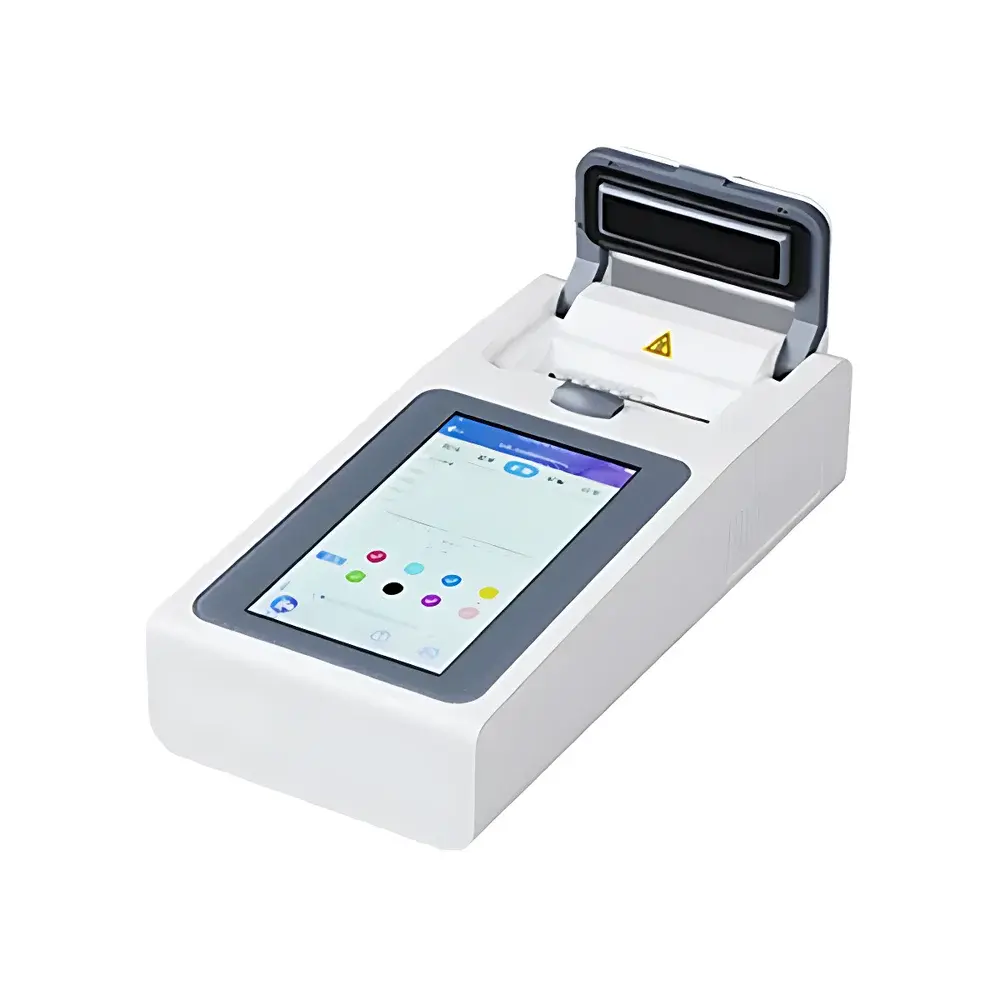
Allsheng Gene-8C Isothermal Fluorescence Detection System
| Brand | Allsheng |
|---|---|
| Origin | Zhejiang, China |
| Model | Gene-8C |
| Sample Capacity | 8 × 0.2 mL wells (compatible with 8-tube strips) |
| Reaction Volume | 20–100 µL (recommended: 25–30 µL) |
| Excitation Wavelength F1 | 470/30 nm |
| Emission Wavelength F1 | 535/20 nm |
| Light Source | High-stability LED |
| Detection Method | Real-time fluorescence monitoring |
| Temperature Range | Ambient to 99 °C |
| Max Heating/Cooling Rate | 2 °C/s |
| Temperature Uniformity | ±0.15 °C |
| Temperature Accuracy | ±0.1 °C |
| Thermal Lid | Integrated |
| Display | 7-inch capacitive touchscreen |
| Power Supply | 100–240 VAC, 50–60 Hz |
| Dimensions (W×D×H) | 145 × 305 × 100 mm |
| Weight (without battery) | 2.3 kg |
| Compatible Dyes | FAM/SYBR Green I, HEX/VIC/JOE |
Overview
The Allsheng Gene-8C Isothermal Fluorescence Detection System is an integrated, portable instrument engineered for real-time nucleic acid detection under constant temperature conditions. Unlike conventional thermal cycling-based qPCR platforms, the Gene-8C leverages isothermal amplification chemistries—including LAMP, RPA, and HDA—combined with sensitive LED-excited fluorescence detection to enable rapid, field-deployable molecular diagnostics. Its optical architecture employs a side-mounted excitation-detection path optimized for low-volume reactions (as small as 20 µL), minimizing background scatter and maximizing signal-to-noise ratio. The system maintains precise thermal control across all eight reaction wells (±0.15 °C uniformity; ±0.1 °C accuracy), ensuring reproducible amplification kinetics essential for quantitative interpretation. Designed for decentralized testing environments—from mobile veterinary clinics and food safety inspection sites to environmental field stations—the Gene-8C supports end-to-end assay execution without reliance on centralized laboratory infrastructure.
Key Features
- Side-path optical detection system enabling reliable fluorescence readout from ultra-low-volume (20 µL) reactions
- High-precision thermoregulation: ≤0.15 °C inter-well temperature variation and ±0.1 °C absolute accuracy over full operating range (ambient to 99 °C)
- Real-time fluorescence acquisition with dual-band optical filtering (470/30 nm excitation; 535/20 nm emission) compatible with FAM/SYBR Green I, HEX/VIC, and JOE dyes
- Integrated 7-inch capacitive touchscreen interface supporting standalone operation—no external computer required for assay setup, run initiation, or result interpretation
- On-device binary (positive/negative) call generation based on amplification curve threshold crossing and melt-curve analysis
- Optional built-in rechargeable lithium-ion battery enabling >4 hours of continuous operation in off-grid settings
- Compact footprint (145 × 305 × 100 mm) and lightweight design (2.3 kg without battery) for seamless integration into portable lab kits
Sample Compatibility & Compliance
The Gene-8C accommodates standard 0.2 mL PCR tubes and 8-tube strip formats, supporting both DNA and RNA templates when used with appropriate isothermal master mixes. It has been validated for use with commercially available reagents targeting WSSV, IHHNV, EHP, TSV, SHIV, and species-specific animal origin markers (e.g., porcine, avian, bovine genomic sequences). While not certified under ISO 13485 or FDA 21 CFR Part 11 out-of-the-box, the system’s data logging architecture—including timestamped raw fluorescence values, thermal profiles, and user-defined metadata—supports GLP-compliant documentation workflows when paired with validated PC software. Exported datasets comply with MIQE guidelines for minimum information reporting in quantitative molecular assays.
Software & Data Management
The Gene-8C operates via a dual-mode software ecosystem: an embedded Android-based instrument OS and a cross-platform desktop application (Windows/macOS). Instrument firmware provides intuitive assay configuration, real-time curve visualization, automatic Ct/Tm calling, and onboard result archiving. Data export is supported via USB mass storage mode, Wi-Fi transfer (to local network shares or cloud endpoints), or direct printing via USB-connected thermal printers. The desktop software enables advanced post-run analysis—including baseline correction, multi-curve overlay, efficiency calculation, and export to CSV, PDF, or Excel-compatible formats. All software modules retain full audit trails: operator ID, timestamp, assay parameters, and version-controlled firmware logs are embedded in each exported dataset.
Applications
- Rapid pathogen screening in aquaculture: detection of white spot syndrome virus (WSSV), infectious hypodermal and hematopoietic necrosis virus (IHHNV), and Enterocytozoon hepatopenaei (EHP) in shrimp hatcheries
- Clinical point-of-care testing: identification of bacterial, fungal, and parasitic agents in resource-limited settings without access to central labs
- Food authenticity verification: detection of undeclared animal-derived ingredients (e.g., pork, chicken, beef) using species-specific isothermal assays
- Environmental microbiology: on-site monitoring of fecal indicator organisms or antibiotic resistance genes in water samples
- Transgenic crop screening: qualitative detection of GMO-associated sequences in field-collected plant tissues
- Embryo sex determination in livestock breeding programs using Y-chromosome-specific amplicons
FAQ
Does the Gene-8C support multiplex detection?
No—the system is configured for single-channel fluorescence detection (FAM/SYBR Green I channel only). Multiplexing requires sequential runs with dye-specific calibration or external validation of spectral overlap.
Can the instrument perform melt-curve analysis?
Yes—post-amplification high-resolution melt (HRM) profiling is supported, with temperature ramping at 0.1 °C increments between 65–95 °C.
Is the battery included by default?
The rechargeable Li-ion battery is an optional accessory (part number AS-BAT-001); instruments ship with AC power adapter unless specified otherwise.
What file formats does the PC software support for data import/export?
Raw .csv (fluorescence vs. time), annotated .pdf reports, and structured .xlsx workbooks containing sample IDs, Ct values, Tm peaks, and operator metadata.
How is firmware updated?
Updates are delivered via signed .zip packages transferred via USB stick or Wi-Fi; installation requires administrator-level authentication and automatic rollback on checksum failure.



