
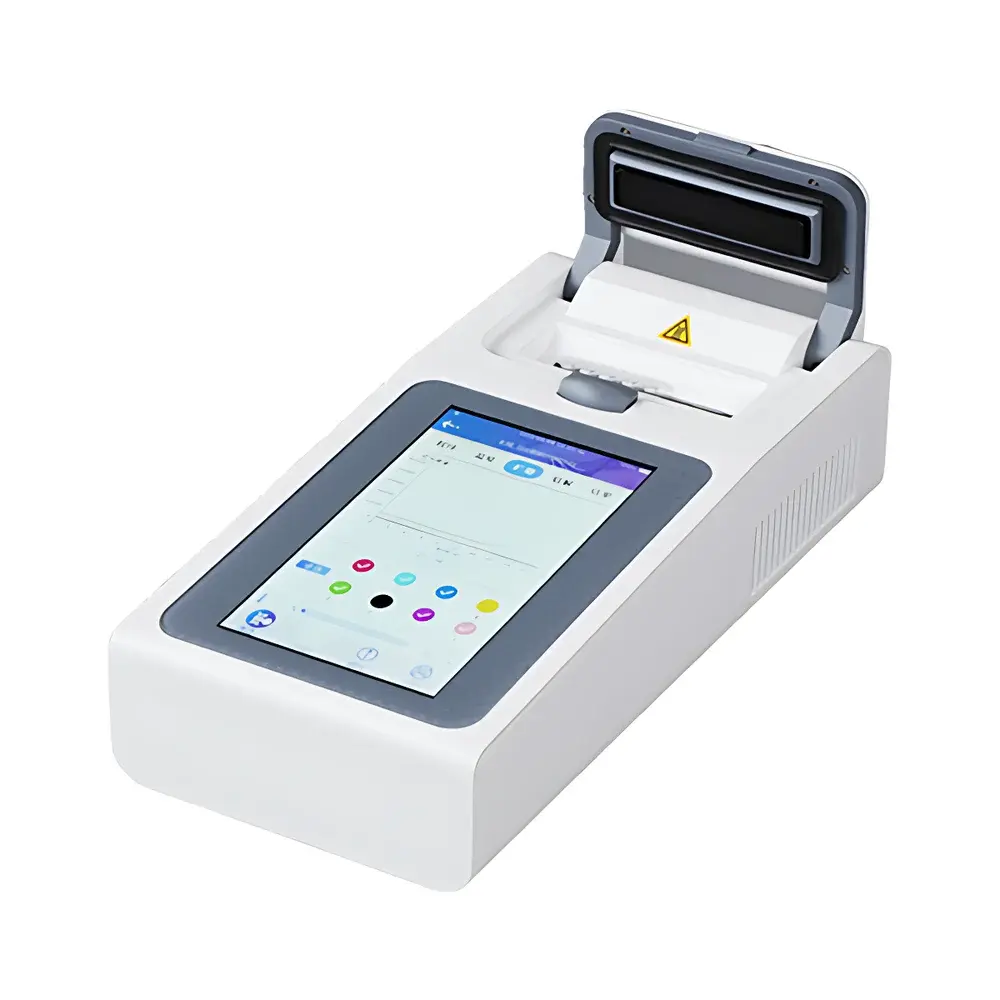
Allsheng Gene-8C2 Isothermal Fluorescence Detection System
| Brand | Allsheng (Hangzhou Allsheng Instruments Co., Ltd.) |
|---|---|
| Origin | Zhejiang, China |
| Model | Gene-8C2 |
| Excitation Sources | Blue LED (470/15 nm), Green LED (535/30 nm) |
| Emission Filters | Blue channel (545/45 nm), Green channel (605/65 nm) |
| Detector | Hamamatsu S1337-66BQ photodiode |
| Spectral Range | 190–1100 nm |
| Sample Format | 0.2 mL flat-cap single tubes or 8-tube strips |
| Temperature Range | 10–99 °C (lid: ambient to 110 °C) |
| Max. Heating/Cooling Rate | ≥2 °C/s |
| Temperature Uniformity | ±0.3 °C at 39 °C, ±0.6 °C at 63 °C, ±1.0 °C at 95 °C |
| Temperature Accuracy | ±0.2 °C |
| Temperature Control Precision | ≤0.1 °C |
| Lid Ramp Time | 30–105 °C in <125 s |
| Fluorescence Reproducibility (CV) | ≤3% |
| Fluorescence Precision (CV) | ≤5% |
| Detection Limit | ≥10% fluorescence signal rise |
| Peak Consistency (CV) | ≤10% |
| Display | 7-inch capacitive touchscreen |
| Power Input | 15 V / 6.67 A |
| Dimensions (L×W×H) | 305 × 148 × 104 mm |
| Weight | ~2.8 kg |
| Built-in Rechargeable Battery | Yes |
| Connectivity | USB-A ×2, USB-B ×1, Wi-Fi (802.11 b/g/n), optional cloud sync |
| Data Export | CSV, PDF, image (JPEG/PNG), experimental metadata embedded |
Overview
The Allsheng Gene-8C2 Isothermal Fluorescence Detection System is a compact, battery-powered benchtop instrument engineered for real-time fluorescence monitoring during nucleic acid amplification under constant temperature conditions. Unlike thermal cycling-based qPCR platforms, the Gene-8C2 operates on isothermal amplification principles—including LAMP, RPA, and HDA—enabling rapid, field-deployable detection without thermocycling hardware. Its dual-channel optical architecture supports simultaneous excitation and emission detection at blue (470/15 nm → 545/45 nm) and green (535/30 nm → 605/65 nm) wavelengths, facilitating multiplexed assays using common fluorophores such as FAM, SYBR Green I, HEX, and ROX. The system integrates a high-sensitivity Hamamatsu S1337-66BQ photodiode detector with optimized side-optical path geometry, enabling reliable quantification from as little as 10 µL reaction volume. Designed for GLP-aligned workflows, it delivers temperature stability of ≤0.1 °C control precision and inter-well uniformity of ±0.3 °C at clinically relevant setpoints (e.g., 63 °C for LAMP), minimizing assay variability across replicates.
Key Features
- Dual-channel fluorescence detection with independently configurable blue and green excitation/emission pathways, supporting probe- and dye-based isothermal assays
- Side-optical path design with minimized optical crosstalk and calibrated spectral filtering—ensures accurate signal separation and low background noise
- Precision thermal module with real-time PID feedback: ±0.2 °C absolute accuracy, ≤0.1 °C control resolution, and <0.15 °C well-to-well variation at 63 °C
- Integrated 7-inch capacitive touchscreen interface with intuitive workflow navigation—no external PC required for setup, run, analysis, or result export
- Onboard rechargeable lithium-ion battery (typical runtime: 4–6 h continuous operation), enabling true point-of-need deployment in clinics, farms, food processing facilities, or environmental sampling sites
- Real-time fluorescence curve acquisition with automatic thresholding, Cq calculation, and binary positive/negative call generation per well
- Melting curve analysis capability for post-amplification verification of amplicon specificity and primer-dimer discrimination
Sample Compatibility & Compliance
The Gene-8C2 accepts standard 0.2 mL flat-cap PCR tubes and 8-tube strips, ensuring compatibility with widely adopted isothermal master mixes and commercial kits—including Allsheng’s RS-IP series (e.g., WSSV, IHHNV, EHP, TSV, SHIV) and RS-QP probe-based qRT-PCR reagents. Its thermal and optical performance meets essential requirements for ISO/IEC 17025-compliant laboratories conducting qualitative molecular diagnostics. While not certified for IVD use under FDA 510(k) or CE-IVD directives, the system supports audit-ready data integrity through time-stamped experimental logs, user-accessible calibration records, and exportable raw fluorescence traces with metadata (cycle number, temperature, timestamp, operator ID). Firmware implements write-once data storage for critical run files, aligning with ALCOA+ principles for traceability in regulated environments.
Software & Data Management
The instrument runs a lightweight Android-based embedded OS with native support for USB mass storage, Wi-Fi file transfer, and optional cloud synchronization (configurable via enterprise deployment). Experimental data—including normalized RFU curves, Cq values, melt profiles, and pass/fail flags—are exportable in CSV, PDF, and PNG formats with embedded EXIF-style metadata (instrument ID, firmware version, date/time, protocol name). The companion Android application (Allsheng GeneControl) enables remote instrument monitoring, push notifications upon run completion, and live streaming of fluorescence kinetics—critical for multi-site surveillance programs. PC software (Windows/macOS) provides advanced post-run analysis: comparative delta-Cq calculations, inter-assay normalization, batch report generation, and integration with LIMS via CSV import. USB printer support allows direct hardcopy output of summary reports without intermediate computing devices.
Applications
- Rapid pathogen screening: Detection of viral (WSSV, TSV, IHHNV), bacterial (Vibrio spp.), fungal, and parasitic nucleic acids in aquaculture, livestock, and clinical specimens
- Food safety testing: Identification of species-specific DNA (porcine, bovine, avian, ovine) in processed meat products and feedstuffs per ISO 22000 and EU Regulation (EC) No 853/2004
- Environmental monitoring: Quantification of fecal indicator organisms (e.g., Enterococcus, E. coli) in water samples using isothermal enrichment protocols
- Transgenic food verification: Screening for exogenous genetic elements (e.g., CaMV 35S promoter, NOS terminator) in grain and oilseed matrices
- Embryo sex determination: Real-time amplification of Y-chromosome-specific sequences in bovine or porcine preimplantation embryos
- Field-deployable biosecurity: On-site testing at border checkpoints, slaughterhouses, or outbreak zones where infrastructure limitations preclude conventional lab infrastructure
FAQ
Does the Gene-8C2 support quantitative analysis beyond qualitative detection?
Yes—it calculates Cq (quantification cycle) values using adaptive baseline correction and second-derivative maximum algorithms, enabling semi-quantitative comparison across samples when used with standardized reference materials and validated calibrators.
Can the instrument be calibrated or verified by end users?
Yes. Built-in optical and thermal validation routines are accessible via service mode. Users may perform routine checks using supplied fluorescent reference standards and NIST-traceable temperature probes; calibration certificates are issued upon factory service.
Is Wi-Fi connectivity mandatory for data export?
No. All data transfer functions operate independently via USB-A host mode (to flash drives), USB-B device mode (to PCs), or optional Bluetooth tethering—Wi-Fi is an enhancement, not a dependency.
What regulatory documentation is provided with the system?
Each unit ships with a Declaration of Conformity (RoHS, CE), Factory Calibration Report, User Manual (EN/ES/FR), and Software Verification Summary aligned with ICH Q5A and ISO 13485 design controls.
How is firmware updated?
Firmware updates are delivered as signed .zip packages via Allsheng’s secure customer portal. Updates are installed locally via USB drive or Wi-Fi download, with rollback capability and SHA-256 hash verification.



