
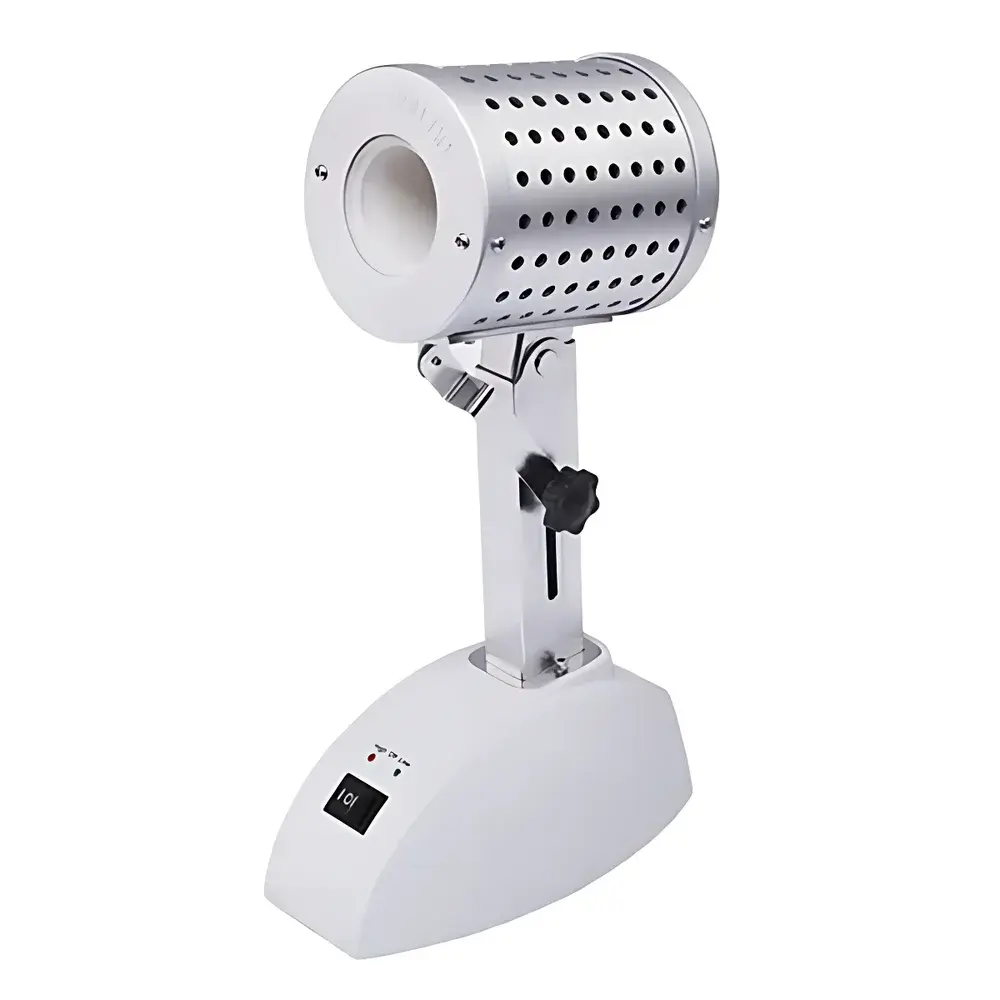
Allsheng HM-3000E Infrared Inoculation Loop Sterilizer
| Brand | Allsheng |
|---|---|
| Origin | Zhejiang, China |
| Model | HM-3000E |
| Convection Type | Natural Convection |
| Operating Temperature Range | 825°C ± 50°C |
| Temperature Control Accuracy | ≤ ±5°C |
| Temperature Uniformity | ≤ ±5°C |
| Heating Power | 320 W |
| Internal Dimensions (W×D×H) | 100 × 153 × 280 mm |
| Max. Sample Diameter | Φ35 mm |
| Heating Zone Length | 100 mm |
| Net Weight | 1.6 kg |
| Ambient Operating Temperature | −10°C to 50°C |
| Relative Humidity | ≤90% RH |
| Altitude Limit | Unrestricted |
Overview
The Allsheng HM-3000E Infrared Inoculation Loop Sterilizer is a compact, high-temperature dry heat sterilization device engineered for rapid, flame-free decontamination of microbiological tools in controlled laboratory environments. Unlike traditional open-flame methods or convection-based hot air ovens, the HM-3000E employs focused infrared radiation emitted from a ceramic heating element to achieve instantaneous thermal sterilization—reaching peak temperatures of up to 825°C at the center of its sterilization chamber. This radiant heat transfer mechanism ensures efficient energy delivery directly to metallic and glass surfaces without relying on ambient air circulation, making it inherently insensitive to airflow disturbances. As a result, the unit operates reliably inside biosafety cabinets (Class II A2/B2), laminar flow hoods, anaerobic chambers, fume hoods, and mobile laboratory platforms—environments where open flames pose unacceptable safety or contamination risks. Its design complies with core principles of aseptic technique as defined in ISO 14644-1 (cleanroom classification) and supports adherence to GLP and GMP documentation requirements through consistent, repeatable thermal exposure.
Key Features
- Adjustable heating head orientation: Tilt range of −40° (downward) to +15° (upward) relative to horizontal plane, enabling ergonomic access and optimal alignment with various vessel necks (e.g., Erlenmeyer flasks, test tubes, Petri dish rims).
- Rapid sterilization cycle: Achieves microbial inactivation (>6-log reduction of Bacillus atrophaeus spores) within 5–7 seconds at operational setpoint, verified per ISO 17665-1 for dry heat processes.
- Ceramic infrared emitter with integrated thermal shielding: Minimizes radiant heat loss and prevents external surface temperatures from exceeding safe handling thresholds (≤60°C at housing exterior under continuous operation).
- Compact footprint (153 × 100 × 280 mm) and lightweight construction (1.6 kg): Facilitates integration into space-constrained workspaces including gloveboxes and portable lab carts.
- No consumables required: Eliminates dependency on ethanol, propane, or other flammable fuels—reducing operational cost, storage hazard, and regulatory reporting burden.
- Robust temperature control architecture: Digital PID regulation maintains setpoint stability within ±5°C across the active heating zone, with uniformity ≤±5°C verified per ASTM E220 calibration standards.
Sample Compatibility & Compliance
The HM-3000E accommodates standard microbiological instruments with maximum outer diameters up to 35 mm—including platinum/iridium inoculation loops, stainless steel needles, forceps, scissors, and capillary pipettes. Its extended 100-mm heating zone allows full insertion of flask necks (up to 250 mL capacity) and inverted Petri dish lids for rim sterilization. The unit meets IEC 61010-1:2010 safety requirements for electrical equipment used in laboratory settings and is suitable for use in ISO Class 5 (Grade A) environments when installed per manufacturer-specified clearance guidelines. It supports compliance with USP Sterility Assurance and EU Annex 1 (2022) provisions for aseptic processing by eliminating flame-associated particulate generation and cross-contamination pathways.
Software & Data Management
The HM-3000E operates as a standalone analog-controlled instrument with no embedded microprocessor or digital interface. Temperature setpoint and status indication are managed via front-panel LED display and mechanical potentiometer. While it does not support data logging or electronic audit trails, its deterministic thermal profile enables full traceability when integrated into laboratory quality systems: users may record sterilization events manually in bound logbooks or electronic lab notebooks (ELN) aligned with 21 CFR Part 11-compliant platforms. Routine verification—such as daily thermocouple checks against NIST-traceable reference standards—is recommended to maintain confidence in sterility assurance.
Applications
- Routine sterilization of inoculation loops and needles in clinical microbiology, pharmaceutical QC, and academic research labs.
- Aseptic transfer preparation in anaerobic workstations where oxygen exclusion prohibits flame use.
- Decontamination of instrument tips prior to MALDI-TOF sample loading or automated colony picking.
- Pre-sterilization of glassware rims before membrane filtration or pour-plate procedures.
- Field-deployable sterilization in mobile diagnostic units operating under WHO Emergency Use Listing (EUL) protocols.
FAQ
What is the maximum recommended dwell time for sterilizing a standard platinum loop?
For complete sporicidal efficacy, insert the loop tip fully into the heating zone for 5–7 seconds; prolonged exposure (>10 s) may accelerate metal oxidation and reduce loop lifespan.
Can the HM-3000E be used inside a Class II biosafety cabinet without triggering alarms?
Yes—the unit produces no volatile emissions or significant convective updrafts, and its surface temperature remains below cabinet alarm thresholds when mounted on non-combustible supports.
Is calibration required before first use?
Initial verification using a calibrated thermocouple probe is advised; subsequent recalibration should follow institutional SOPs—typically every 6 months or after physical impact.
Does the device meet FDA or CE marking requirements?
It carries CE marking per Directive 2014/30/EU (EMC) and 2014/35/EU (LVD); FDA registration is not applicable as it is classified as a general-purpose lab accessory, not a medical device.
How often should the ceramic emitter be replaced?
Under normal usage (≤100 cycles/day), the emitter typically exceeds 5,000 operational hours; visual inspection for cracking or discoloration is the primary maintenance indicator.



