
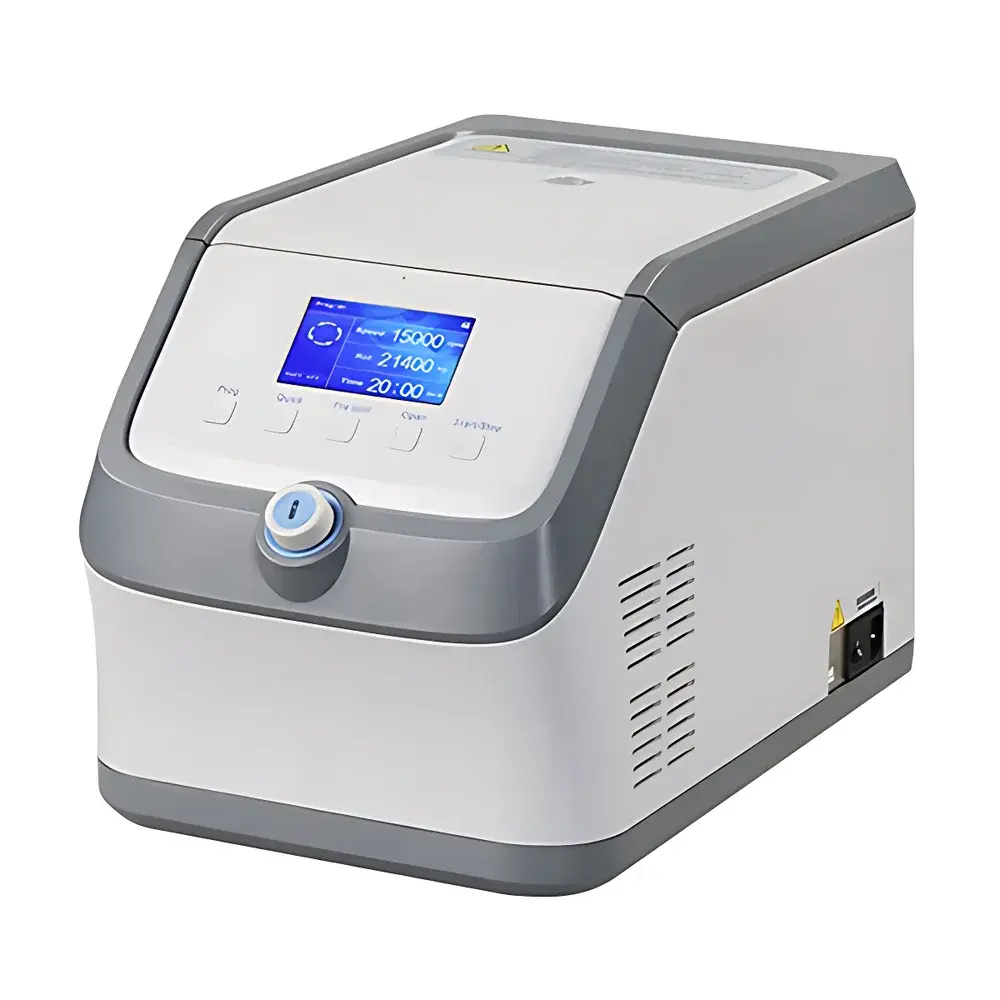
Allsheng iCEN-24R Benchtop High-Speed Refrigerated Centrifuge
| Brand | Allsheng |
|---|---|
| Origin | Zhejiang, China |
| Model | iCEN-24R |
| Instrument Type | Benchtop Centrifuge |
| Speed Range | 500–15,000 rpm (in 100 rpm increments) |
| Max RCF | 21,400 × g |
| Max Capacity | 24 × 1.5/2.0 mL tubes |
| Temperature Range | −10 °C to +40 °C |
| Cooling Performance | Maintains 4 °C at maximum speed |
| Pre-cooling Time | ≤20 min (from ambient to 4 °C) |
| Noise Level | <60 dB(A) |
| Acceleration/Deceleration Time | 15 s (soft off), 45 s (soft on) |
| Rotor Material | Anodized aluminum alloy, autoclavable |
| Dimensions (L×W×H) | 300 × 500 × 320 mm |
| Net Weight | 28 kg |
| Power Supply | AC 100–120 V / 200–240 V, 50–60 Hz |
| Compliance | CE, IEC 61010-2-020 |
Overview
The Allsheng iCEN-24R is a compact, high-performance benchtop refrigerated centrifuge engineered for precision separation of biological macromolecules—including nucleic acids, proteins, organelles, and viral particles—in molecular biology, cell culture, and clinical diagnostics laboratories. Utilizing fixed-angle rotor geometry and a brushless DC motor with closed-loop speed control, the iCEN-24R delivers reproducible centrifugal forces up to 21,400 × g at 15,000 rpm. Its integrated vapor-compression refrigeration system maintains stable temperature control across the full operational range (−10 °C to +40 °C), including active thermal regulation at maximum rotational speed—ensuring sample integrity during high-speed pelleting or density-gradient applications. The unit’s low-profile footprint (300 × 500 × 320 mm) and quiet operation (<60 dB[A]) make it suitable for shared lab spaces, biosafety cabinets, and ISO-classified environments where acoustic and spatial constraints are critical.
Key Features
- Three interchangeable rotors: 24-position fixed-angle rotor for 1.5/2.0 mL tubes; 4-position PCR strip rotor (8 × 0.2 mL strips); and 12-position rotor for 5 mL conical tubes—each constructed from high-strength, anodized aluminum alloy rated for repeated autoclaving (121 °C, 20 min, 100 kPa).
- Soft deceleration algorithm (soft-off) minimizes sediment resuspension by controlling braking torque, preserving pellet integrity for sensitive downstream assays such as qPCR, NGS library prep, and enzyme activity studies.
- Static pre-cooling mode initiates compressor operation automatically upon lid closure—eliminating manual pre-chill delays and reducing thermal shock to samples prior to run initiation.
- Intuitive 5.7-inch color LCD interface displays real-time parameters: speed (rpm), relative centrifugal force (×g), elapsed time, set temperature, and remaining time—with simultaneous dual-unit readout capability.
- Dedicated “pulse” button enables rapid transient centrifugation (1 s–99 min 59 s) without program configuration—ideal for quick pellet collection, supernatant removal, or microcentrifuge-style workflows.
- Automatic lid opening post-run prevents heat accumulation inside the chamber, mitigating thermal degradation of temperature-sensitive biomolecules and extending rotor seal longevity.
- Comprehensive safety architecture includes imbalance detection, lid interlock, overtemperature cutoff, rotor recognition, and automatic rotor ID verification—fully compliant with CE marking per EN 61010-2-020 and IEC 61010-1.
Sample Compatibility & Compliance
The iCEN-24R accommodates standard microcentrifuge formats including 0.2 mL, 0.5 mL, 1.5 mL, 2.0 mL, and 5.0 mL tubes, as well as 8-well PCR strips. Rotor configurations support both routine pelleting (e.g., plasmid DNA isolation, bacterial cell harvesting) and low-volume high-g applications (e.g., exosome enrichment, ribonucleoprotein complex purification). All rotors meet ISO 13485-aligned manufacturing controls and are validated for sterility assurance under GLP-compliant processes. The system supports audit-ready operation in regulated environments through traceable parameter logging and non-volatile memory retention of last 100 run records—facilitating alignment with FDA 21 CFR Part 11 principles when paired with secure networked data export protocols.
Software & Data Management
While the iCEN-24R operates via embedded firmware without external PC dependency, its internal controller logs complete run metadata—including date/time stamp, rotor ID, speed profile, temperature history, acceleration/deceleration curves, and error flags—for local review and export via USB interface. Exported CSV files contain ISO 8601 timestamps and SI-unit-conformant values (rpm, ×g, °C, seconds), enabling integration into LIMS platforms or statistical process control (SPC) dashboards. Firmware updates are delivered via encrypted USB key with version-controlled checksum validation, ensuring regulatory continuity and cybersecurity compliance.
Applications
- Molecular biology: Plasmid miniprep, genomic DNA extraction, RNA precipitation, cDNA synthesis cleanup.
- Cell biology: Subcellular fractionation (mitochondria, nuclei, lysosomes), extracellular vesicle isolation, cytosolic protein clarification.
- Clinical diagnostics: Serum/plasma separation, PBMC isolation, pathogen concentration from low-volume specimens.
- Quality control: Residual host-cell protein removal in biopharmaceutical intermediates, filter integrity verification via particle challenge testing.
- Education & training: Hands-on instruction in centrifugation theory, RCF calculation, rotor safety margins, and cold-chain preservation protocols.
FAQ
What is the maximum RCF achievable with the 24-position rotor?
21,400 × g at 15,000 rpm with a maximum rotor radius of 85 mm.
Can the iCEN-24R maintain 4 °C during continuous operation at 15,000 rpm?
Yes—the refrigeration system is thermodynamically sized to sustain 4 °C ±2 °C at maximum speed under standard ambient conditions (23 °C, 50% RH).
Are rotor lifetime limits specified, and is autoclaving permitted?
No finite lifetime is assigned; all aluminum rotors are certified for unlimited autoclave cycles (121 °C, 20 min, saturated steam) per ISO 17664.
Does the system support programmable multi-step protocols?
No—this model implements single-step timed runs only; multi-step gradient protocols require external scheduling via laboratory automation interfaces.
How is rotor imbalance detected and managed?
Vibration sensors coupled with motor current monitoring trigger immediate deceleration and visual/audible alerts if mass asymmetry exceeds 5 g across opposing positions.



