
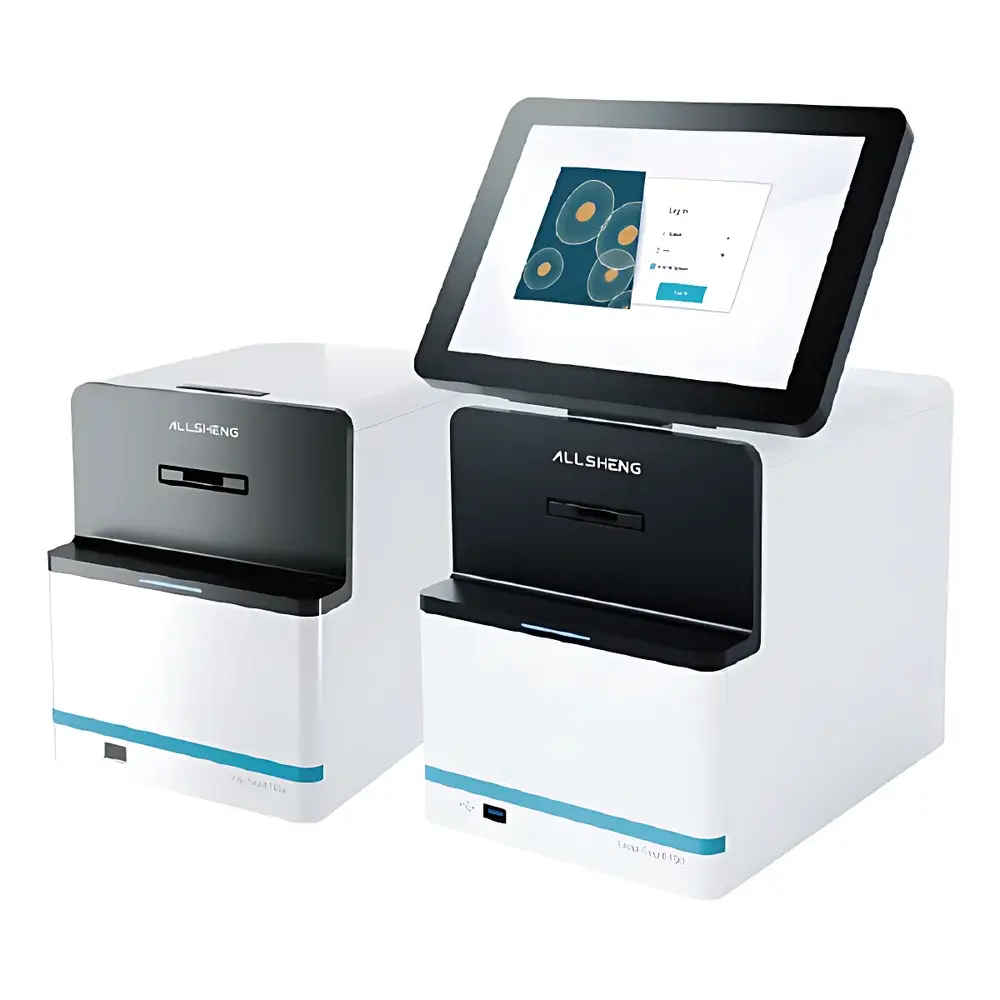
Allsheng Leap-Count 100/100A Automated Cell Counter
| Brand | Allsheng |
|---|---|
| Origin | Zhejiang, China |
| Model | Leap-Count 100 / Leap-Count 100A |
| Measurement Principle | Brightfield optical imaging with AI-powered image segmentation |
| Cell Diameter Range | 3–60 µm |
| Cell Concentration Range | 1×10⁴–1×10⁹ cells/mL |
| Optimal Concentration Range | 1×10⁵–1×10⁷ cells/mL |
| Viability Detection Range | 0–100% |
| Sample Volume per Chamber | 10 µL |
| Analysis Time (Leap-Count 100) | ≤8 s |
| Analysis Time (Leap-Count 100A) | ≤2 s |
| Imaging Sensor | 6 MP CMOS |
| Objective Magnification | 3× |
| Repeatability (CV) | <5% |
| Storage Capacity | 1 TB (Leap-Count 100), External PC only (Leap-Count 100A) |
| Display | 10.1″ LCD, 1920×1200 (Leap-Count 100), None (Leap-Count 100A) |
| Data Export Formats | PDF, XLS, TIFF, PNG, JPG |
| Operating System | Windows 10 or later |
| Interface | USB 3.2 Gen 2 ×2 + Ethernet (Leap-Count 100) |
| Dimensions (W×D×H) | 260×268×246 mm (flat) / 260×268×376 mm (vertical) (Leap-Count 100) |
| Weight | 6.5 kg (Leap-Count 100), 5.0 kg (Leap-Count 100A) |
| Power Supply | 100–240 V AC, 50/60 Hz |
Overview
The Allsheng Leap-Count 100 and Leap-Count 100A are benchtop automated cell counters engineered for precision, reproducibility, and workflow efficiency in academic, biopharmaceutical, and clinical research laboratories. These instruments employ high-resolution brightfield optical imaging combined with proprietary deep-learning-based image segmentation algorithms to quantify total cell count, viable and non-viable cell concentration, viability percentage, mean cell diameter, circularity, aggregation rate, and morphological descriptors—all from a single 10 µL sample loaded onto a standard dual-chamber disposable counting slide. Unlike manual hemocytometer-based methods, the Leap-Count platform eliminates subjective operator bias and inter-user variability by automating focus adjustment, illumination optimization, and pixel-level cell boundary recognition. The system is calibrated for use with 0.4% trypan blue dye, leveraging differential membrane integrity to distinguish live (unstained, phase-bright) from dead (blue-stained, phase-dark) cells—fully compliant with ISO 20387:2018 (Biobanking) and aligned with GLP-relevant documentation practices for cell-based assay validation.
Key Features
- Auto-focus and auto-illumination: Real-time adaptive focusing and dynamic light intensity adjustment ensure optimal contrast and resolution across heterogeneous cell populations without manual intervention.
- Aggregation-aware segmentation: Advanced convolutional neural network (CNN) architecture identifies and quantifies clustered cells, reporting aggregation rate as a normalized metric critical for suspension culture QC and transfection readiness assessment.
- Low-volume sampling: Each chamber requires only 10 µL of sample—minimizing consumption of precious primary cells, stem cells, or engineered cell lines while maintaining statistical robustness at concentrations from 1×10⁴ to 1×10⁹ cells/mL.
- Dual-platform flexibility: The Leap-Count 100 integrates an embedded 10.1″ high-definition touchscreen, 1 TB SSD storage (supporting >70,000 records), and local data analysis; the Leap-Count 100A operates as a dedicated imaging module, connecting via USB 3.0 to external Windows PCs for centralized lab deployment and IT-managed data governance.
- Validated performance: CV <5% across instrument units and repeated measurements (n=9 per unit) confirms analytical consistency required for longitudinal studies and multi-site comparability. Benchmarked against manual hemocytometry using CHO, RAW264.7, and PBMCs, the Leap-Count demonstrates superior repeatability and reduced user-induced variance.
Sample Compatibility & Compliance
The Leap-Count platform supports a broad spectrum of adherent and suspension mammalian cell types—including Vero, HEK293T, Jurkat, MDA-MB-231, HepG2, HCT116, and primary human PBMCs—validated under standardized trypan blue staining protocols. It accommodates commercially available PMMA-based dual-chamber counting slides (17×6.4×0.1 mm chamber dimensions), eliminating cleaning, autoclaving, or cross-contamination risks associated with reusable hemocytometers. The system complies with fundamental metrological requirements outlined in ISO/IEC 17025 for testing laboratories and supports audit-ready workflows through timestamped, user-annotated result exports. While not FDA 510(k)-cleared, its design aligns with principles referenced in USP (Cell-Based Assays) and ASTM E2877-22 (Standard Guide for Characterization of Cell Populations).
Software & Data Management
Both models run on Windows 10 or later and feature an intuitive graphical interface with integrated dilution calculator, real-time histogram visualization (cell diameter distribution), and customizable report templates. The Leap-Count 100 stores all images, metadata, and analysis logs locally with full traceability—including operator ID, timestamp, slide lot number, and environmental conditions (ambient temperature/humidity). Export options include PDF (print-ready reports), XLS (tabular data for statistical analysis), and high-fidelity TIFF/PNG/JPG (for publication-grade figure generation). For regulated environments, optional software modules can be configured to enforce electronic signatures, audit trails, and 21 CFR Part 11–compliant user access controls when deployed with validated LIMS or ELN integration.
Applications
- Standardized daily passaging: Rapid viability and concentration assessment prior to subculturing ensures consistent seeding density and reduces experimental drift.
- Transfection and gene editing QC: Pre- and post-electroporation/nucleofection viability profiling informs protocol optimization and correlates delivery efficiency with functional outcomes.
- Cell therapy manufacturing: Monitoring expansion kinetics, aggregation status, and morphology shifts during bioreactor runs supports release criteria alignment with ISCT guidelines.
- Drug cytotoxicity screening: Dose-response curves generated from serial dilutions benefit from precise baseline cell counts and low-CV viability metrics.
- Stem cell differentiation assays: Temporal tracking of size distribution and circularity provides early morphological indicators of lineage commitment beyond surface marker expression.
FAQ
What cell types have been experimentally validated on the Leap-Count platform?
The instrument has been verified with over 20 mammalian cell lines and primary isolates—including CHO, RAW264.7, K562, MCF7, A549, HepG2, HEK293T, and human PBMCs—using standardized 0.4% trypan blue staining and manufacturer-recommended counting slides.
Does the Leap-Count 100A require a specific computer configuration?
Yes: a Windows 10 or later PC with USB 3.0 port, ≥8 GB RAM, ≥256 GB SSD, and Intel Core i5 or equivalent processor is recommended for stable image acquisition and real-time analysis.
How does the system handle highly aggregated samples, such as neurospheres or organoids?
While optimized for monodisperse suspension cultures, the Leap-Count’s aggregation detection algorithm identifies clusters larger than 3× the median cell diameter and reports them as % aggregated events—enabling semi-quantitative monitoring of clumping trends across passages.
Is raw image data retained after analysis?
Yes: both models save original 6 MP grayscale TIFF images alongside processed masks and measurement tables, supporting retrospective reanalysis and method verification per ALCOA+ data integrity principles.
Can the Leap-Count be integrated into automated liquid handling workflows?
Via its Ethernet (Leap-Count 100) or USB (Leap-Count 100A) interface, the device supports HTTP API and COM port command protocols for third-party orchestration—enabling synchronization with robotic arms, plate handlers, and central data lakes in high-throughput screening environments.






