
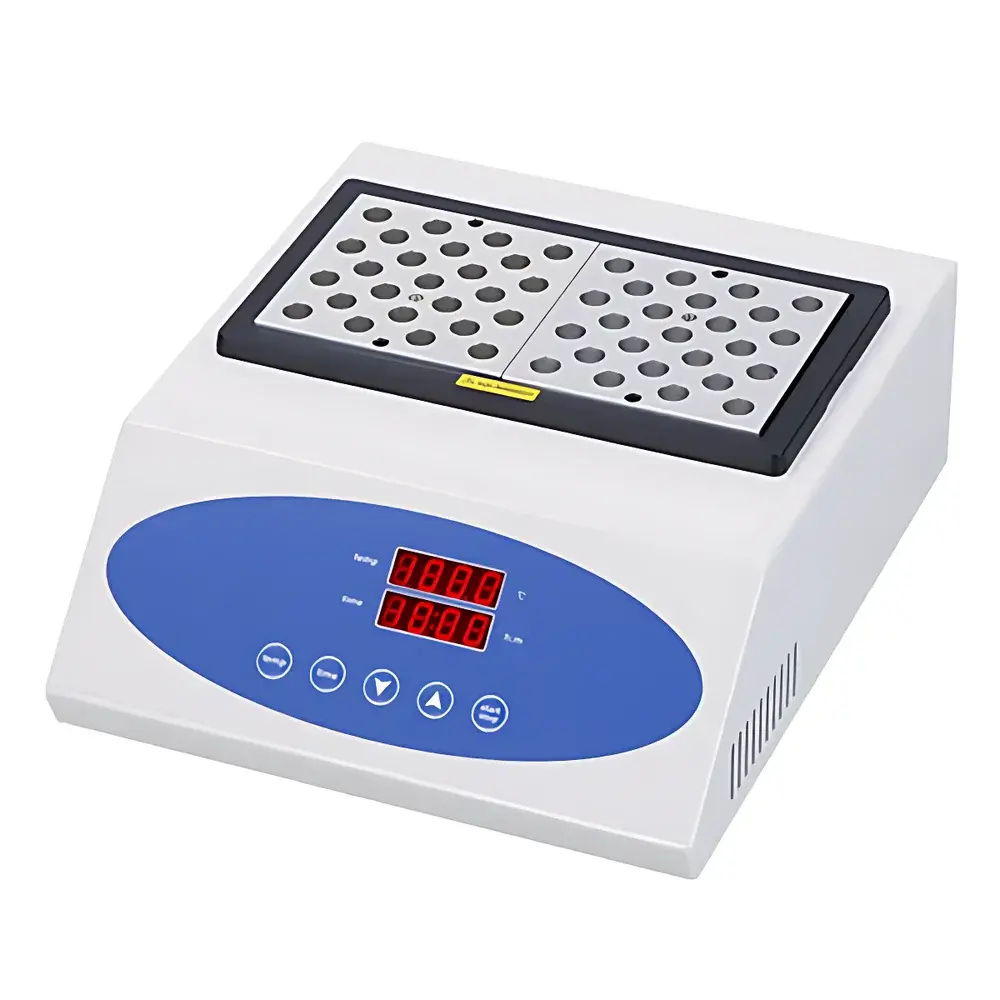
Allsheng MK200-2 High-Temperature Dry Block Heater
| Brand | Allsheng |
|---|---|
| Origin | Zhejiang, China |
| Model | MK200-2 |
| Temperature Range | Ambient +5°C to 150°C |
| Temperature Accuracy | ≤±0.5°C (at 100°C), ±0.3°C (at 40°C), ±1.0°C (at 120°C) |
| Heating Time | ≤30 min (from 25°C to 150°C) |
| Dimensions (W×D×H) | 280 mm × 240 mm × 110 mm |
| Net Weight | Q |
| Power Supply | AC 220 V / 120 V, 50 / 60 Hz, 400 W |
| Display Resolution | 0.1°C |
| Timer Range | 1 min – 99 h 59 min |
| Over-Temperature Protection | Built-in |
| Calibration Offset Adjustment | Yes |
Overview
The Allsheng MK200-2 High-Temperature Dry Block Heater is an electronically controlled, dual-zone metal block heating system engineered for precise thermal management in molecular biology, clinical diagnostics, and quality control laboratories. Unlike water baths—whose temperature uniformity is compromised by evaporation, convection gradients, and contamination risk—the MK200-2 employs solid aluminum heating blocks with optimized thermal mass and PID-driven feedback control to deliver rapid, stable, and repeatable heating across two independent zones. Its operational range spans from ambient +5°C up to 150°C, making it suitable for applications requiring elevated temperatures beyond conventional incubation, including enzyme inactivation, serum coagulation, nucleic acid denaturation prior to PCR, and pre-electrophoresis sample conditioning. The device complies with fundamental safety and electromagnetic compatibility requirements per IEC 61010-1 for laboratory electrical equipment and is constructed with flame-retardant housing materials meeting UL 94 V-0 classification.
Key Features
- Dual independent heating blocks enable simultaneous processing of two sample types at different temperatures or time profiles—ideal for comparative assays or workflow parallelization.
- PID temperature control algorithm ensures high reproducibility with stability of ±0.5°C at 100°C and ±0.3°C at 40°C, verified via traceable NIST-calibrated reference thermometers during factory validation.
- LED display shows real-time temperature and countdown timer with 0.1°C resolution and 1-minute to 99-hour 59-minute programmability—supporting both continuous operation and timed shut-off.
- Integrated over-temperature protection circuit automatically cuts power if block temperature exceeds user-defined or safety-limited thresholds, preventing sample degradation and hardware damage.
- Modular block design allows rapid interchange of standardized aluminum blocks (e.g., for 0.2 mL, 0.5 mL, 1.5 mL, or 2.0 mL tubes, PCR strips, or microplates), facilitating cleaning, autoclaving, and cross-contamination mitigation.
- Self-diagnostic system continuously monitors sensor integrity, heater continuity, and thermal runaway conditions; audible alarm and on-screen error codes (e.g., E1 = sensor fault, E2 = overheat) assist troubleshooting without service intervention.
Sample Compatibility & Compliance
The MK200-2 accommodates a broad spectrum of consumables through interchangeable aluminum blocks, supporting common formats used in life science workflows: single-tube configurations (0.2–2.0 mL), 8-well and 12-well PCR strips, 96-well PCR plates (full or half-block), and custom inserts for specialized vessels. Each block undergoes surface anodization to enhance thermal conductivity while resisting corrosion from repeated exposure to reagents such as EDTA, SDS, or ethanol-based solutions. From a regulatory standpoint, the instrument supports GLP and GMP-aligned practices through its configurable timer, calibration offset function (for lab-specific traceability), and non-volatile parameter retention after power loss. While not FDA 21 CFR Part 11 compliant out-of-the-box (as it lacks electronic audit trail or user authentication), its operational parameters are fully documentable via external loggers for ISO/IEC 17025-accredited testing environments.
Software & Data Management
The MK200-2 operates as a standalone benchtop unit with no embedded software stack or network interface. All settings—including target temperature, hold duration, and calibration offset—are configured directly via front-panel membrane keys and retained in EEPROM memory. For laboratories requiring digital recordkeeping, optional RS-232 or USB-to-serial adapters (sold separately) permit integration with third-party data acquisition systems or LIMS platforms using ASCII command protocols. Temperature logging at user-defined intervals (e.g., every 10 seconds) can be achieved using open-source terminal emulators or validated commercial DAQ software compliant with ASTM E2911 standards for thermal validation documentation.
Applications
- DNA denaturation and pre-PCR sample preparation at 95°C–100°C with tight thermal homogeneity across all wells.
- Serum clotting assays at 37°C with ±0.3°C stability—critical for coagulation cascade consistency in clinical labs.
- Enzyme inactivation steps (e.g., restriction digest termination) at 65°C–80°C, minimizing residual activity.
- Lyophilized reagent reconstitution at controlled rates using ramp-and-hold profiles.
- Calibration verification of thermocouples or RTDs using traceable block temperatures under ISO/IEC 17025 Clause 6.4.10.
- Stability testing of diagnostic kits under accelerated aging conditions per ICH Q1A(R2).
FAQ
What is the maximum recommended operating temperature for continuous use?
The MK200-2 is rated for sustained operation up to 150°C; however, prolonged use above 120°C may reduce long-term thermal sensor accuracy and accelerate seal degradation in certain tube types.
Can the device maintain temperature uniformity across both blocks simultaneously?
Yes—each block is independently controlled and calibrated; uniformity within ±0.8°C across a 1.5 mL tube array at 100°C has been verified per ASTM E2209 test methodology.
Is the unit compatible with international voltage standards?
Yes—factory-configurable dual-voltage input (AC 120 V / 220 V, 50 / 60 Hz) eliminates need for external transformers in global lab deployments.
How often should temperature calibration offset be verified?
We recommend quarterly verification using a NIST-traceable reference thermometer, especially when used in regulated environments where temperature-critical steps impact final assay validity.
Are replacement blocks available for non-standard tube formats?
Allsheng offers OEM-customizable block machining services upon request; standard catalog includes inserts for common microcentrifuge and PCR vessel geometries.



