
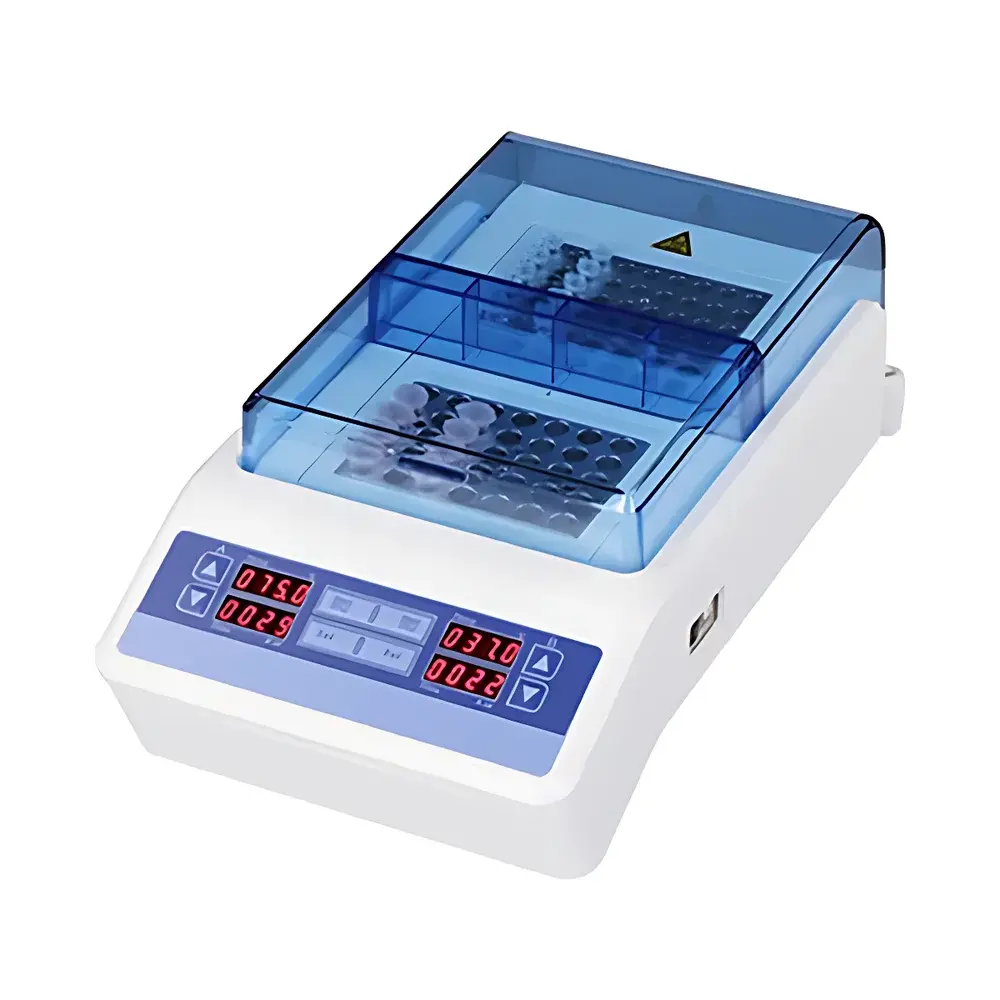
Allsheng MK2000-2E Dual-Zone Dry Block Heater
| Brand | Allsheng |
|---|---|
| Origin | Zhejiang, China |
| Model | MK2000-2E |
| Temperature Range | Ambient +5°C to 100°C |
| Temperature Stability @100°C | ≤0.5°C |
| Block Uniformity @37°C | ±0.2°C |
| Heating Time (25°C to 105°C) | ≤20 min |
| Display Resolution | 0.1°C |
| Dimensions (W×D×H) | 365 mm × 210 mm × 150 mm |
| Net Weight | 4.5 kg |
| Power Supply | AC 220 V / 120 V, 50 / 60 Hz |
| Rated Power | 200 W |
| Dual Independent Heating Zones | Yes |
| Standard Module Quantity | 2 |
Overview
The Allsheng MK2000-2E Dual-Zone Dry Block Heater is an engineered thermal platform designed for precise, reproducible, and independent temperature control of two sample blocks simultaneously. Unlike water baths or circulating ovens, this metal block heater utilizes solid-state aluminum heating blocks with high thermal conductivity and low thermal mass to deliver rapid, uniform heat transfer—ideal for applications requiring stable incubation, enzymatic reactions, sample thawing, or reagent pre-warming in molecular biology, clinical diagnostics, and quality control laboratories. Its core architecture adheres to fundamental thermodynamic principles: resistive heating elements embedded beneath precision-machined aluminum blocks, coupled with PID-controlled feedback loops and NTC thermistors for real-time temperature monitoring at both block surface and depth. The device operates without consumables or moving parts, ensuring long-term reliability and minimal maintenance under routine laboratory use.
Key Features
- Dual-zone independent temperature control: Each of the two interchangeable aluminum blocks can be set and maintained at different target temperatures (range: ambient +5°C to 100°C), enabling parallel processing of dissimilar protocols.
- High thermal performance: Achieves ≤20 minutes ramp time from 25°C to 105°C; maintains stability within ±0.5°C at 100°C and uniformity within ±0.2°C across the block surface at 37°C—validated per ISO/IEC 17025 traceable calibration practices.
- User-configurable modular design: Supports standardized well configurations (e.g., 0.2 mL, 0.5 mL, 1.5 mL, 2.0 mL tubes, PCR strips, microplates) with optional custom machining available for non-standard vessel geometries.
- Integrated safety and diagnostics: Automatic over-temperature cutoff, open-circuit detection, and audible/visual fault alerts prevent thermal runaway and ensure protocol integrity.
- Ergonomic operation: Transparent polycarbonate lid minimizes evaporative loss and accidental contamination while permitting visual monitoring; integrated lifting handles simplify module exchange and cleaning.
- Flexible sensing options: Factory-calibrated internal sensor standard; optional external probe input supports remote temperature verification aligned with GLP documentation requirements.
Sample Compatibility & Compliance
The MK2000-2E accommodates a broad spectrum of sample containers—including conical tubes, PCR tubes, microcentrifuge tubes, and 96-well plates—via user-swappable aluminum blocks. All standard modules are CNC-machined from aerospace-grade 6061-T6 aluminum, anodized for corrosion resistance and thermal consistency. The system complies with IEC 61010-1:2010 for electrical safety in laboratory equipment and meets RoHS Directive 2011/65/EU for hazardous substance restrictions. While not certified for medical device use under FDA 21 CFR Part 820, its temperature accuracy, repeatability, and audit-ready logging capabilities (when paired with compatible software) support adherence to ISO 13485 quality management systems and internal SOPs governing thermal validation in QC/QA environments.
Software & Data Management
The MK2000-2E operates as a standalone instrument with intuitive membrane keypad interface and dual-line LCD display showing setpoint, actual temperature, and countdown timer (0–99 h 59 min). For enhanced traceability, optional RS-232 or USB connectivity enables integration with third-party data acquisition platforms (e.g., LabVIEW, Python-based scripts) to record timestamps, temperature profiles, and alarm events. When used in regulated settings, users may implement manual logbooks or electronic lab notebooks (ELNs) compliant with 21 CFR Part 11 requirements—leveraging the unit’s built-in temperature deviation calibration function to document periodic performance verification against NIST-traceable references.
Applications
- Enzyme kinetics assays requiring tightly controlled reaction temperatures across multiple conditions
- Cell culture reagent equilibration prior to addition to sensitive mammalian or microbial cultures
- DNA/RNA denaturation and hybridization steps in nucleic acid purification and amplification workflows
- Standard curve preparation in ELISA and other immunoassays where consistent incubation temperature directly impacts signal linearity
- Stability testing of pharmaceutical excipients or diagnostic reagents under accelerated thermal stress conditions
- Calibration of thermocouples or digital thermometers using reference blocks traceable to national metrology institutes
FAQ
Can the MK2000-2E accommodate custom tube formats not listed in the standard module catalog?
Yes—Allsheng provides OEM module design services based on dimensional specifications and thermal load requirements. Lead time and minimum order quantities apply.
Is temperature calibration performed at the block surface or at the sample well bottom?
Calibration is conducted at the center of the well base using a calibrated reference thermometer; surface readings may vary by ≤0.3°C due to thermal gradient effects.
Does the unit support continuous operation beyond 24 hours?
Yes—the MK2000-2E is rated for unattended operation up to 99 hours 59 minutes per cycle, with thermal protection circuits active throughout.
What maintenance is required to sustain long-term temperature accuracy?
Annual verification using a traceable reference thermometer is recommended; no lubrication or internal servicing is needed under normal operating conditions.
How does the dual-zone control improve experimental reproducibility compared to single-block heaters?
Independent PID tuning per zone eliminates cross-talk between thermal loads, allowing simultaneous optimization of disparate protocols—e.g., one block at 37°C for cell lysis and another at 65°C for protein denaturation—without compromise.



