
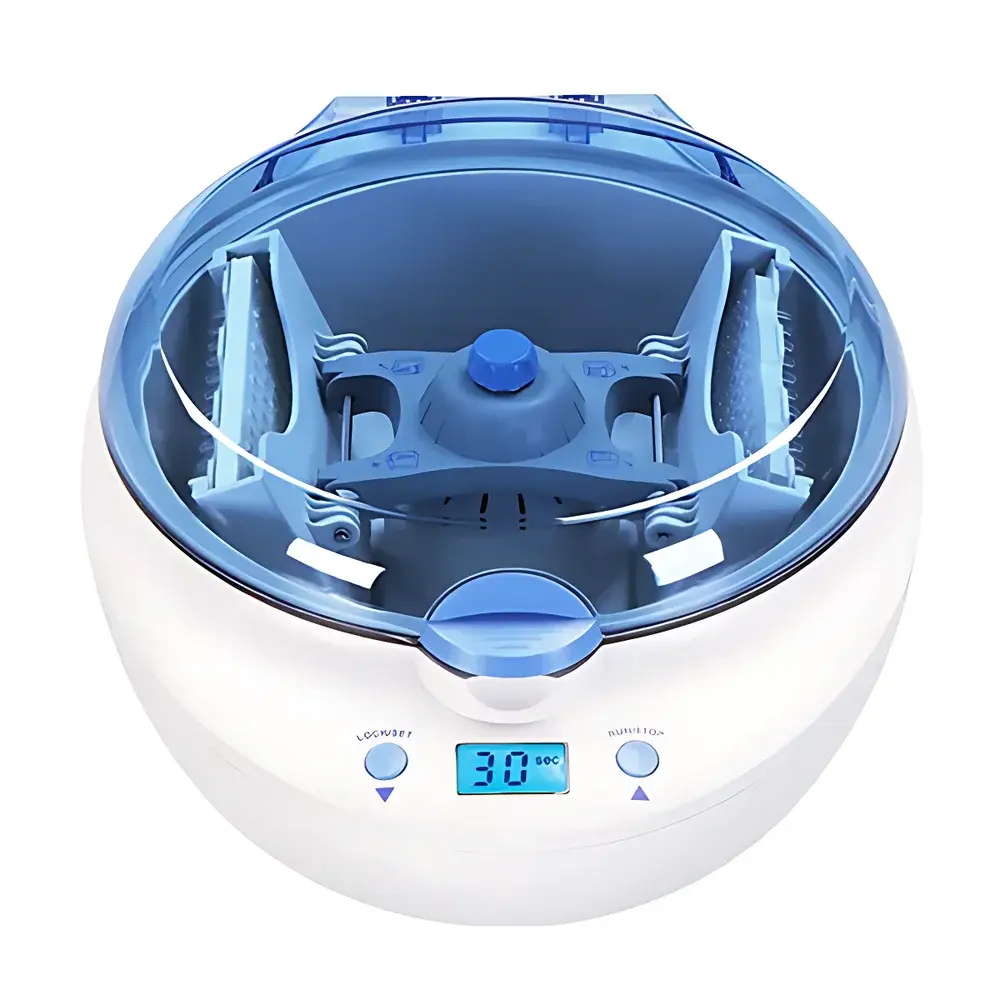
Allsheng MPC-P25 Microplate Mini Centrifuge
| Brand | Allsheng |
|---|---|
| Origin | Zhejiang, China |
| Model | MPC-P25 |
| Instrument Type | Benchtop Centrifuge |
| Category | Low-Speed Centrifuge (≤2,200 rpm) |
| Rotor Configuration | Horizontal Swinging-Bucket Rotor |
| Max Capacity | 2 × microplates (96-well or 384-well PCR/ELISA plates), 24 × 0.2 mL PCR strips, or 192 × 0.2 mL PCR tubes |
| Max Speed | 2,200 rpm |
| Max RCF | 480 × g |
| Timer Range | 0–10 min |
| Dimensions (W×D×H) | 290 × 360 × 140 mm |
| Weight | 3.6 kg |
| Power Supply | AC 120 V / 220 V, 50 / 60 Hz |
| Safety Features | Automatic braking (brake time ≈ 30 s), transparent lid with interlock, soft-start/soft-stop control |
Overview
The Allsheng MPC-P25 Microplate Mini Centrifuge is a compact, purpose-engineered benchtop centrifuge designed specifically for rapid, gentle pelleting of liquid samples in high-throughput molecular biology workflows. Unlike fixed-angle centrifuges, the MPC-P25 employs a patented horizontal swinging-bucket rotor system: sample carriers—preloaded with microplates or PCR tube arrays—are mounted on inclined cradles that dynamically level under rotational force. This mechanical reorientation ensures uniform radial orientation of wells during acceleration, minimizing meniscus distortion and maximizing efficiency in removing condensation or wall-bound droplets—a critical requirement for downstream applications such as qPCR, RT-PCR, NGS library preparation, and ELISA assay setup. Its low-speed operational envelope (up to 2,200 rpm / 480 × g) prioritizes sample integrity over high-force sedimentation, making it ideal for delicate biological matrices including enzymatic reaction mixtures, pre-amplified cDNA, antibody-conjugated beads, and cell lysates where shear-induced denaturation must be avoided.
Key Features
- Horizontal swinging-bucket rotor architecture enabling automatic leveling of microplates and tube strips during spin-up—ensuring consistent well alignment and eliminating cross-contamination risk from uneven pelleting.
- Dual operation modes: momentary “pulse” mode for quick spin-down of condensation prior to thermal cycling, and programmable timer mode (0–10 minutes) for reproducible, hands-free runs.
- Integrated safety interlock system with optically clear polycarbonate lid; motor halts instantly upon lid opening, compliant with IEC 61010-1 electrical safety standards for laboratory equipment.
- Brushless DC motor delivering quiet operation (<55 dB[A] at 2,200 rpm) and long-term reliability with minimal maintenance requirements.
- Ergonomic footprint (290 × 360 × 140 mm) optimized for crowded biosafety cabinets, PCR workstations, and mobile lab carts—no dedicated bench space required.
- Auto-braking function with controlled deceleration profile (~30 s full stop), reducing mechanical stress on rotor assemblies and preserving adapter integrity across repeated cycles.
Sample Compatibility & Compliance
The MPC-P25 supports universal microplate formats without modification: standard and skirted 96-well PCR plates, semi-skirted and non-skirted variants, 384-well low-profile plates, and 96-well ELISA plates. Optional accessories include AS-08091-01 (universal plate adapter set) and AS-08091-02 (strip and single-tube adapter). All adapters are precision-machined from autoclavable polypropylene and certified free of DNase/RNase, pyrogens, and heavy metals per ISO 10993-5 biocompatibility guidelines. The instrument complies with CE marking requirements (2014/30/EU EMC Directive and 2014/35/EU LVD Directive), and its firmware design accommodates audit-ready usage logs when integrated into GLP/GMP environments via external data capture systems.
Software & Data Management
The MPC-P25 operates via an embedded microcontroller with tactile membrane keypad interface—no external software or drivers required. While it does not feature onboard data logging or USB connectivity, its deterministic timer logic and repeatable RCF output enable strict protocol adherence across shifts and operators. For laboratories implementing 21 CFR Part 11 compliance, the device may be incorporated into electronic lab notebook (ELN) workflows using timestamped operator entries linked to batch records. Firmware revision history and calibration verification dates can be documented manually per internal SOPs, supporting routine IQ/OQ validation protocols.
Applications
- Rapid removal of condensation from PCR plate lids prior to thermal cycling.
- Consolidation of reagents in low-volume wells (e.g., master mixes, restriction digests, ligation reactions).
- Pre-centrifugation of enzyme-linked immunosorbent assay (ELISA) plates to ensure uniform coating and reduce edge effects.
- Post-lysis clarification of mammalian or bacterial lysates prior to supernatant transfer.
- Centrifugal consolidation of magnetic bead suspensions in nucleic acid extraction workflows.
- Pre-analytical conditioning of clinical specimens (e.g., whole blood, serum, saliva) in point-of-care molecular testing platforms.
FAQ
What microplate formats are compatible with the MPC-P25 without adapters?
Standard 96-well PCR plates (skirted, semi-skirted, and non-skirted), 384-well PCR plates, and 96-well ELISA plates fit directly into the rotor cradle.
Can the MPC-P25 accommodate 0.5 mL or 1.5 mL tubes?
No—the MPC-P25 is engineered exclusively for microplate and 0.2 mL tube formats. Larger tube formats require dedicated centrifuges with appropriate rotor geometry.
Is the MPC-P25 suitable for use inside a biosafety cabinet?
Yes—its compact dimensions, low heat dissipation, and silent operation make it fully compatible with Class II A2 and B2 biosafety cabinets.
Does the MPC-P25 support continuous operation?
It is rated for intermittent duty: maximum run time per cycle is 10 minutes, with recommended cooldown intervals of ≥2 minutes between consecutive runs to maintain motor longevity.
How is calibration verified for regulatory audits?
Users perform periodic speed verification using a traceable tachometer; RCF values are calculated from measured rpm and rotor radius per ISO 21501-4. Calibration records should be retained per organizational quality management system requirements.



