
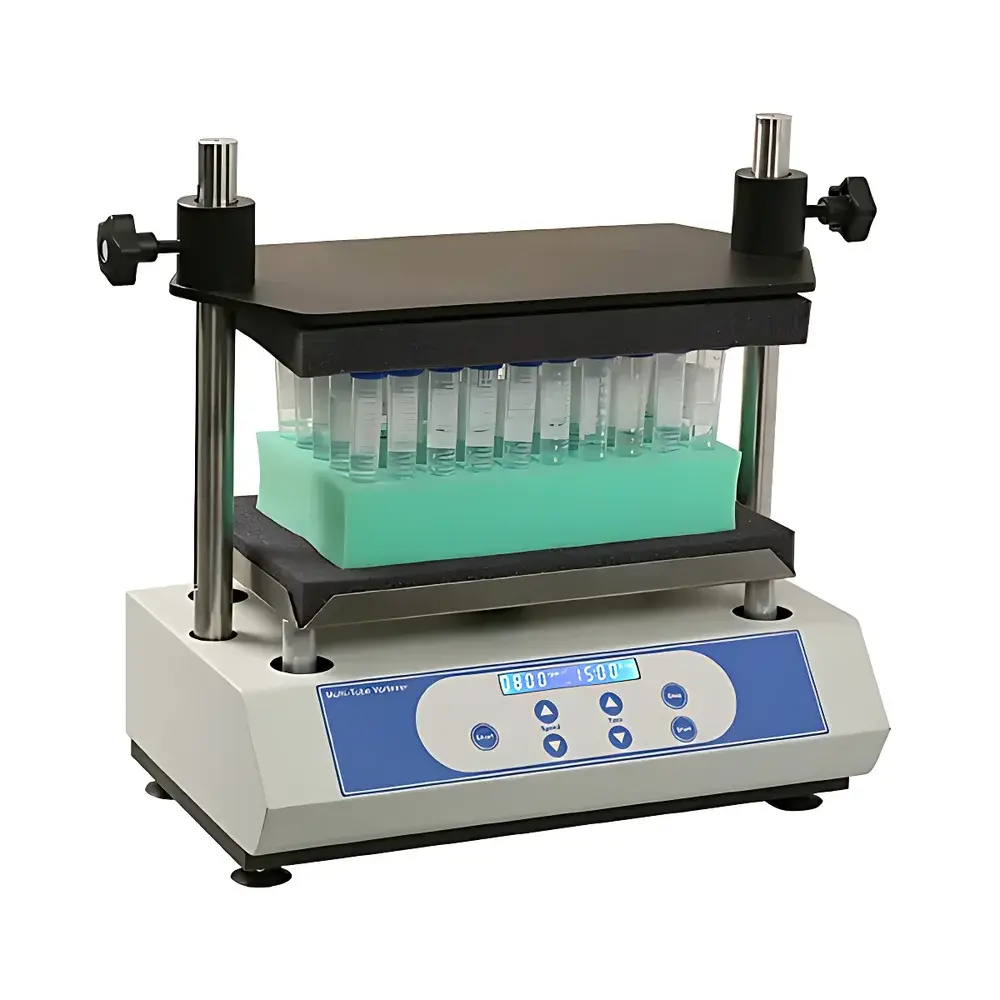
Allsheng MTV-100 Multi-Tube Vortex Mixer
| Brand | Allsheng |
|---|---|
| Model | MTV-100 |
| Orbital Diameter | 3.6 mm |
| Speed Range | 500–2500 rpm |
| Speed Accuracy | ±10 rpm |
| Timer Range | 1 min – 99 h 59 min |
| Max Load Capacity | 4.5 kg |
| Top Panel Dimensions (L×W) | 310 × 180 mm |
| Instrument Dimensions (L×W×H) | 426 × 250 × 480 mm |
| Net Weight | 21.5 kg |
| Power Consumption | 60 W |
| Safety Certification | CE-compliant |
Overview
The Allsheng MTV-100 Multi-Tube Vortex Mixer is an engineered solution for high-throughput sample homogenization in molecular biology, clinical diagnostics, and pharmaceutical quality control laboratories. Designed around a robust orbital shaking principle—where samples undergo controlled circular motion with a fixed 3.6 mm displacement—the instrument ensures consistent vortexing across up to 50 tubes simultaneously without cross-contamination or positional bias. Unlike single-tube vortexers, the MTV-100 employs a rigid aluminum alloy platform driven by a brushless DC motor and precision-machined cam mechanism, delivering stable rotational energy distribution even under full load. Its architecture supports reproducible mixing of viscous, particulate, or low-volume samples—including PCR master mixes, cell suspensions, ELISA reagents, and extraction buffers—while maintaining thermal stability during extended operation. The unit operates independently of external cooling or heating systems, making it suitable for ambient-temperature applications where temperature-sensitive analytes must remain unaltered.
Key Features
- High-capacity processing: Simultaneous vortexing of up to 50 tubes using interchangeable foam tube racks (compatible with diameters from 10 mm to 29 mm)
- Microprocessor-controlled operation: LCD interface displays real-time speed (500–2500 rpm), elapsed time, and remaining timer duration
- Dual-mode functionality: Continuous mode for sustained mixing; programmable pulse mode with adjustable interval duration (1–59 seconds) for delicate samples requiring intermittent agitation
- Precision engineering: Speed accuracy maintained within ±10 rpm across the full range; orbital motion ensures uniform shear distribution without splashing or foaming
- Enhanced safety and durability: CE-certified electrical design; overheat protection circuitry; non-slip rubber feet; reinforced steel housing with powder-coated finish
- Ergonomic usability: Top panel (310 × 180 mm) optimized for rapid rack placement; intuitive keypad navigation with tactile feedback
Sample Compatibility & Compliance
The MTV-100 accommodates standard laboratory consumables including microcentrifuge tubes (0.2–2.0 mL), PCR strips, deep-well plates (96-well format with optional adapter), and conical tubes (15 mL and 50 mL). Foam inserts are available for precise tube retention across six inner diameters (10, 12, 13, 16, 25, and 29 mm), minimizing vibration-induced tube displacement and ensuring mechanical coupling efficiency. All accessories—including the standard 12 mm foam rack (AS-02041-02) and replaceable silicone tray pad (AS-02041-00)—are autoclavable and chemically resistant to common solvents (e.g., ethanol, isopropanol, dilute acids/bases). The device complies with IEC 61010-1:2010 for laboratory electrical equipment safety and meets EN 61326-1:2013 electromagnetic compatibility requirements. It is routinely validated in GLP environments for use in method development protocols aligned with ISO/IEC 17025 and USP endotoxin testing workflows.
Software & Data Management
The MTV-100 operates as a standalone hardware platform with no embedded firmware update capability or network connectivity. However, its programmable timer and pulse function support audit-ready documentation when integrated into electronic lab notebook (ELN) systems via manual entry or barcode-scanned protocol logs. The LCD display retains last-used parameters after power cycling, facilitating repeat-run consistency. For laboratories operating under FDA 21 CFR Part 11 requirements, the instrument may be included in system validation packages as a “non-configurable ancillary device,” with operational parameters recorded externally through SOP-defined checklists and timestamped logbooks. Optional rack labeling kits (sold separately) enable traceability of tube position mapping during batch processing.
Applications
- Pre-PCR preparation: Homogenization of genomic DNA/RNA extraction lysates prior to column binding or magnetic bead separation
- Clinical microbiology: Resuspension of bacterial pellets for MALDI-TOF MS target plate spotting
- Immunoassay workflow: Uniform mixing of antigen–antibody conjugates in ELISA coating and detection steps
- Pharmaceutical QC: Reconstitution and dispersion of lyophilized reference standards for HPLC calibration
- Cell culture support: Gentle resuspension of adherent cell monolayers post-trypsinization without excessive shear stress
- Biochemical assay setup: Blending enzyme–substrate mixtures for kinetic studies requiring precise initiation timing
FAQ
What tube formats are supported without modification?
The MTV-100 accepts 50 × 12 mm microtubes as standard. Other configurations require compatible foam racks (e.g., AS-02041-01 for 10 mm tubes; AS-02041-05 for 25 mm tubes).
Can the unit be operated inside a cold room or incubator?
No. The MTV-100 is rated for ambient operation only (10–30 °C, <80% RH non-condensing). Internal electronics and motor performance are not specified for sub-ambient or elevated temperatures.
Is the timer resolution sufficient for short-duration mixing protocols?
Yes. The pulse mode allows discrete activation intervals from 1 to 59 seconds in 1-second increments, enabling precise control for heat-labile or aggregation-prone samples.
How is maintenance performed on the drive mechanism?
The brushless DC motor and cam assembly are sealed and require no routine lubrication or user-accessible servicing. Annual visual inspection of rack mounting integrity and panel fasteners is recommended.
Does the device support integration with LIMS or automated liquid handlers?
Not natively. It lacks digital I/O ports or API interfaces. Integration must occur at the procedural level—e.g., via synchronized start triggers documented in process maps or executed manually following robotic arm completion signals.



