
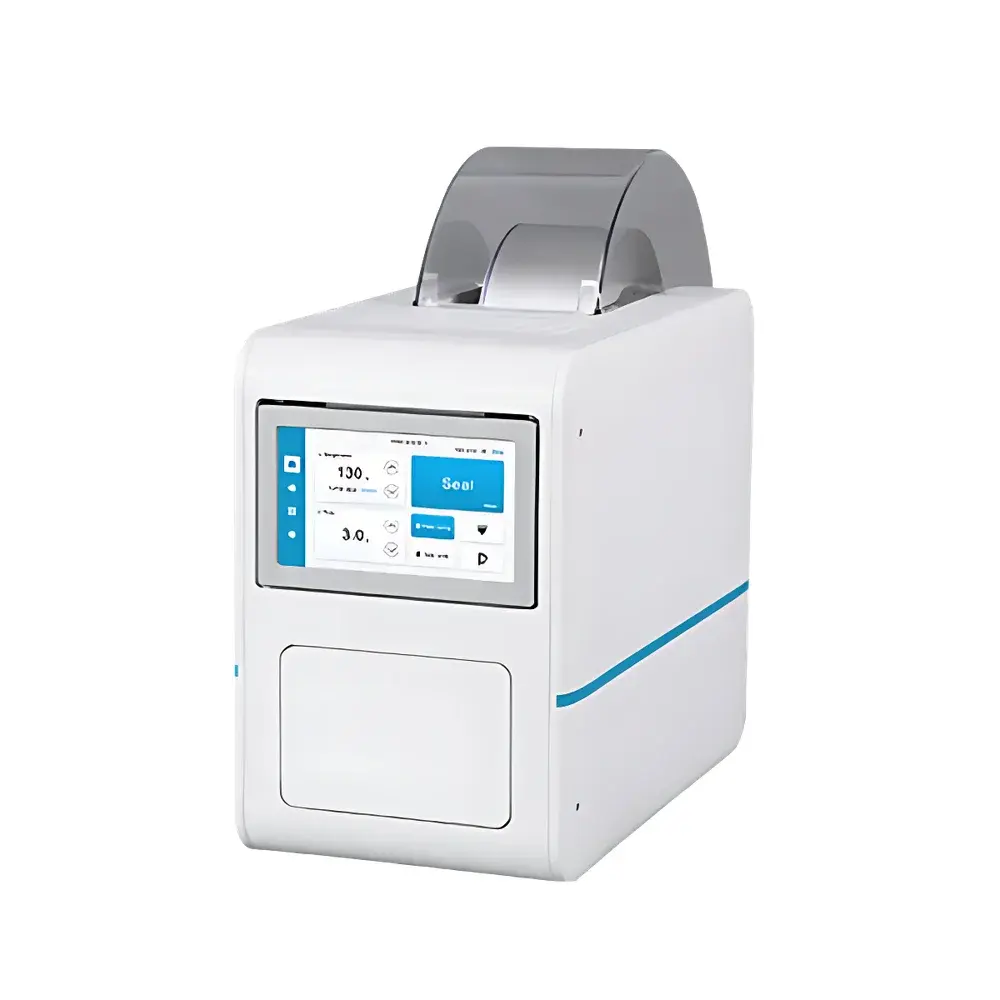
Allsheng SealBio-1 Automated Microplate Heat Sealer
| Brand | Allsheng |
|---|---|
| Origin | Zhejiang, China |
| Model | SealBio-1 |
| Temperature Range | Ambient to 200 °C (±1 °C accuracy) |
| Temperature Adjustment Increment | 1 °C |
| Preheating Time | 5 min |
| Cycle Time | <20 s per plate |
| Sealing Time Range | 0.5–9.9 s (0.1 s increment) |
| Compatible Plate Heights | 3–62 mm |
| Plate Standards | ANSI/SBS-compliant 12-, 24-, 48-, 96-, and 384-well plates (PCR, ELISA, deep-well, cell culture) |
| Film Width | 78 mm |
| Film Types | Piercable film, aluminum foil film, high-strength thermal seal film |
| Loading Method | Automatic pre-loading |
| Integrated Air Source | Yes |
| Interface | USB-B + Ethernet |
| Power Supply | AC 100–240 V, 50/60 Hz |
| Max Power | 300 W |
| Display | 7-inch capacitive touchscreen (1024 × 600 resolution) |
| Safety Features | Plate presence detection, film presence detection, standby mode |
Overview
The Allsheng SealBio-1 Automated Microplate Heat Sealer is an engineered solution for high-integrity, reproducible thermal sealing of standardized microplates in life science laboratories, diagnostic manufacturing facilities, and biobanking operations. It operates on resistive heating and pneumatic compression principles—applying precisely controlled temperature, pressure, and dwell time to form hermetic seals across a wide range of thermoplastic and metallized films. Designed for compliance-critical workflows—including pre-aliquoted reagent packaging, PCR setup, long-term sample archiving, and regulated assay kit assembly—the SealBio-1 delivers consistent seal quality without manual intervention or external compressed air infrastructure.
Key Features
- Programmable temperature control from ambient to 200 °C with ±1 °C stability and 1 °C adjustment resolution—enabling optimization for diverse film chemistries (e.g., polypropylene-based piercable films vs. laminated aluminum foils).
- Automatic film pre-loading mechanism eliminates manual threading, reducing operator error and enabling unattended batch processing of up to 96 plates per hour under typical conditions.
- Integrated air compressor provides stable, oil-free pneumatic actuation—ensuring repeatable sealing force independent of facility air supply fluctuations or contamination risks.
- 7-inch high-resolution capacitive touchscreen interface supports intuitive navigation, real-time parameter monitoring, and on-device editing of sealing protocols.
- Onboard protocol storage accommodates ≥20 user-defined sealing methods, each preserving temperature setpoint, dwell time (0.5–9.9 s, 0.1 s increments), and plate-height compensation settings.
- Dual-sensor safety system verifies both microplate presence and film availability prior to cycle initiation, preventing dry-actuation or mis-seal events.
- Modular film guard assembly protects the 78 mm-wide roll surface from dust, fingerprints, and mechanical abrasion during operation and idle periods.
Sample Compatibility & Compliance
The SealBio-1 accepts all ANSI/SBS-standard microplates within a 3–62 mm height envelope—including skirted and non-skirted 96-well PCR plates, low-profile 384-well assay plates, 24-well cell culture plates, and 48-well deep-well storage plates. Its adaptive platen design compensates for dimensional variance across manufacturers (e.g., Corning, Thermo Fisher, Greiner Bio-One). Film compatibility extends to medical-grade piercable films (EN ISO 8536-4 compliant), pharmaceutical aluminum laminates (USP tested), and high-barrier heat-seal films used in IVD kit manufacturing. While the instrument itself does not carry CE marking or FDA 510(k) clearance, its operational parameters align with common validation requirements for GLP/GMP environments—particularly when integrated into documented sealing SOPs referencing ASTM F2096 (bubble leak testing) or ISO 11607-2 (sterile barrier system validation).
Software & Data Management
Control firmware runs on a deterministic real-time OS, ensuring cycle timing repeatability unaffected by UI interaction latency. All sealing parameters—including timestamp, operator ID (via optional network login), plate type, film lot number (manually entered), and measured peak temperature—are logged locally in CSV format via USB-B export. Ethernet connectivity enables remote status polling (HTTP/REST API), scheduled firmware updates, and integration with LIMS or MES platforms through configurable JSON payloads. Audit trail functionality meets basic ALCOA+ data integrity expectations: entries are immutable, time-stamped, and attributable. For full 21 CFR Part 11 compliance, external electronic signature and role-based access control must be implemented at the enterprise software layer.
Applications
- Pre-analytical sealing of qPCR master mixes and NGS library prep reagents in clinical and research labs.
- Final packaging of lyophilized or liquid reagent kits for in vitro diagnostics—supporting shelf-life validation studies requiring consistent seal integrity.
- Biobank specimen plate capping prior to ultra-low temperature storage (−80 °C or liquid nitrogen), minimizing condensation ingress and cross-contamination risk.
- High-throughput compound screening workflows where sealed plates undergo automated liquid handling, centrifugation, and incubation steps.
- Quality control labs performing seal peel strength testing (per ASTM F88) or dye penetration verification (per ASTM F1929) on representative production batches.
FAQ
Does the SealBio-1 support barcode-triggered protocol selection?
Yes—when connected via Ethernet to a host system, the device accepts HTTP POST requests containing a scanned plate or film barcode, automatically loading the corresponding preconfigured sealing method.
Can it seal plates with raised rims or irregular topography?
It accommodates ANSI/SBS-compliant plates only; non-standard geometries (e.g., certain custom microfluidic chips or plates with asymmetric flanges) may require mechanical adaptation or are unsupported.
Is routine calibration required?
Temperature sensor drift is minimal (<0.3 °C/year); however, annual verification using a NIST-traceable contact thermometer and documented procedure is recommended for regulated use.
What maintenance is needed for the integrated air compressor?
The oil-free diaphragm pump requires no lubrication; filter replacement every 12 months or 2000 operating hours ensures optimal airflow and noise performance.





