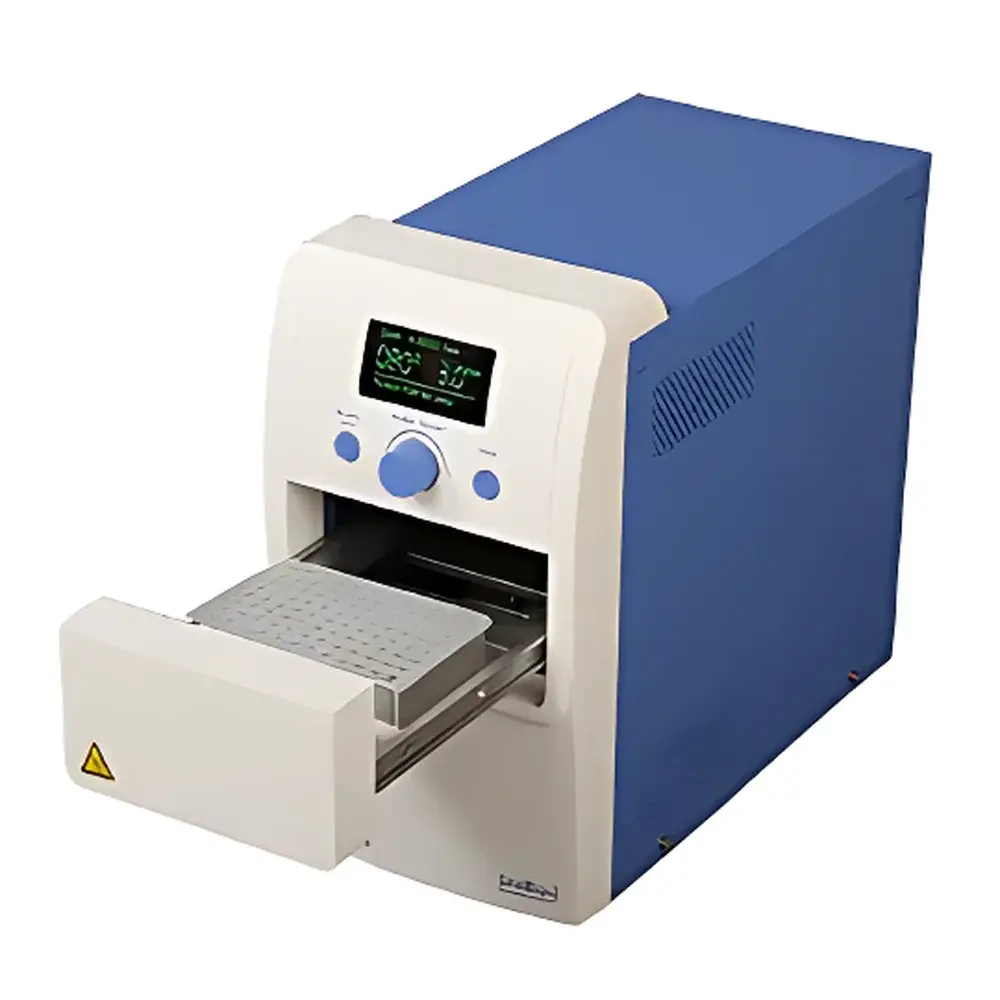
Allsheng SealBio-2 Semi-Automatic Microplate Sealer
| Brand | Allsheng (Hangzhou) |
|---|---|
| Origin | Zhejiang, China |
| Manufacturer Type | Authorized Distributor |
| Country of Origin | China |
| Model | SealBio-2 Semi-Automatic Microplate Sealer |
| Pricing | Upon Request |
| Heating Temperature Range | 80–200 °C (1.0 °C increment) |
| Temperature Accuracy | ±1.0 °C |
| Temperature Uniformity | ±1.0 °C |
| Sealing Time Range | 0.5–10.0 s (0.1 s increment) |
| Plate Height Detection | Automatic (9–48 mm) |
| Max. Power Input | 300 W |
| Dimensions (D×W×H) | 370 × 178 × 330 mm |
| Weight | 9.6 kg |
| Compatible Plate Materials | PP, PS, PE |
| Compatible Plate Types | Standard ELISA/cell culture plates, 96-well/384-well PCR plates (full-skirted, half-skirted, non-skirted), deep-well storage plates |
| Compatible Sealing Films | Polypropylene foil, PET-PP laminates, transparent polymer films, thin-gauge thermoplastic films, aluminum foil membranes |
Overview
The Allsheng SealBio-2 Semi-Automatic Microplate Sealer is an engineered thermal sealing solution designed for high-integrity sample containment in life science laboratories. It operates on resistive heating principle, applying controlled thermal energy and mechanical pressure to bond heat-activated sealing films onto polymeric microplates—ensuring hermetic closure without compromising plate integrity or downstream assay compatibility. Unlike fully automated systems integrated into robotic workcells, the SealBio-2 delivers benchtop precision with semi-automated workflow efficiency: users load plates manually, initiate sealing via intuitive interface, and benefit from real-time thermal feedback and adaptive height sensing. Its compact footprint (370 mm depth × 178 mm width) enables seamless integration into biosafety cabinets, cold rooms, and high-density lab benches—particularly where space-constrained environments demand reliable, repeatable sealing performance for qPCR, HTS, compound screening, and biobanking applications.
Key Features
- Intelligent motor-driven access door with obstacle detection: reverses motion upon physical obstruction, meeting IEC 61000-4-2 ESD safety requirements and minimizing operator risk.
- Auto-height recognition system: detects plate stack height between 9 mm and 48 mm without manual adjustment—enabling consistent contact pressure across diverse plate formats (e.g., shallow 96-well ELISA plates vs. deep-well 2.2 mL storage plates).
- Precision thermal control: PID-regulated heating element maintains setpoint stability within ±1.0 °C accuracy and ±1.0 °C uniformity across the sealing surface; temperature displayed in real time on a high-brightness OLED screen with full viewing angle visibility—even under low-light hood conditions.
- Granular parameter tuning: sealing time adjustable in 0.1-second increments (0.5–10.0 s), temperature in 1.0 °C steps (80–200 °C), and pressure via calibrated mechanical actuator—allowing method optimization for sensitive substrates such as low-binding PCR plates or fragile hydrogel-coated surfaces.
- Energy-conscious power management: automatic standby mode engages after 60 minutes of inactivity (reducing heater temperature to 60 °C); “deep sleep” mode activates after 120 minutes (disabling display and cutting heating element power while retaining core controller functionality for rapid resume).
- Modular service design: heating plate assembly and access door are mechanically decoupled for tool-free disassembly—facilitating routine cleaning, calibration verification, and preventive maintenance per GLP-compliant lab SOPs.
Sample Compatibility & Compliance
The SealBio-2 supports universal microplate compatibility across ISO/ANSI standard footprints (SBS format), including 96-well, 384-well, and 1536-well configurations. It accommodates plates fabricated from polypropylene (PP), polystyrene (PS), and polyethylene (PE), with validated performance on full-skirted, half-skirted, and non-skirted PCR plates—critical for thermal cycling integrity. Compatible sealing media include peelable PP-based films (Seal-150), solvent-resistant compound storage films (Seal-200), and pierceable aluminum laminates (Seal-300), all compliant with USP extractables profiling guidelines. While not certified to UL/CSA standards, its electrical architecture conforms to IEC 61010-1 for laboratory equipment safety, and its operational repeatability supports audit readiness for ISO 17025-accredited testing labs and FDA-regulated QC environments requiring documented sealing process parameters.
Software & Data Management
The SealBio-2 operates via embedded firmware with no external PC dependency. All sealing protocols—including temperature, dwell time, and pressure—are stored locally in non-volatile memory and recalled via rotary encoder navigation. The OLED interface logs last-used parameters and displays real-time heater status, but does not generate timestamped audit trails or exportable data files. For labs requiring 21 CFR Part 11 compliance, integration with third-party LIMS or electronic lab notebook (ELN) systems can be achieved via optional RS-232 serial output (available upon request), enabling protocol synchronization and basic event logging (e.g., “seal cycle initiated”, “temperature reached setpoint”). Firmware updates are delivered via USB flash drive, supporting version-controlled deployment aligned with internal change control procedures.
Applications
- qPCR and digital PCR workflow integrity: prevents evaporation-induced concentration drift and cross-contamination during thermal cycling.
- High-throughput screening (HTS): ensures consistent film adhesion across 384-well assay plates prior to automated liquid handling and readout.
- Compound library archiving: enables long-term storage of DMSO-solubilized small molecules under inert atmosphere using Seal-200’s chemical resistance profile.
- Cell-based assay preservation: seals cell culture plates post-transfection or treatment to maintain sterility and media volume over extended incubation periods.
- Clinical diagnostics: supports CLIA-waived and CAP-accredited workflows where sealed plate integrity is prerequisite for analyte stability in ELISA and multiplex immunoassays.
FAQ
Does the SealBio-2 support programmable multi-step sealing protocols?
No—it executes single-parameter sealing cycles only. Each run requires manual selection of temperature, time, and pressure; no built-in sequence programming or conditional logic is available.
Can the instrument be validated for GMP environments?
Yes—its thermal accuracy (±1.0 °C), uniformity (±1.0 °C), and mechanical repeatability enable IQ/OQ execution using standard NIST-traceable thermocouples and gauge blocks. Full PQ validation must be performed in situ with user-specific plate/film combinations.
Is the OLED display compatible with glove use in biosafety cabinets?
Yes—the capacitive-free rotary encoder and tactile feedback buttons ensure reliable operation with nitrile or latex gloves; the OLED’s high-luminance output remains legible under cabinet lighting.
What maintenance intervals are recommended?
Heating plate surface cleaning is advised after every 500 cycles using lint-free wipes and isopropanol; annual verification of door motor torque and thermal sensor calibration is recommended per manufacturer service bulletin SB-SEALBIO-2023-01.
Are spare sealing films supplied with the instrument?
No—films are ordered separately using part numbers AS-15021-11 through AS-15021-13; each film type has distinct peel strength, puncture resistance, and optical transmission characteristics suited to specific assay requirements.