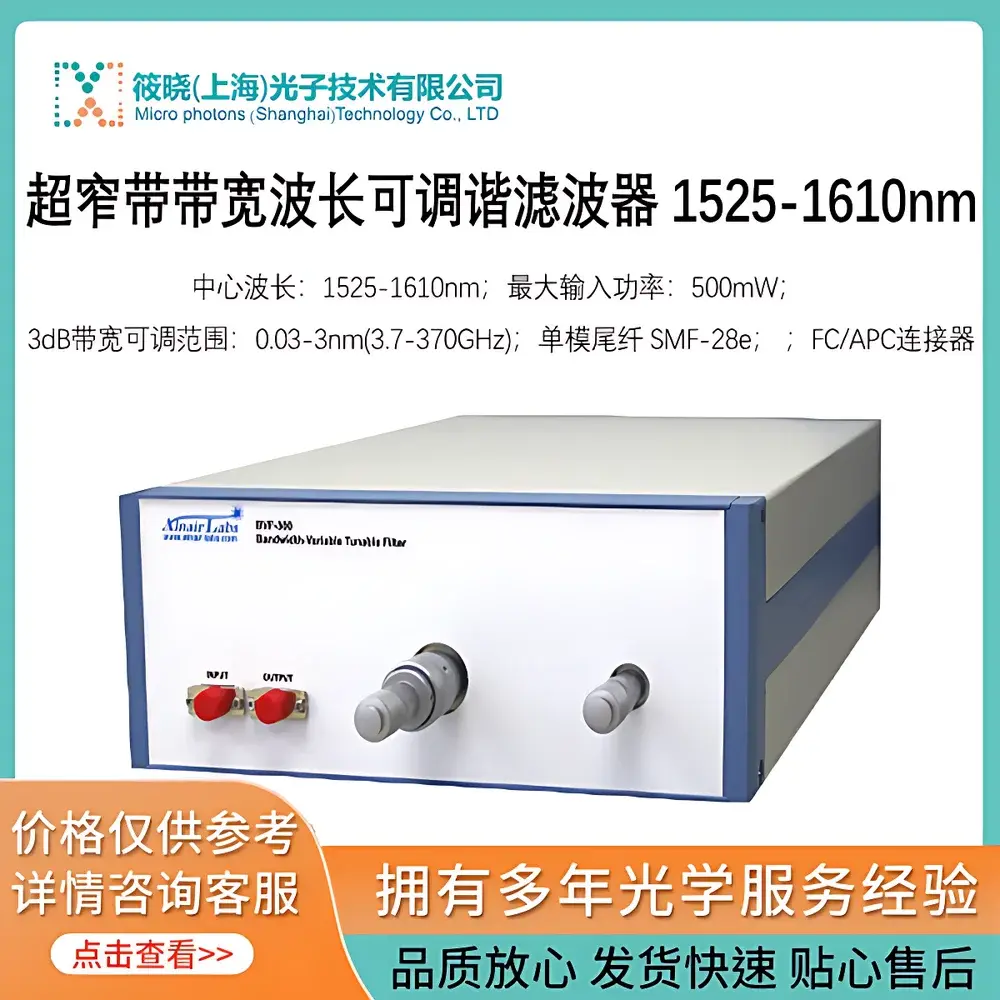
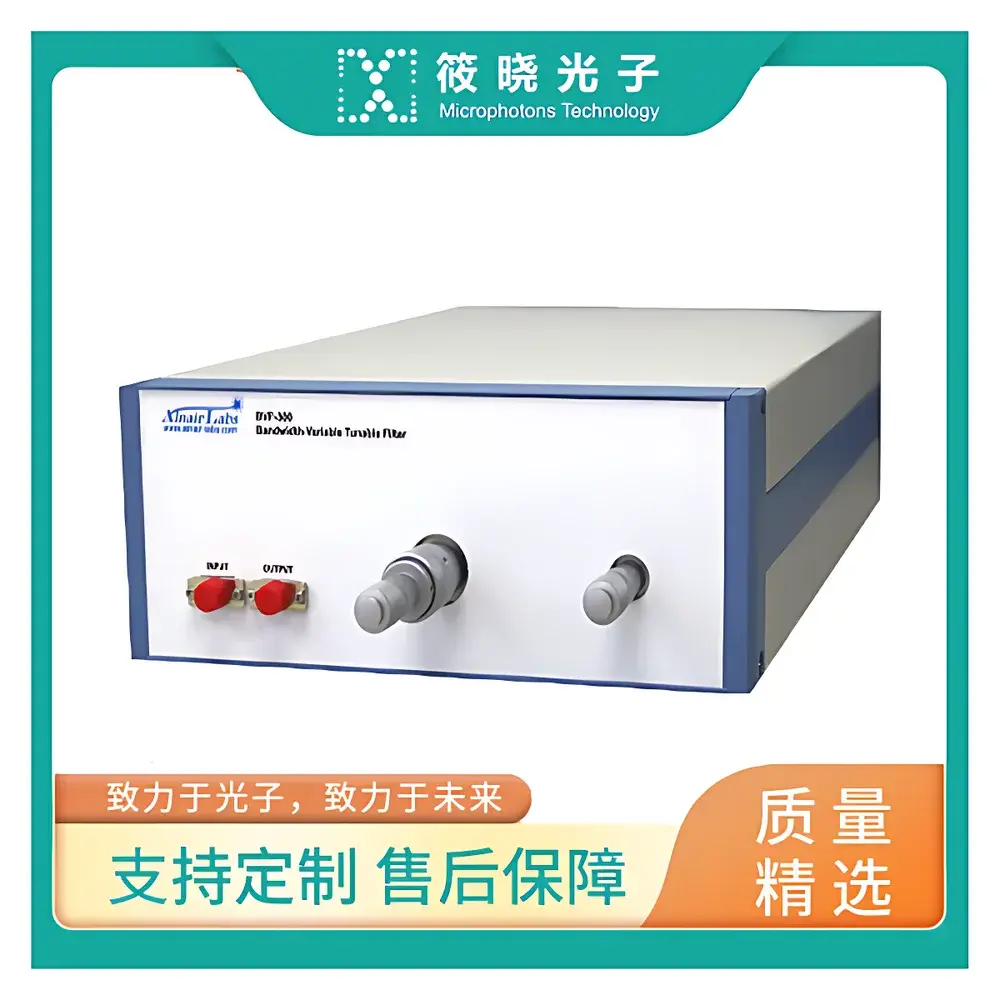
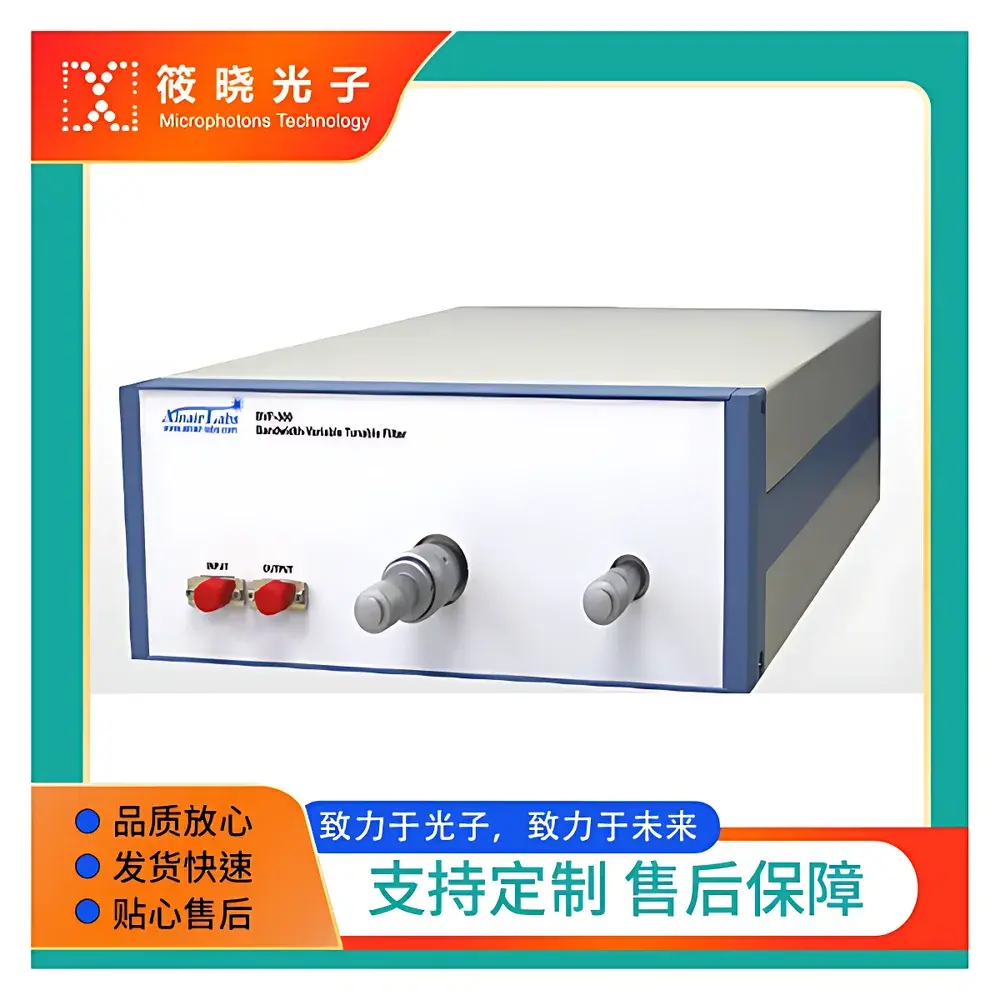
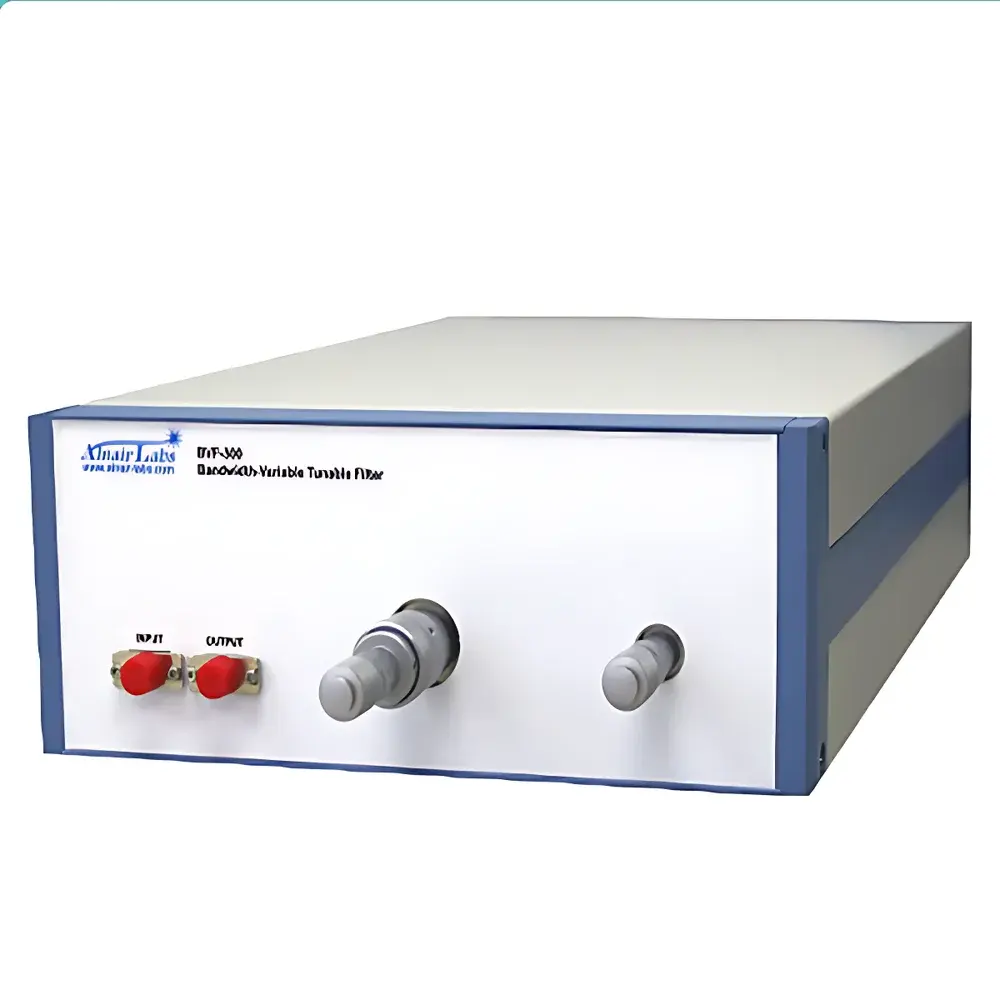
Alnair Labs BVF-300CL-SM-FA Ultra-Narrowband Tunable Optical Bandpass Filter (1525–1610 nm)
| Brand | Alnair Labs |
|---|---|
| Origin | Japan |
| Model | BVF-300CL-SM-FA |
| 3 dB Bandwidth Tuning Range | 0.03–3.7 nm (0.03–370 GHz) |
| Center Wavelength Tuning Range | 1525–1610 nm |
| Wavelength Accuracy | < ±0.05 nm |
| Wavelength Repeatability | < ±0.01 nm |
| Insertion Loss (BW > 0.1 nm) | 4.5–6.5 dB |
| Insertion Loss (BW = 0.03 nm) | 5.5–8 dB |
| Roll-off (−3 dB to −40 dB) | 1000–1500 dB/nm |
| Out-of-Band Suppression | 40–50 dB |
| Return Loss | ≥40 dB |
| Polarization-Dependent Loss (SMF) | ≤0.2 dB |
| Max Input Power (SMF) | 500 mW |
| Fiber Type | SMF-28 or PMF |
| Connector | FC/APC |
| Interface | Manual tuning (no electronic control) |
| Dimensions (W×H×D) | 236×88×380 mm |
| Weight | 7 kg |
Overview
The Alnair Labs BVF-300CL-SM-FA is a high-precision, manually operated ultra-narrowband tunable optical bandpass filter engineered for demanding spectral selection tasks in fiber-optic communication research, quantum optics, laser linewidth characterization, and coherent detection systems. Operating across the full C+L telecommunication bands (1525–1610 nm), it employs a robust all-fiber interferometric design—based on cascaded Mach–Zehnder and Fabry–Pérot cavity principles—to deliver exceptional wavelength selectivity with sub-picometer resolution. Unlike broadband or fixed-wavelength filters, the BVF-300CL-SM-FA enables continuous, mechanical tuning of both center wavelength and 3 dB bandwidth without mode hopping or thermal drift, ensuring stable passband positioning during long-duration measurements. Its architecture avoids active thermal stabilization or piezoelectric actuators, resulting in intrinsic long-term stability and immunity to electromagnetic interference—critical for metrology-grade optical setups where reproducibility and traceability are essential.
Key Features
- Ultra-narrow 3 dB bandwidth tuning range: 0.03 nm (3.7 GHz) to 3.7 nm (450 GHz), supporting high-resolution spectral isolation of individual DWDM channels or narrow-linewidth lasers.
- Continuous center wavelength tuning from 1525 nm to 1610 nm with < ±0.01 nm repeatability and < ±0.05 nm absolute accuracy—calibrated against NIST-traceable reference sources.
- Steep spectral roll-off of 1000–1500 dB/nm (measured between −3 dB and −40 dB points), enabling effective suppression of adjacent ASE noise or out-of-band amplified spontaneous emission.
- Low polarization-dependent loss (< 0.2 dB) in SMF-28 configuration, ensuring consistent transmission regardless of input SOP—validated per IEC 61300-3-32.
- High out-of-band rejection (>40 dB typical, up to 50 dB) and return loss (>40 dB), minimizing back-reflection into sensitive sources such as DFB lasers or optical amplifiers.
- FC/APC connectorized single-mode fiber interface (SMF-28), optimized for low reflectance and compatibility with industry-standard test benches and optical circulators.
- Compact benchtop form factor (236 × 88 × 380 mm) with rigid aluminum housing, designed for vibration-insensitive operation in shared laboratory environments.
Sample Compatibility & Compliance
The BVF-300CL-SM-FA is compatible with standard single-mode telecom fibers (ITU-T G.652.D) and supports maximum continuous-wave optical power up to 500 mW—sufficient for characterizing high-power EDFAs, Raman pumps, or swept-source OCT systems. For polarization-sensitive applications, optional PMF versions (BVF-300CL-PM-FA) are available with aligned slow-axis coupling and reduced max input power (300 mW) to preserve extinction ratio integrity. All units comply with IEC 61300-2-1 (vibration), IEC 61300-2-5 (impact), and IEC 61300-2-17 (temperature cycling) standards. While not certified for medical or aerospace use, its performance parameters are fully documented per ISO/IEC 17025-aligned internal calibration protocols, including wavelength traceability to NIST SRM 1681a and insertion loss verification using calibrated photodiodes traceable to PTB.
Software & Data Management
As a manually tuned instrument, the BVF-300CL-SM-FA does not include electronic interfaces (USB/GPIB) or embedded firmware. However, its mechanical tuning mechanism features engraved micrometer scales with 0.01 nm resolution markings and dual-axis vernier readouts for independent center wavelength and bandwidth adjustment—enabling manual mapping of spectral response without external instrumentation. Users routinely integrate it with third-party optical spectrum analyzers (e.g., Yokogawa AQ6370, Keysight 86140B) or lock-in amplifiers for automated sweep-and-record workflows. Calibration reports—including full wavelength vs. dial position lookup tables and bandwidth-vs-rotation-angle curves—are supplied with each unit and archived in CSV format for integration into LabVIEW, Python (PyVISA + NumPy), or MATLAB-based data acquisition pipelines compliant with GLP audit requirements.
Applications
- DWDM channel isolation and crosstalk analysis in multi-channel optical networks.
- Laser linewidth measurement via delayed self-heterodyne interferometry (DSHI).
- Optical coherence tomography (OCT) source characterization and swept-wavelength calibration.
- Quantum key distribution (QKD) receiver filtering for wavelength-division multiplexed BB84 implementations.
- Stimulated Brillouin scattering (SBS) gain spectrum profiling in nonlinear fiber experiments.
- Reference filter for calibrating tunable lasers (TLS) and optical vector analyzers (OVAs) per ITU-T G.698.2 and Telcordia GR-1312-CORE.
FAQ
Is the BVF-300CL-SM-FA compatible with polarization-maintaining fiber systems?
Yes—Alnair Labs offers a dedicated PMF variant (BVF-300CL-PM-FA) with factory-aligned slow-axis coupling and specified extinction ratio preservation at ≤300 mW input power.
What is the typical warm-up time required before achieving specification-grade stability?
No thermal stabilization is required; mechanical tuning achieves stable output within <30 seconds after adjustment due to passive athermal design.
Can this filter be used in reflective configurations (e.g., with an optical circulator)?
Yes—its high return loss (>40 dB) and low PDL make it suitable for reflection-mode setups when paired with low-backreflection circulators meeting IEC 61300-2-19 Class A specifications.
Are calibration certificates included with shipment?
Each unit ships with a factory calibration report documenting wavelength accuracy, bandwidth linearity, and insertion loss across the full tuning range, traceable to national metrology institutes.
Does Alnair Labs offer OEM integration support for custom mechanical or optical packaging?
Yes—custom flange mounts, collimated free-space variants (with FC-to-lens adapters), and rack-mount chassis integration are available under NDA-supported engineering collaboration.