
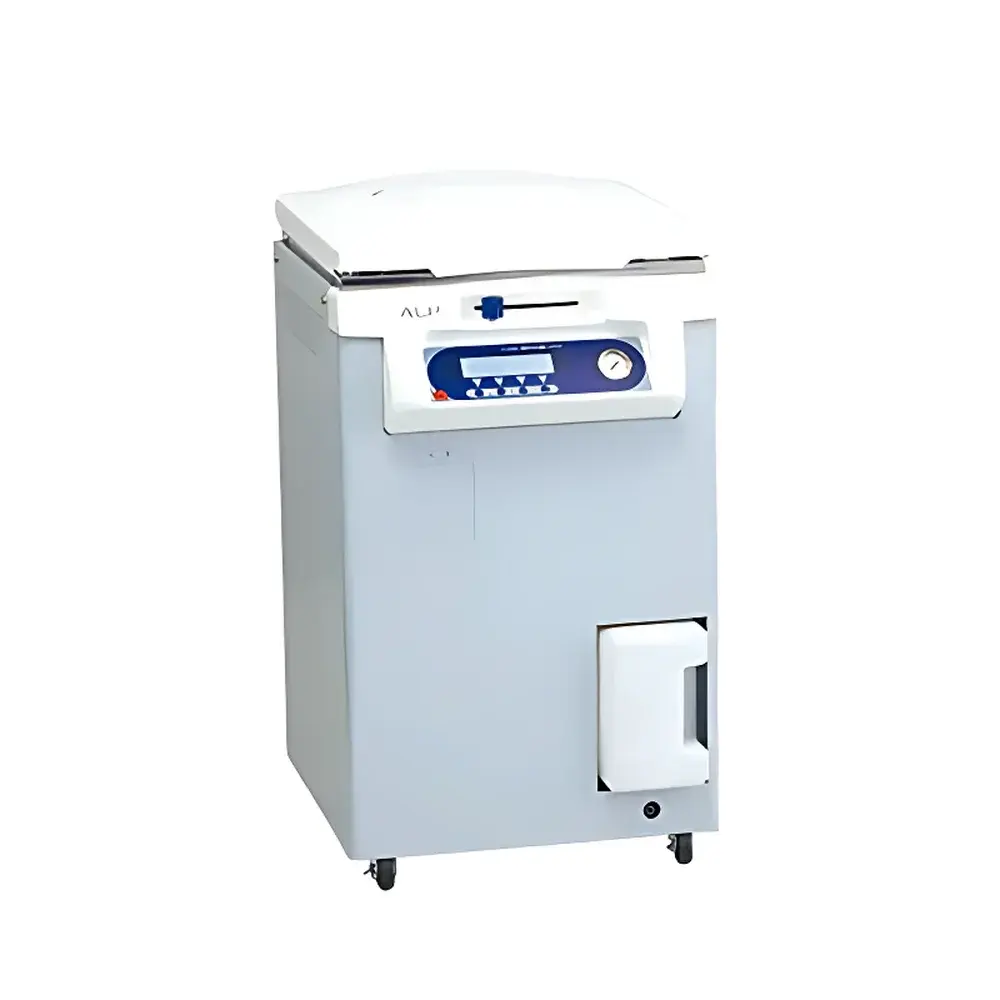
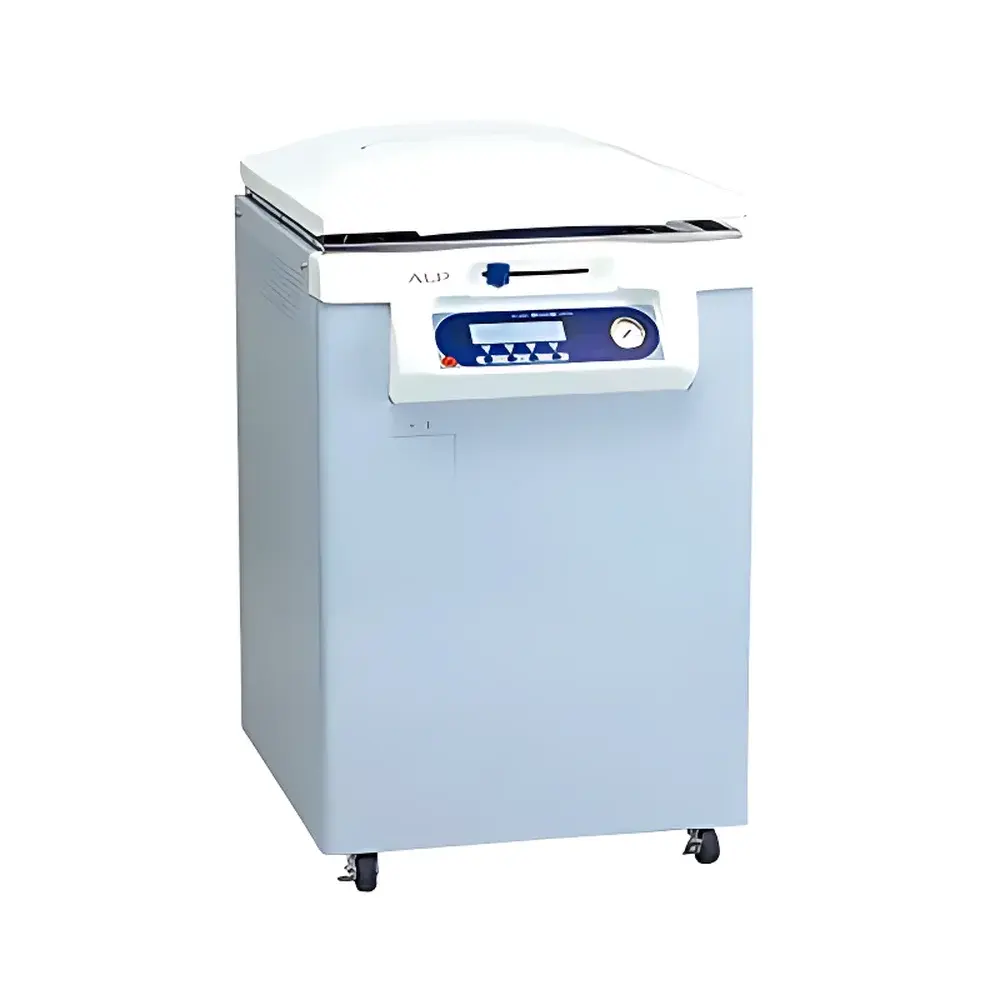
ALP CLG-32L & CLG-40M Pre-Vacuum Steam Sterilizers
| Brand | ALP |
|---|---|
| Origin | Japan |
| Model | CLG-32L / CLG-40M |
| Chamber Dimensions (Ø × Depth) | 320 × 676 mm (32L) / 400 × 672 mm (40M) |
| Chamber Volume | 54 L / 85 L |
| Sterilization Temp Range | 100–140 °C (CLG-32L), 100–137 °C (CLG-40M) |
| Dissolution/Heating Temp Range | 40–99 °C / 40–60 °C |
| Max Operating Pressure | 0.270 MPa / 0.250 MPa |
| Cycle Time | Sterilization/Dissolution: 0–10 h |
| Holding | 0–48 h |
| Programmable Cycles | 10 stored protocols with mode & data logging |
| Vacuum System | Triple-pulse pre-vacuum with high-capacity vacuum pump |
| Air Filtration | 0.2 µm hydrophobic filter for heated air drying |
| Drying Method | Vacuum-assisted hot-air drying post-sterilization |
| Safety Certification | PED 97/23/EC compliant |
| Construction | Inner chamber – SUS304 stainless steel |
| Power Supply | AC 220–240 V, 1-phase, 50/60 Hz |
| Rated Current | 12 A |
| Heating Power | 2.6 / 2.8 / 2.9 kW (model-dependent) |
| Dimensions (W×D×H) | 550 × 550 × 950 mm (CLG-32L) / 620 × 650 × 990 mm (CLG-40M) |
| Weight | 65 kg / 83 kg |
| Control Interface | Backlit LCD display with real-time monitoring of temperature, pressure, phase status, and elapsed time |
| Door Mechanism | Central lever lock with automatic interlock, motor-assisted hinge, and power-dependent electronic safety lock |
| Cooling | Active rapid cooling to <80 °C post-cycle |
| Drainage | Front-mounted manual drain valve and accessible front-positioned waste tank |
| Optional | Integrated product temperature probe port (probe sold separately) |
| Compliance | Meets IEC 61000-6-3 (EMC) and IEC 61000-6-4 (emission) standards |
Overview
The ALP CLG-32L and CLG-40M are pre-vacuum steam sterilizers engineered for laboratories requiring high-reliability, repeatable terminal sterilization of heat-stable instruments, glassware, media, and porous loads. Based on saturated steam under controlled pressure and temperature—governed by the fundamental principle that microbial inactivation follows first-order kinetics dependent on both time and temperature—these units implement a validated triple-pulse vacuum cycle to evacuate ambient air prior to steam introduction. This ensures uniform saturation and penetration into complex geometries and absorbent materials, eliminating cold spots and fulfilling critical requirements for sterility assurance levels (SAL) of 10⁻⁶ as defined in ISO 17665-1. Designed and manufactured in Japan, each unit complies with the Pressure Equipment Directive (PED) 97/23/EC for Class II pressure vessels and conforms to electromagnetic compatibility (IEC 61000-6-3/-4) and acoustic emission standards (ISO 7197), making them suitable for installation in regulated GMP, GLP, and clinical research environments.
Key Features
- Triple-pulse pre-vacuum system with high-efficiency vacuum pump ensures complete air removal—critical for achieving true saturated steam conditions and consistent lethality across heterogeneous loads.
- Vacuum-assisted hot-air drying using HEPA-grade 0.2 µm filtered air reduces post-sterilization handling time and prevents recontamination during cooldown.
- Motor-assisted auto-hinge door mechanism and central lever locking system provide ergonomic operation while enforcing mechanical and electrical interlocks aligned with EN 61010-1 safety requirements.
- Real-time LCD interface displays chamber temperature, absolute pressure, cycle phase, elapsed time, and fault diagnostics—enabling immediate verification of process integrity.
- Rapid active cooling subsystem reduces chamber temperature to <80 °C within minutes after cycle completion, improving throughput without compromising safety.
- Front-accessible waste collection tank and manually operated drain valve simplify maintenance and reduce service downtime.
- Configurable programmable logic controller supports up to 10 user-defined cycles—including sterilization, dissolution, holding, and drying—with timestamped execution logs.
- Standardized probe port accommodates optional calibrated product temperature sensors (e.g., Class A Pt100), enabling direct validation of thermal penetration in biological or media loads per ISO 11140 and USP <1211>.
Sample Compatibility & Compliance
The CLG series accommodates a broad spectrum of laboratory payloads: wrapped surgical kits, unwrapped metal instruments, liquid culture media (including agar-based formulations), porous textiles, and autoclavable plastics rated for repeated steam exposure. Its pre-vacuum architecture is particularly effective for sterilizing lumened devices and densely packed trays where residual air pockets would otherwise impede steam contact. All models are constructed from medical-grade SUS304 stainless steel for inner chamber surfaces, ensuring corrosion resistance against repeated condensate exposure and facilitating compliance with cleaning validation protocols. Regulatory alignment includes PED 97/23/EC certification for pressure containment, electromagnetic emissions compliance per IEC 61000-6-4, and immunity testing per IEC 61000-6-2. While not inherently 21 CFR Part 11 compliant out-of-the-box, audit-ready data logging (with optional external USB or Ethernet modules) supports integration into FDA-regulated workflows when paired with validated software platforms.
Software & Data Management
Cycle parameters—including setpoints, ramp rates, dwell durations, vacuum depth, and exhaust profiles—are stored in non-volatile memory and assigned unique identifiers for traceability. Each executed run generates a timestamped log containing real-time temperature/pressure curves, phase transitions, and operator-initiated interventions. Data export is supported via USB interface (CSV format), enabling import into LIMS or statistical process control (SPC) systems. For facilities requiring electronic signature and audit trail functionality, ALP’s optional SteriLink™ software module provides role-based access control, change history tracking, and PDF report generation aligned with ALCOA+ principles. All firmware updates are delivered through secure, version-controlled channels and require dual-authentication before installation.
Applications
These sterilizers serve core functions across academic, pharmaceutical, biotech, and clinical microbiology settings. In cell culture labs, they enable reliable preparation of sterile growth media and glassware without thermal degradation. In quality control laboratories, they support routine sterilization of sampling tools, dilution blanks, and environmental monitoring swabs under ISO 14644-1 classified environments. Their precise dissolution capability (40–99 °C) allows standardized melting of solidified agar plates or enzymatic reagents, while extended holding modes (up to 48 h at 40–60 °C) maintain temperature-sensitive media in ready-to-use condition. The CLG-40M variant—optimized for higher throughput—is frequently deployed in central sterilization services (CSSD) supporting multi-user research cores or small-scale GMP manufacturing suites.
FAQ
What is the difference between gravity displacement and pre-vacuum sterilization cycles?
Pre-vacuum cycles (like those used in the CLG series) actively remove air from the chamber before steam injection, ensuring deeper penetration into porous or hollow items—whereas gravity displacement relies on steam density to displace air passively, limiting efficacy for complex loads.
Can these units be validated for use in GMP environments?
Yes—when equipped with optional temperature probes and connected to compliant data acquisition systems, IQ/OQ/PQ protocols can be executed per ISO 13485 and EU Annex 1 requirements.
Is the drying function suitable for moisture-sensitive instruments?
The 0.2 µm filtered hot-air drying minimizes oxidation risk and avoids water spotting, making it appropriate for precision optics, stainless steel components, and polymer-based disposables.
Does the unit support remote monitoring or network integration?
Via optional Ethernet or RS-485 interfaces, real-time status and historical logs can be integrated into building management systems (BMS) or centralized lab infrastructure dashboards.
What maintenance intervals are recommended for the vacuum pump and filters?
ALP recommends quarterly inspection of the vacuum pump oil level and annual replacement of the 0.2 µm hydrophobic air filter, with log entries traceable via the onboard event history.



