
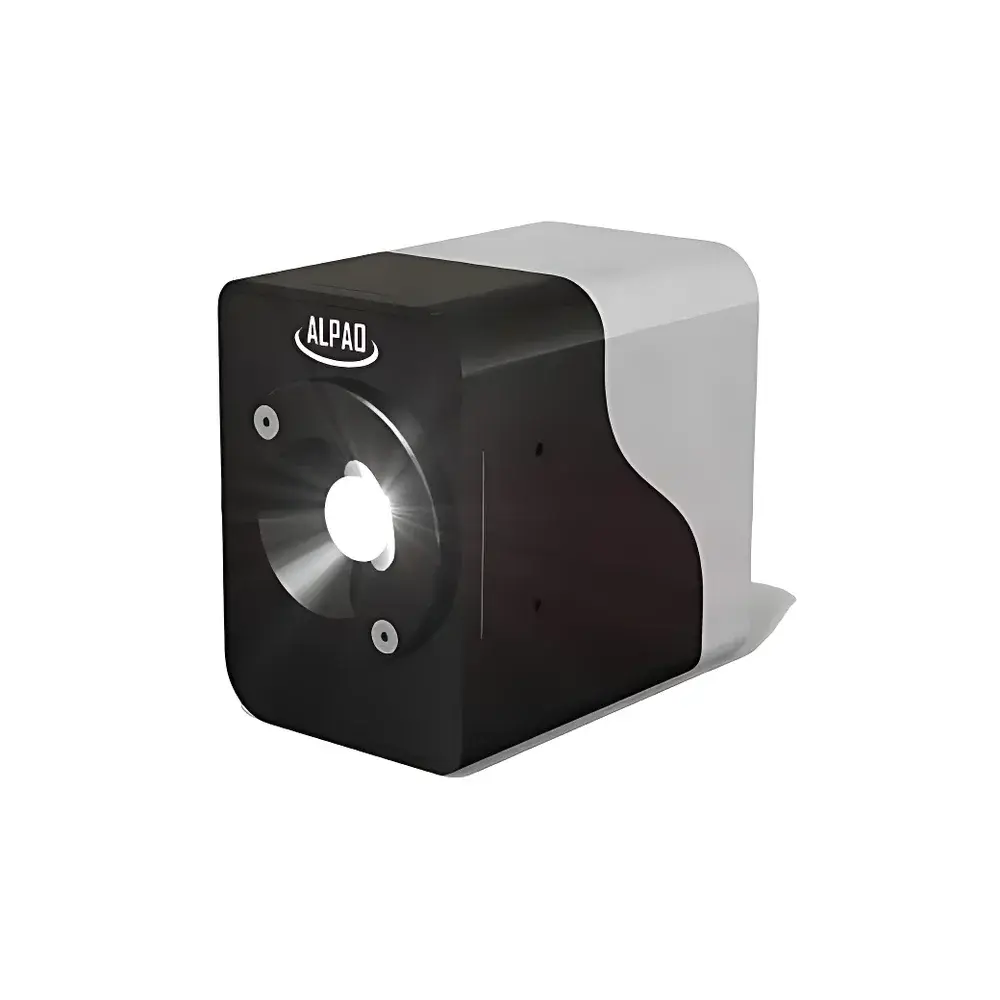
Alpao DM Series MEMS Continuous Surface Deformable Mirror
| Brand | Alpao |
|---|---|
| Origin | France |
| Model | DM Series |
| Actuator Count | 69–820 |
| Pupil Diameter | 7.2–45.0 mm |
| Max Wavefront Stroke (PtV) | 80–120 µm |
| Settling Time | 500–1600 µs |
| Bandwidth (−3 dB) | 400–2000 Hz |
| Hysteresis Error | <2% |
| Nonlinearity Error | <3% |
| Coating | Protected Silver (R > 96.5% @ 0.5–2.0 µm) |
| Operating Temperature | −10 to 35 °C |
| Drive Voltage | ±1 V |
| Power Consumption | <10 W |
Overview
The Alpao DM Series MEMS Continuous Surface Deformable Mirror is a high-performance adaptive optics component engineered for precision wavefront correction in demanding optical systems. Based on monolithic micro-electro-mechanical systems (MEMS) technology, it features an optically continuous, reflective silicon membrane actuated by an array of electromagnetic drivers embedded beneath the surface. Unlike segmented or piezoelectric-based mirrors, the Alpao DM delivers true analog deformation with no print-through artifacts, enabling diffraction-limited correction of both low-order aberrations (e.g., tip/tilt, defocus, astigmatism) and high-order spatial modes (e.g., coma, spherical, trefoil). Its design adheres to fundamental principles of closed-loop adaptive optics: high actuator density, sub-millisecond temporal response, exceptional linearity, and long-term thermal and mechanical stability — making it suitable for real-time compensation in laser beam shaping, ophthalmic imaging, astronomical AO systems, and ultrafast laser pulse compression.
Key Features
- Electromagnetic actuation architecture ensuring >97% linearity and <±1% long-term stroke stability over extended operation
- Continuous, monolithic mirror surface with RMS surface flatness ≤7.0 nm in closed-loop configuration (no actuator-induced print-through)
- Configurable actuator counts from 69 to 820, supporting pupil diameters ranging from 7.2 mm to 45.0 mm
- High dynamic range: up to 80 µm peak-to-valley (PtV) wavefront modulation standard; extended stroke options up to 120 µm available upon request
- Fast temporal response: minimum settling time as low as 500 µs (±10%) and closed-loop bandwidth exceeding 2 kHz for the DM241 and DM820 models
- Low-voltage drive electronics (±1 V) with average power consumption <10 W, minimizing thermal load and simplifying integration into compact optical benches
- Protected silver coating optimized for broadband reflectivity (>96.5% across 0.5–2.0 µm), compatible with visible, NIR, and SWIR applications
- Robust mechanical packaging with standardized kinematic mounting interfaces (e.g., SM1, SM2, or custom flanges) for rapid alignment and vacuum-compatible variants
Sample Compatibility & Compliance
The Alpao DM Series is designed for integration into Class 1 and Class 3B laser systems compliant with IEC 60825-1:2014 and ANSI Z136.1-2022 safety standards. Its continuous surface geometry ensures minimal scattering and preserves M² beam quality during active correction. All models meet RoHS Directive 2011/65/EU and REACH Regulation (EC) No. 1907/2006 requirements. For regulated environments (e.g., medical device R&D or aerospace test facilities), documentation packages include traceable calibration certificates, material declarations, and environmental stress screening reports. While not FDA-cleared as a standalone medical device, the DM mirrors are routinely deployed in ISO 13485-certified ophthalmic research platforms and GLP-compliant optical metrology setups.
Software & Data Management
Alpao provides the full-featured Alpao Control Software Suite, a Windows-based application supporting real-time wavefront control via USB 3.0 or Ethernet interfaces. The suite includes pre-calibrated influence function matrices, modal decomposition tools (Zernike, Karhunen–Loève), and closed-loop feedback integration with Shack–Hartmann or pyramid wavefront sensors. APIs (C/C++, Python, MATLAB) enable seamless embedding into custom control architectures. Audit trails, parameter versioning, and timestamped waveform logging comply with data integrity requirements under 21 CFR Part 11 when used with validated system configurations. Firmware updates are digitally signed and delivered via secure HTTPS channels.
Applications
- Astronomical adaptive optics: Real-time atmospheric turbulence correction in ground-based telescopes (e.g., post-focal wavefront control in LGS-AO systems)
- Ophthalmic imaging: High-resolution retinal scanning using confocal SLO and AO-OCT, where precise correction of ocular aberrations enables cellular-level visualization
- Laser material processing: Dynamic beam homogenization and focus stabilization in ultrashort-pulse machining and EUV lithography illumination systems
- Free-space optical communications: Mitigation of phase distortions induced by atmospheric turbulence in terrestrial and satellite downlinks
- Quantum optics experiments: Active mode matching between single-photon sources and fiber-coupled detectors or cavity resonators
- Beam shaping for ultrafast lasers: Pulse front tilt correction and spatiotemporal coupling management in CPA and OPCPA architectures
FAQ
What is the difference between “open-loop” and “closed-loop” stroke specifications?
Open-loop stroke refers to maximum displacement achievable without feedback correction; closed-loop values account for sensor noise, control latency, and residual error — typically 10–15% lower but more representative of actual system performance.
Can the DM be operated in vacuum?
Yes — vacuum-compatible versions (with modified bonding materials and outgassing-tested coatings) are available; contact Alpao technical support for chamber pressure ratings and bake-out protocols.
Is custom influence function calibration included?
Each unit ships with factory-measured influence functions and Zernike mode coefficients; site-specific recalibration services are offered under NDA for mission-critical deployments.
How is thermal drift managed during extended operation?
The mirror substrate uses low-thermal-expansion silicon, and the control electronics incorporate temperature-compensated drive amplifiers; typical drift is <0.5 nm RMS/hour at stable ambient conditions.
Are there restrictions on incident beam angle or polarization?
Normal incidence is recommended; operation at up to ±5° is supported with minor reflectivity loss. The protected silver coating maintains consistent performance across s- and p-polarizations within the specified wavelength band.





