
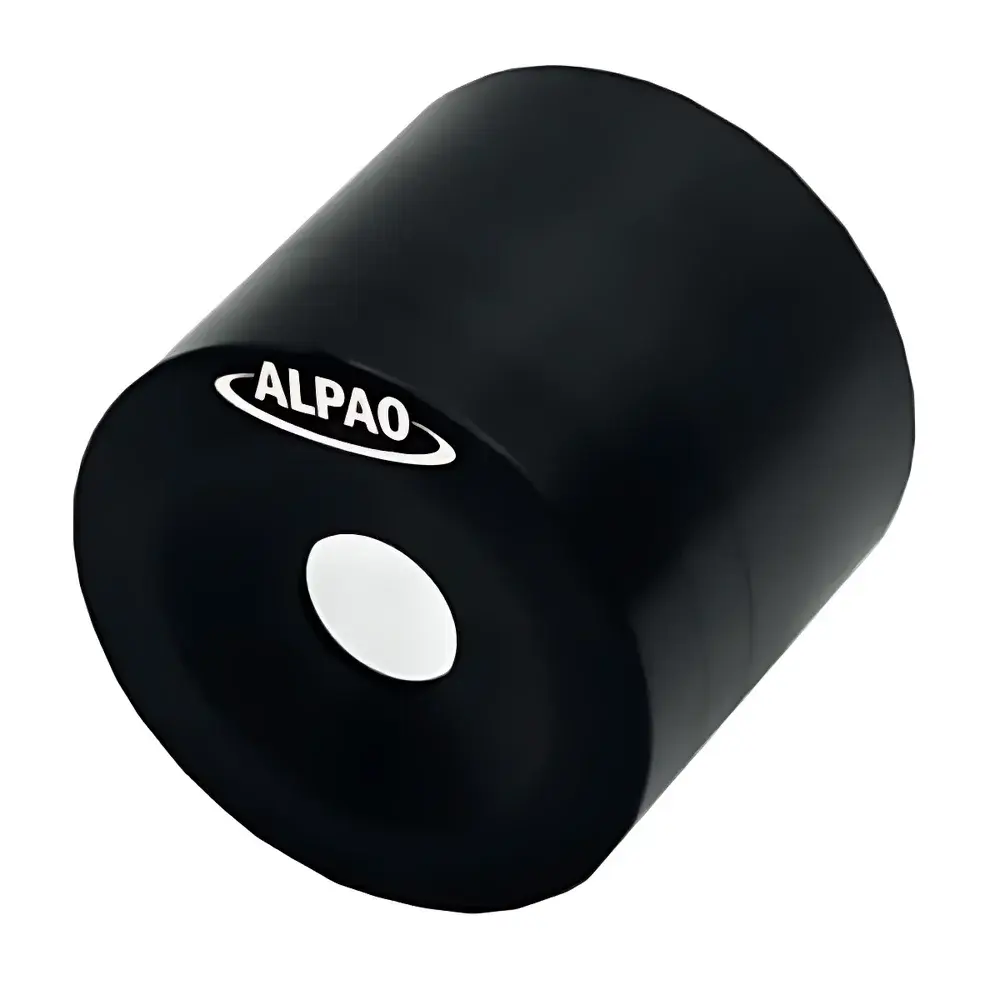
Alpao DMM Series Deformable Modal Mirror
| Brand | Alpao |
|---|---|
| Origin | France |
| Model | DMM Series |
| Surface Roughness (RMS) | <15 Å |
| Max. Stroke per Mode | ±100 µm |
| Coating | Protected Silver |
| LIDT (1064 nm, 12 ns, 10 Hz) | 880 mJ/cm² |
| LIDT (CW, 1064 nm) | 50 W |
| Control Interface | Ethernet (Web-based API) / USB (via dongle) |
| Zernike Mode Support | Yes |
| Enclosure | Standard Cylindrical Mount |
Overview
The Alpao DMM Series Deformable Modal Mirror is a high-precision adaptive optics component engineered for deterministic correction of low- to mid-order optical aberrations in real time. Unlike continuous-surface deformable mirrors (DMs), the DMM operates on a modal basis—each actuator independently controls a single orthogonal optical mode (e.g., defocus, astigmatism, coma, or tilt), enabling intuitive, decoupled wavefront shaping without complex inverse matrix calibration. This architecture eliminates cross-talk between modes and significantly simplifies control logic—making it especially suitable for OEM integration into spectroscopic systems, laser beam conditioning platforms, confocal microscopes, and astronomical instrumentation where robustness, repeatability, and deterministic response are critical. Designed and manufactured in Grenoble, France, the DMM leverages Alpao’s proprietary piezoelectric actuation technology and monolithic mirror substrate fabrication to deliver stable, hysteresis-free performance under both static and dynamic correction regimes.
Key Features
- Modal Actuation Architecture: One-to-one correspondence between control voltage and Zernike mode; no need for wavefront sensor feedback loop during open-loop operation—ideal for pre-compensation or fixed-aberration correction scenarios.
- High Stroke Capacity: ±100 µm peak-to-valley deformation per mode enables correction of large-amplitude aberrations commonly encountered in misaligned optical trains or thermally distorted cavities.
- Ultra-Low Surface Roughness: Mirror surface RMS roughness <15 Å ensures minimal scatter-induced signal loss—critical for high-dynamic-range spectroscopy and quantum optics applications.
- Protected Silver Coating: Broadband reflectivity (>97% from 400–2000 nm) combined with environmental durability and high laser damage threshold (880 mJ/cm² at 1064 nm, 12 ns; 50 W CW).
- No Cover Glass Design: Eliminates parasitic reflections, chromatic dispersion, and additional wavefront error introduced by protective substrates—preserving phase fidelity across spectral bands.
- Compact, Cylindrical Housing: Industry-standard mechanical interface (M30×0.5 or custom flange options) facilitates drop-in replacement in existing optical benches and modular instrument designs.
Sample Compatibility & Compliance
The DMM Series is compatible with collimated or slightly convergent beams up to Ø25 mm aperture (standard variants); custom apertures available upon request. Its modal response is characterized at λ = 633 nm per ISO 10110-5, and wavefront correction fidelity is validated using interferometric metrology traceable to NIST standards. The device complies with CE marking requirements for electromagnetic compatibility (EN 61326-1) and safety (EN 61010-1). For regulated environments—including clinical spectroscopy, pharmaceutical process analytical technology (PAT), or GLP/GMP-compliant R&D—the DMM supports audit-ready operation via its web-based API with full command logging, timestamped actuator state history, and optional integration with FDA 21 CFR Part 11–compliant electronic record systems through third-party middleware.
Software & Data Management
Control is implemented via a lightweight, embedded web server accessible through any modern browser—no proprietary software installation required. The system exposes a RESTful Web API supporting JSON-over-HTTP requests for mode amplitude setting, status polling, and firmware updates. Full documentation—including Python, MATLAB, and LabVIEW code examples—is provided under NDA. All commands and responses are timestamped and logged locally on-device (microSD slot optional), enabling reproducible experiment tracking and post-hoc wavefront reconstruction. For high-throughput applications, the Ethernet interface supports UDP streaming of actuator state vectors at up to 1 kHz, synchronized with external trigger signals (TTL input/output pins available on rear panel).
Applications
- Real-time compensation of thermal lensing in high-power laser spectroscopy setups
- Aberration pre-correction in multi-modal imaging systems (e.g., STED + Raman co-registration)
- Beam shaping for ultrafast pulse compression and spatial light modulation
- Wavefront engineering in cavity-enhanced absorption spectrometers (CEAS) and off-axis integrated cavity output spectroscopy (OA-ICOS)
- OEM integration into portable FTIR, LIBS, and hyperspectral sensors requiring size-, weight-, and power-constrained AO solutions
- Alignment stabilization in fiber-coupled Raman probe heads and free-space quantum communication terminals
FAQ
What Zernike modes does the DMM support?
The standard DMM configuration supports up to 15 Zernike modes (Z2–Z16), including tilt, defocus, astigmatism, coma, trefoil, and spherical aberration. Custom mode sets can be defined upon request.
Is closed-loop operation possible?
Yes—when paired with a compatible wavefront sensor (e.g., Shack-Hartmann or pyramid type) and Alpao’s optional real-time controller, the DMM supports full closed-loop adaptive optics with sub-10 ms latency.
Can the DMM be used in vacuum environments?
Standard units are rated for ambient operation only; vacuum-compatible versions with outgassing-certified materials and feedthrough connectors are available as part of Alpao’s OEM customization program.
How is calibration performed?
Each unit ships with factory-measured mode shape matrices and stroke linearity data. In-situ calibration is optional and typically performed using a reference interferometer or Hartmann sensor—Alpao provides detailed SOPs and MATLAB toolboxes for this purpose.
What is the typical lifetime under continuous operation?
Based on accelerated life testing at 25°C and 70% relative humidity, mean time to failure (MTTF) exceeds 20,000 hours for static operation and >10⁷ cycles for dynamic mode switching at 100 Hz.



