
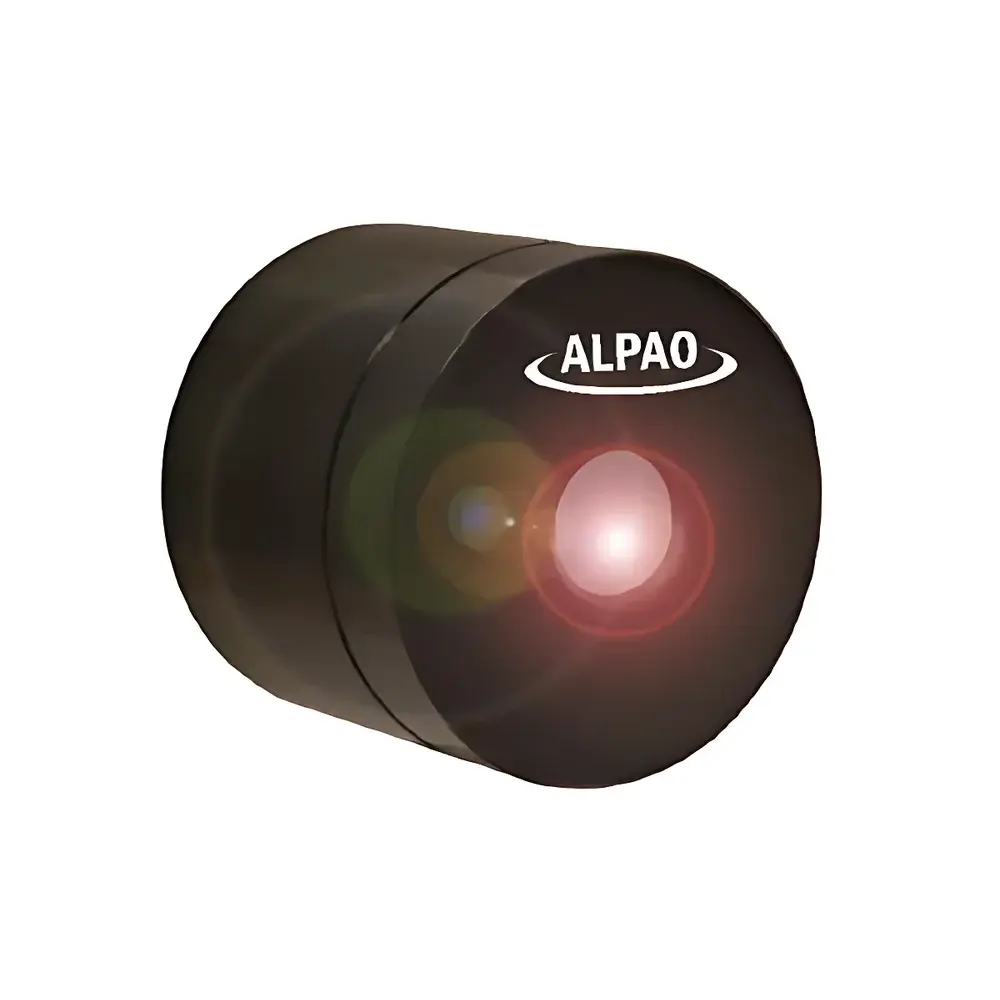
Alpao DMM7/DMM8 OEM Deformable Mirror (Mode-Controlled, Electromagnetic Actuation)
| Brand | Alpao |
|---|---|
| Origin | France |
| Type | OEM Deformable Mirror |
| Diameter | 50 mm |
| Max. Piston Stroke | 100 µm (P-V) |
| Fitting Error | ≤2% RMS |
| Actuation Principle | Electromagnetic |
| Control Mode | Zernike Mode-Based Open-Loop or Closed-Loop |
| Compatibility | Windows/Linux/macOS, C/C++/Python/MATLAB APIs |
| Power Supply | Low-Voltage DC (<24 V), Low Power Consumption |
| Sensor Integration | Compatible with Shack-Hartmann and Pyramid Wavefront Sensors |
Overview
The Alpao DMM7 and DMM8 are compact, high-performance, mode-controlled deformable mirrors (DMMs) engineered for integration into adaptive optics (AO) systems across demanding scientific and industrial applications. Designed and manufactured in Grenoble, France, these OEM-grade devices employ a monolithic silicon continuous-face membrane actuated by an array of electromagnetic actuators—eliminating hysteresis, minimizing creep, and enabling precise, repeatable wavefront modulation. Unlike voltage-driven piezoelectric or electrostatic mirrors, the Alpao DMM architecture delivers intrinsic linearity (>99.5% correlation between commanded Zernike mode amplitude and actual surface displacement) and high dynamic fidelity, with closed-loop bandwidths exceeding 1 kHz depending on control configuration and sensor latency. The core optical surface—50 mm clear aperture, λ/20 surface figure (as-built)—is optimized for visible to near-infrared wavelengths (400–1100 nm), supporting diffraction-limited correction in astronomical observatories, high-resolution retinal imaging, ultrafast multiphoton microscopy, and beam shaping in next-generation EUV lithography tools.
Key Features
- Compact OEM form factor: 50 mm outer diameter, <25 mm total height, designed for seamless integration into space-constrained optical benches and embedded instrumentation.
- Large stroke capability: ±50 µm per actuator, enabling up to 100 µm peak-to-valley (P-V) piston displacement—sufficient for correcting strong low- and mid-order aberrations (e.g., defocus, astigmatism, coma) induced by atmospheric turbulence or optical misalignment.
- Mode-based control architecture: Native support for Zernike polynomial decomposition; users command orthogonal modes directly (e.g., Z₂⁰ for focus, Z₃⁻¹ for vertical coma), simplifying calibration and improving repeatability versus pixel-based addressing.
- Low-power electromagnetic actuation: Operates from standard low-voltage DC supplies (<24 V), consuming <3 W at full static stroke—ideal for portable, air-cooled, or power-sensitive platforms including airborne AO systems and clinical ophthalmic devices.
- High-fidelity surface reproduction: Typical fitting error <2% RMS relative to target Zernike shape across full stroke range; verified via interferometric characterization traceable to ISO 10110-5 standards.
- Driver-free software operation: Native USB 3.0 interface with cross-platform SDK (C, Python, MATLAB, LabVIEW); no proprietary hardware drivers required—enables rapid deployment in automated test environments and GxP-compliant workflows.
Sample Compatibility & Compliance
The DMM7 (7×7 actuator array, 49 channels) and DMM8 (8×8 actuator array, 64 channels) are compatible with standard AO system components—including Shack-Hartmann wavefront sensors (e.g., Imagine Optic HASO, Boston Micromachines XC12), pyramid sensors (e.g., PYR-100), and EMCCD or sCMOS detectors operating at ≥1 kHz frame rates. Each unit undergoes factory calibration with NIST-traceable interferometry and ships with full Zernike mode coupling matrix and influence function maps. The design conforms to CE marking requirements (EMC Directive 2014/30/EU, RoHS 2011/65/EU) and supports audit-ready documentation packages for GLP and ISO/IEC 17025-accredited laboratories. While not FDA-cleared as a medical device, the DMM series is widely deployed in Class IIa-certified ophthalmic imaging systems under manufacturer-led risk management per ISO 14971.
Software & Data Management
Alpao provides the open-source AlpaoSDK, a header-only C library with language bindings for Python (via ctypes), MATLAB (MEX), and LabVIEW (DLL import). All control functions—including mode loading, gain scaling, real-time feedback loop closure (with external sensor input), and nonlinearity compensation—are accessible programmatically. Configuration files are stored in human-readable JSON format, enabling version control, reproducible experiment scripting, and integration with CI/CD pipelines. Time-stamped wavefront correction logs (including commanded Zernike coefficients, measured residual error, and system temperature) can be exported in HDF5 or CSV for post-processing in Python (SciPy, NumPy) or MATLAB. The SDK supports deterministic timing via OS-level thread prioritization and is validated for use in real-time Linux (PREEMPT_RT) and Windows Subsystem for Linux 2 (WSL2) environments.
Applications
- Astronomy: Real-time atmospheric turbulence correction in 1–4 m class telescopes; used in laser guide star AO systems and exoplanet direct imaging instruments (e.g., VLT/SPHERE upgrades).
- Ophthalmology: High-speed aberration correction in confocal scanning laser ophthalmoscopy (cSLO) and adaptive optics–optical coherence tomography (AO-OCT), enabling cellular-resolution imaging of photoreceptor mosaics.
- Microscopy: Aberration compensation in two-photon and three-photon fluorescence microscopy, especially for deep-tissue imaging through scattering media (e.g., brain slices, tumor xenografts).
- Semiconductor metrology: Beam wavefront stabilization in EUV mask inspection tools and high-NA projection optics alignment systems, where sub-nanometer wavefront stability is critical.
- Free-space optical communications: Mitigation of scintillation and beam wander in ground-to-satellite and inter-satellite links operating at 1550 nm.
FAQ
What is the difference between DMM7 and DMM8?
The DMM7 features a 7×7 actuator array (49 independent channels), optimized for cost-sensitive, mid-complexity AO systems requiring correction of up to 20–25 Zernike modes. The DMM8 offers an 8×8 array (64 channels), providing higher spatial resolution for applications demanding finer control over mid-spatial-frequency aberrations—such as high-NA microscope objective correction or extreme AO in large telescopes.
Can the DMM operate in closed-loop without Alpao’s proprietary wavefront sensor?
Yes. The DMM accepts external wavefront error signals via analog input or digital API callback; it is fully interoperable with third-party sensors (e.g., IRIS AO, Imagine Optic, Flexible Optical) provided latency and sampling rate constraints are met.
Is firmware update supported in the field?
Yes. Firmware updates are delivered via the AlpaoSDK and applied over USB without hardware modification; version history and MD5 checksums are provided for validation in regulated environments.
What thermal management is required during continuous operation?
No active cooling is required. The DMM operates stably at ambient temperatures from 15 °C to 35 °C; internal temperature rise remains <3 °C above ambient at full static stroke due to low-power electromagnetic actuation.
Do you provide Zernike mode calibration data for each unit?
Yes. Each shipped DMM includes a serialized calibration report containing full influence function matrix, cross-coupling coefficients, and residual fitting error statistics—traceable to interferometric measurements performed in Alpao’s ISO 17025-accredited metrology lab.



