
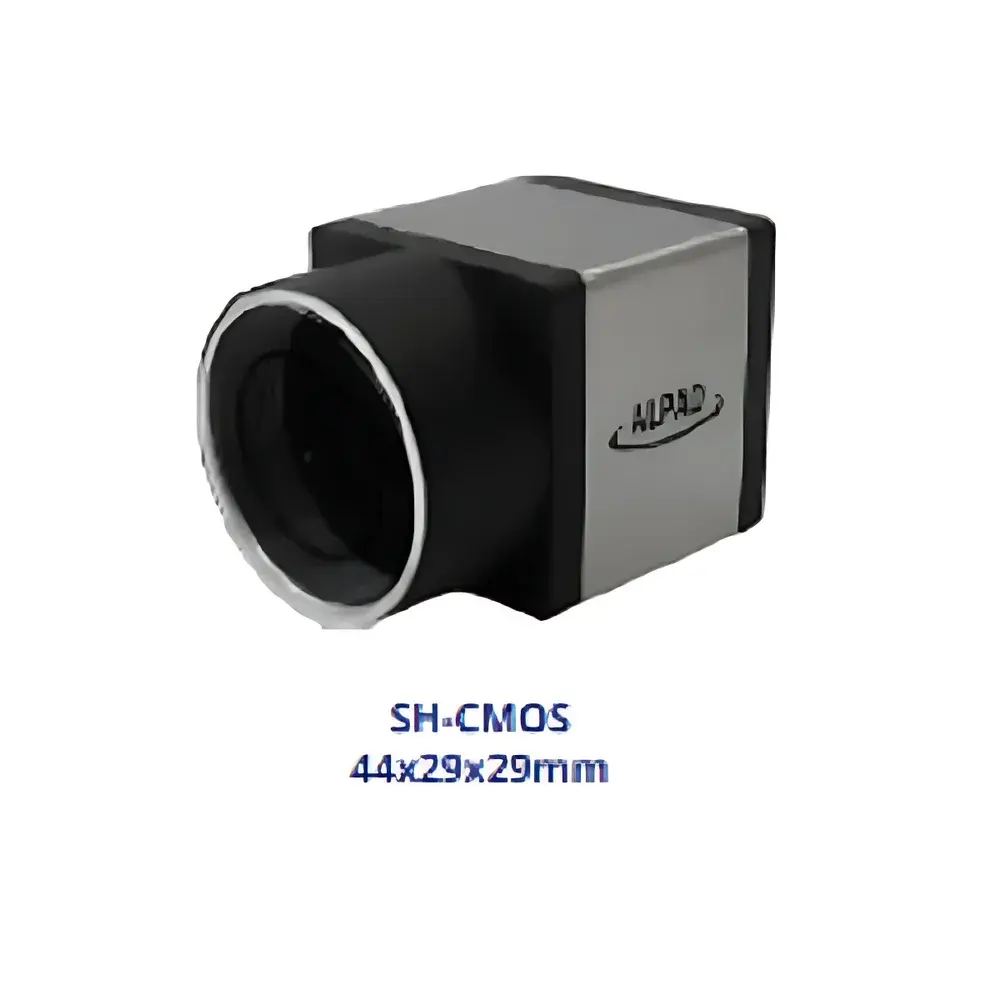
Alpao SH-CMOS High-Speed Adaptive Optics System
| Brand | Alpao |
|---|---|
| Origin | France |
| Model | SH-CMOS |
| Spectral Range | 350–1700 nm |
| Subaperture Count | 50 × 50 |
| Microlens Pitch | 96.6 µm |
| Pupil Diameter | 4.83 µm |
| Sampling Frequency | 477 Hz (standard), up to 28.14 kHz (SH-CMOS Fast) |
| Readout Latency | 5000 µs (standard), down to 10.7 µs (SH-CMOS Fast) |
| Tilt & Defocus Range (PV) | ±96 µm / ±242 µm |
| Repeatability | <152 nm RMS |
| Compliance | Fully compatible with Alpao deformable mirrors and real-time control software |
Overview
The Alpao SH-CMOS High-Speed Adaptive Optics System is a precision-engineered wavefront sensing and correction platform designed for demanding closed-loop adaptive optics (AO) applications. Based on the Shack-Hartmann (SH) principle, it measures optical wavefront distortions by analyzing the centroid displacement of focused spot arrays generated across a microlens array. Coupled with Alpao’s electromagnetic deformable mirrors (DMs) and real-time control infrastructure, this system delivers deterministic, low-latency wavefront correction essential for dynamic optical environments — including atmospheric turbulence compensation in ground-based astronomy, high-resolution retinal imaging, free-space optical communication, and ultrafast laser beam shaping. Its architecture supports full integration into time-critical experimental workflows where sub-millisecond latency, nanometer-level repeatability, and broad spectral coverage (350–1700 nm) are non-negotiable requirements.
Key Features
- Optimized SH wavefront sensor design with configurable sensitivity, frame rate, and spectral response — enabling application-specific tuning without hardware modification.
- Real-time sampling up to 28.14 kHz (SH-CMOS Fast variant), with readout latency as low as 10.7 µs — critical for correcting rapidly evolving phase aberrations such as those induced by atmospheric turbulence or thermal lensing.
- High photon efficiency: operational at signal-to-noise ratio (SNR) = 1 with as few as 3 photons per subaperture — ensuring robust performance under low-light conditions typical in astronomical or biological imaging.
- Subaperture resolution up to 64 × 64 (SH-CMOS Fast), supporting high-order Zernike mode reconstruction and precise spatial sampling of complex wavefront topographies.
- Native compatibility with Alpao’s full portfolio of electromagnetic DMs (e.g., DM69, DM97, DM192), including seamless calibration, actuator mapping, and closed-loop control via standardized SDK interfaces.
- Vacuum-compatible mechanical design and optional cryogenic cooling packages (for EMCCD and InGaAs variants) ensure stable operation in controlled laboratory and space-qualified environments.
Sample Compatibility & Compliance
The SH-CMOS system accommodates diverse optical configurations through its modular optical interface and programmable region-of-interest (ROI) selection. It supports both visible and near-infrared wavelengths (350–1700 nm), making it suitable for applications ranging from ophthalmic wavefront sensing (550 nm) to quantum optics experiments using telecom-band lasers (1550 nm). All variants comply with ISO 10110-7 (surface irregularity specifications) and meet the mechanical and thermal stability criteria required for GLP-aligned optical metrology. When integrated with Alpao’s real-time computer (RTC), the full AO loop satisfies deterministic timing constraints defined in IEEE 1588-2019 (Precision Time Protocol) for synchronized multi-device systems. The absence of protective windows and RMS surface roughness <15 Å on DM substrates ensure minimal wavefront degradation — critical for diffraction-limited performance in high-numerical-aperture systems.
Software & Data Management
Alpao provides a comprehensive, cross-platform software development kit (SDK) supporting LabVIEW, MATLAB, Python, and C/C++. The SDK includes low-level drivers for camera acquisition, DM actuation, and wavefront reconstruction algorithms (e.g., center-of-gravity, weighted least-squares fitting), along with preconfigured AO loop templates. Real-time data logging supports HDF5 and FITS formats for interoperability with astronomical data reduction pipelines (e.g., IRAF, Astropy). Audit-trail functionality — including timestamped command logs, configuration snapshots, and error-state capture — ensures traceability in regulated environments compliant with FDA 21 CFR Part 11 and ISO/IEC 17025. Firmware updates are delivered via secure signed packages, and the RTC supports deterministic scheduling with jitter <1 µs — enabling reproducible experiment execution across multiple sessions.
Applications
- Astronomy: Real-time compensation of atmospheric turbulence for ground-based telescopes; satellite and space debris tracking under variable seeing conditions.
- Ophthalmology: High-speed ocular wavefront sensing for customized vision correction and retinal imaging with enhanced axial resolution.
- Free-space optical communications: Mitigation of beam wander and scintillation in terrestrial and airborne FSO links operating at 1550 nm.
- Laser material processing: Pre-compensation of thermal lensing and beam distortion in high-power CW and pulsed laser systems (e.g., industrial fiber lasers).
- Quantum optics: Active stabilization of interferometric setups requiring sub-wavelength path-length control over extended durations.
- Microscopy: Dynamic aberration correction in multiphoton and adaptive optics scanning microscopy (AOSM) platforms.
FAQ
What is the minimum detectable wavefront slope?
The SH-CMOS achieves sub-pixel centroid resolution via oversampling and centroid interpolation algorithms, yielding effective slope sensitivity below 0.005 pixels RMS — corresponding to ~5 nm RMS wavefront error for a 10 mm pupil diameter at 633 nm.
Can the SH-CMOS be used with third-party deformable mirrors?
Yes — while full native integration (including automatic actuator mapping and closed-loop calibration) is guaranteed only with Alpao DMs, the SDK exposes raw centroid data and accepts arbitrary actuator command vectors, enabling integration with compatible third-party mirrors via custom control logic.
Is the system compatible with vacuum or cryogenic environments?
The SH-CMOS sensor head is vacuum-compatible (10⁻⁶ mbar); for cryogenic operation, the SH-EMCCD Fast and SH-InGaAs Fast variants include integrated cooling packages rated for operation at –45°C and 20°C respectively.
How is synchronization handled between the wavefront sensor and deformable mirror?
Hardware-triggered acquisition (via Trigger-IN/OUT ports) ensures deterministic alignment of exposure windows with DM actuation cycles; all timing parameters are configurable within the SDK and validated against NIST-traceable oscilloscope measurements.
What documentation and calibration support is provided?
Each unit ships with a factory-generated calibration certificate specifying measured microlens pitch uniformity, centroid linearity error (<0.5%), and spectral responsivity curves — traceable to PTB (Physikalisch-Technische Bundesanstalt) standards.





