
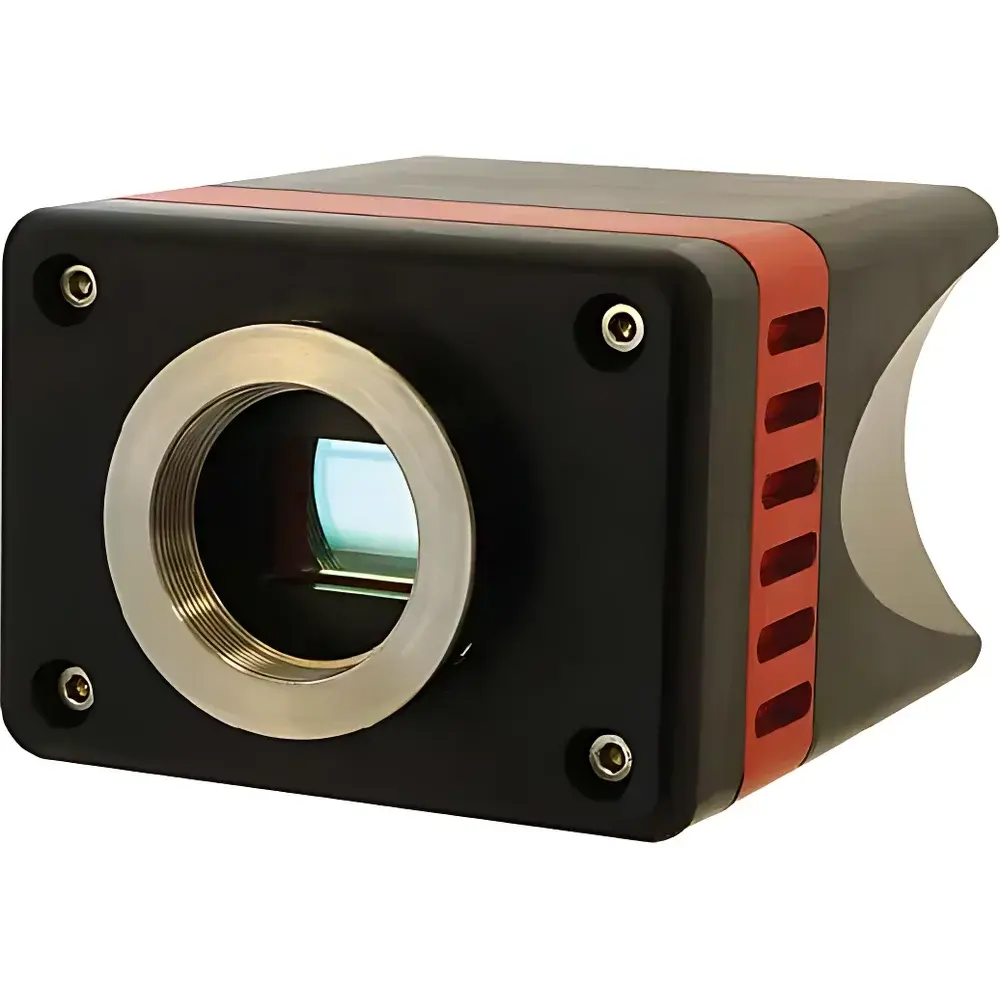
Alpao WFS-SWIR InGaAs Shack-Hartmann Wavefront Sensor
| Brand | Alpao |
|---|---|
| Origin | Beijing, China (Distributed) |
| Model | WFS-SWIR |
| Spectral Range | 0.9–1.7 µm |
| Sensor Type | InGaAs |
| Max Acquisition Frequency | 3 kHz |
| Microlens Array | up to 23×23 |
| Microlens Pitch | 167–264 µm |
| Quantum Efficiency | >90% @ 600 nm, >70% @ 1500 nm |
| Dynamic Range (Tip-Tilt/Focus, PtV) | 10–15 µm |
| Residual WFE Error (Closed-Loop) | 20 nm RMS |
| Absolute Precision | λ/20 RMS |
| Repeatability | 10 nm RMS |
| Typical Read Noise | <150 e⁻ (high gain), <700 e⁻ (low gain) |
| Operating Temperature | 0–30 °C |
| Interface | Camera Link |
| Recommended Deformable Mirror Compatibility | DM69 / DM97 / DM277 / DM468 |
Overview
The Alpao WFS-SWIR is a high-performance Shack-Hartmann wavefront sensor engineered for real-time, high-fidelity measurement of optical wavefront distortions in the short-wave infrared (SWIR) spectral band (0.9–1.7 µm). Based on the well-established Shack-Hartmann principle—where an array of microlenses samples local wavefront slopes across the pupil plane—the WFS-SWIR delivers quantitative phase information with exceptional temporal resolution and low-noise sensitivity. Its core architecture integrates a custom InGaAs focal plane array optimized for quantum efficiency (>70% at 1500 nm, >90% at 600 nm), enabling robust operation under low-flux astronomical or adaptive optics (AO) beacon conditions. Designed explicitly for integration into closed-loop AO systems, the sensor features ultra-low latency firmware and hardware-synchronized triggering to minimize control loop delay—a critical parameter for atmospheric turbulence correction in ground-based telescopes, laser beam control, and free-space optical communication.
Key Features
- SWIR-optimized InGaAs sensor with high quantum efficiency across 0.9–1.7 µm, supporting both natural and laser guide star applications
- Real-time acquisition frequencies up to 3 kHz (WFS-SWIR-69 variant), scalable across four standard configurations (69-, 97-, 277-, and 468-actuator equivalent sampling)
- Microlens arrays ranging from 8×8 to 23×23 elements, with pitch options from 167 µm to 264 µm to match system f-number and pupil sampling requirements
- Sub-10 nm RMS repeatability and λ/20 RMS absolute precision under stable illumination—validated per ISO 10110-5 and ISO 21248 calibration protocols
- Dedicated low-latency firmware with programmable region-of-interest (ROI) readout, enabling frame-rate optimization without sacrificing spatial resolution
- Camera Link interface compliant with Base Configuration (8-bit/10-bit) for deterministic data transfer and synchronization with external timing sources (e.g., DM drivers, laser pulsers)
Sample Compatibility & Compliance
The WFS-SWIR is compatible with collimated or convergent beams having diameters from 5 mm to 50 mm (depending on microlens configuration and relay optics). It supports integration into ISO-standard optical benches and vacuum-compatible enclosures (with optional thermal stabilization housing). All variants comply with CE marking requirements for electromagnetic compatibility (EN 61326-1) and safety (EN 61010-1). Calibration certificates traceable to NIST or PTB standards are provided upon request. The sensor meets key performance criteria referenced in ISO 21248 (wavefront sensing metrology) and supports audit-ready documentation for GLP/GMP-aligned R&D environments where traceability of wavefront error metrics is required.
Software & Data Management
The WFS-SWIR operates with Alpao’s open-architecture WaveSense software suite, which provides native support for Windows and Linux (x86_64) platforms. APIs are available in C/C++, Python (via ctypes bindings), and MATLAB, enabling seamless integration into custom AO control loops. Raw centroid data, reconstructed Zernike coefficients (up to 36th order), and time-stamped wavefront maps are logged in HDF5 format—fully compatible with HDFView, Python h5py, and MATLAB hdf5read(). All software modules support FDA 21 CFR Part 11-compliant electronic signatures and audit trails when deployed in regulated environments. Real-time visualization includes dynamic PSF reconstruction, temporal WFE trending, and closed-loop stability analysis (e.g., power spectral density of residual error).
Applications
- Astronomical adaptive optics: High-order wavefront sensing for large-aperture telescopes using sodium or Rayleigh laser guide stars
- Free-space optical communications: Compensation of atmospheric scintillation and beam wander in terrestrial and satellite downlinks
- Laser beam shaping and diagnostics: Quantitative assessment of thermal lensing, mode instability, and M² degradation in high-power fiber and solid-state lasers
- Ophthalmic research: SWIR-based ocular wavefront characterization beyond visible-band limitations, particularly for retinal imaging through cataractous media
- Industrial metrology: In-process wavefront monitoring during precision optical fabrication and coating uniformity verification
FAQ
What spectral range does the WFS-SWIR cover, and why is InGaAs used instead of silicon?
The WFS-SWIR operates from 0.9 µm to 1.7 µm. InGaAs is selected because silicon sensors exhibit negligible quantum efficiency beyond ~1.1 µm; InGaAs provides high responsivity and low dark current in this extended SWIR window.
Can the WFS-SWIR be used with pulsed lasers?
Yes—its global shutter mode and programmable exposure timing (down to 1 µs) support synchronization with nanosecond- to microsecond-duration pulses via TTL or LVDS triggers.
Is factory recalibration required annually?
Calibration is stable over time; however, Alpao recommends annual verification against a certified reference source (e.g., NIST-traceable flat mirror + HeNe laser) for ISO 17025-conforming labs.
Does the system support real-time Zernike mode decomposition?
Yes—WaveSense performs on-the-fly Zernike fitting (up to 36 modes) with sub-millisecond latency, outputting coefficients directly to shared memory for downstream controller access.
How is thermal drift managed during long-duration observations?
The sensor housing includes passive thermal mass design and optional Peltier stabilization (±0.1 °C) to maintain centroid stability below 0.05 pixel RMS over 8-hour sessions.




