
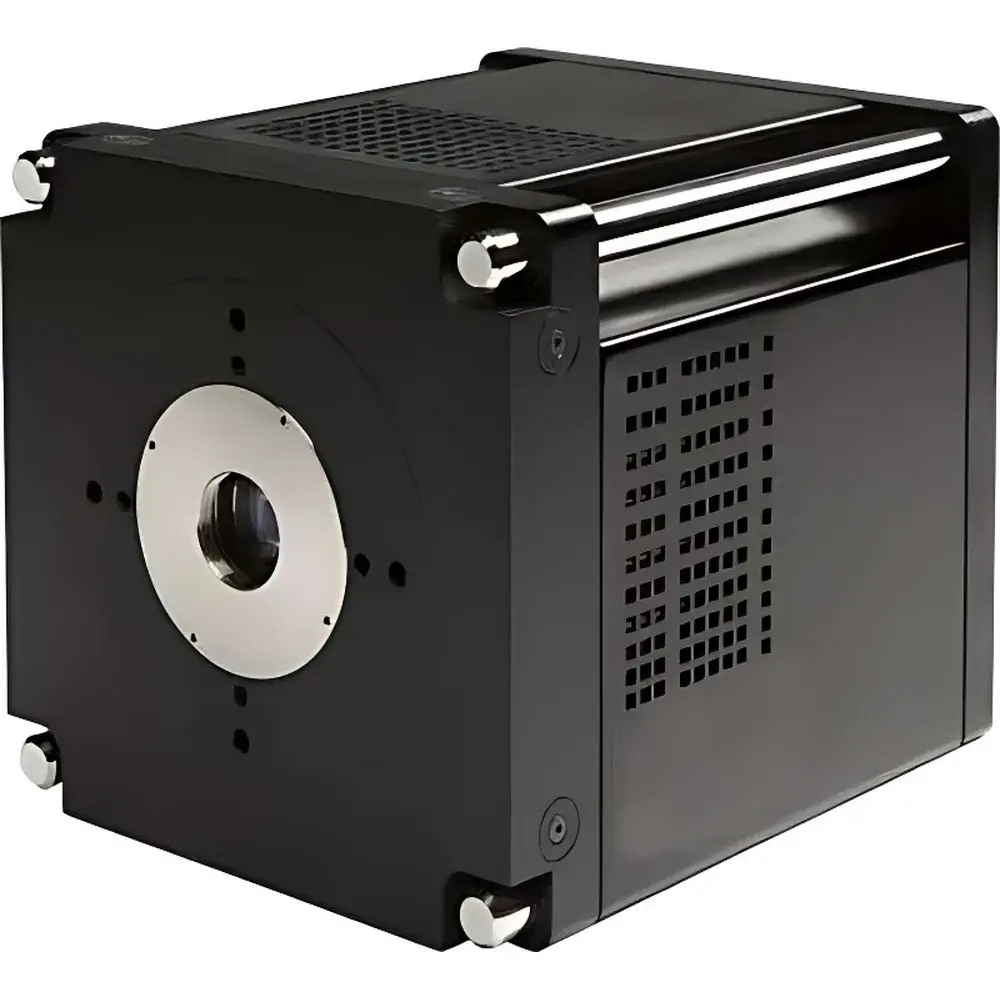
Alpao WFS-VIS Visible-Wavelength Shack-Hartmann Wavefront Sensor
| Brand | Alpao |
|---|---|
| Origin | France |
| Model | WFS-VIS |
| Sensor Type | EMCCD |
| Spectral Range | 250–1100 nm |
| Max Acquisition Frequency | 1838 Hz (WFS-VIS-69) |
| Microlens Array | 8×8 to 23×23 |
| Microlens Pitch | 133–307 µm |
| Quantum Efficiency | >90% @ 600 nm |
| Dynamic Range (Tip-Tilt/Focus, PtV) | 10–20 µm |
| Residual WFE Error (Closed-Loop) | 20 nm RMS |
| Absolute Precision | λ/20 RMS |
| Repeatability | 10 nm RMS |
| Typical Noise | <0.1 electron RMS |
| Operating Temperature | 0–30 °C |
| Interface | Camera Link |
| Compatible Deformable Mirrors | DM69, DM97-15, DM277, DM468 |
Overview
The Alpao WFS-VIS is a high-performance visible-wavelength Shack-Hartmann wavefront sensor engineered for real-time, high-fidelity measurement of optical wavefront distortions induced by atmospheric turbulence, thermal gradients, or optical system aberrations. Based on the well-established Shack-Hartmann principle—where a microlens array subdivides the incident wavefront into subapertures and a focal plane sensor records local spot displacements—the WFS-VIS delivers quantitative, pixel-resolved slope data essential for adaptive optics (AO) control loops. Designed and manufactured in France by Alpao—a leader in high-speed deformable mirrors and integrated AO subsystems—the WFS-VIS operates across the full UV–NIR range (250–1100 nm), with peak quantum efficiency exceeding 90% at 600 nm. Its electron-multiplying CCD (EMCCD) architecture enables single-photon-level sensitivity and ultra-low read noise (<0.1 electron RMS), making it suitable for low-flux applications such as solar astronomy, laser guide star wavefront sensing, and high-resolution microscopy. The sensor’s firmware and hardware are co-optimized with Alpao’s family of piezoelectric deformable mirrors (e.g., DM69, DM277), minimizing latency and ensuring deterministic timing for closed-loop bandwidths up to 1.8 kHz.
Key Features
- EMCCD-based detection with >90% quantum efficiency at 600 nm and broad spectral response (250–1100 nm)
- Four standard configurations (WFS-VIS-69, -97, -277, -468) offering scalable spatial resolution via microlens arrays from 8×8 to 23×23 elements
- High frame rates: up to 1838 Hz (WFS-VIS-69) and 1004 Hz (WFS-VIS-97), synchronized via Camera Link interface for deterministic data acquisition
- Sub-10 nm RMS wavefront repeatability and λ/20 RMS absolute precision under stable illumination conditions
- Low-latency design optimized for closed-loop adaptive optics, with residual wavefront error <20 nm RMS in active correction mode
- Thermally stabilized housing (0–30 °C operational range) and factory-calibrated microlens pitch (133–307 µm) ensure long-term metrological consistency
Sample Compatibility & Compliance
The WFS-VIS is compatible with collimated or near-collimated beams of diameter matching the selected microlens array’s active aperture (e.g., ~1.5 mm for WFS-VIS-69; ~6 mm for WFS-VIS-468). It integrates seamlessly into ISO-standard optical tables and vacuum-compatible beam paths via kinematic mounting options. While not a medical or industrial safety-certified device per se, its optical design complies with ISO 10110-5 (surface form tolerances) and ISO 11146 (laser beam parameters), and its electronic interface adheres to Camera Link Base Configuration standards (ANSI/VITA 1.8). For regulated environments—such as GLP-compliant astronomical instrumentation labs or FDA-audited ophthalmic R&D facilities—the WFS-VIS supports timestamped, metadata-embedded frame logging, enabling traceable wavefront records aligned with 21 CFR Part 11 audit trail requirements when used with compliant host software.
Software & Data Management
Alpao provides the open-source Alpao AO Studio SDK (C/C++, Python, MATLAB APIs) for real-time wavefront reconstruction, centroiding, Zernike decomposition, and closed-loop control integration. Raw centroid displacement data is output as 16-bit signed integers via Camera Link; reconstructed wavefronts (in FITS or HDF5 format) include embedded calibration metadata (microlens pitch, gain, exposure time, temperature). The SDK supports configurable region-of-interest (ROI) readout to maximize frame rate for dynamic regions, and includes built-in dark-frame subtraction, flat-field correction, and Poisson-noise-aware centroid algorithms. All data streams are timestamped with microsecond resolution using the host PC’s PTP-synchronized clock or an optional external GPS trigger input—critical for multi-sensor correlation in large telescope AO systems.
Applications
- Astronomical adaptive optics: Real-time correction of atmospheric turbulence for ground-based telescopes (e.g., solar observatories, exoplanet imaging)
- Laser beam characterization: Quantitative assessment of M², Strehl ratio, and higher-order aberrations in high-power laser systems
- Ophthalmic research: Objective measurement of ocular aberrations in vivo, supporting custom ablation planning and vision science studies
- Free-space optical communications: Monitoring and compensating for beam wander and phase distortion in terrestrial and satellite links
- Microscopy & lithography: In-situ wavefront monitoring for aberration-corrected super-resolution and EUV projection systems
FAQ
What is the minimum detectable wavefront gradient for WFS-VIS?
The practical slope sensitivity depends on photon flux and integration time, but under typical 10⁴–10⁵ photons/subaperture conditions, the WFS-VIS resolves gradients down to ~0.01 pixel displacement (equivalent to ~1–2 nm RMS wavefront error over a 1 mm subaperture).
Can WFS-VIS operate in vacuum or under cryogenic conditions?
The standard unit is rated for ambient operation (0–30 °C); vacuum-compatible variants with modified housing seals and non-outgassing adhesives are available upon request—consult Alpao engineering for custom environmental qualification.
Is camera calibration included with the system?
Yes—each WFS-VIS ships with factory-measured microlens array geometry, pixel-to-subaperture mapping, and gain/dark-current profiles stored in non-volatile memory; calibration files are auto-loaded by AO Studio at initialization.
How does WFS-VIS handle saturated spots or missing subapertures?
The centroiding algorithm employs robust outlier rejection, iterative thresholding, and Gaussian-weighted moment calculation; saturated spots are flagged and excluded from Zernike fitting without propagating bias into the global wavefront solution.
Does Alpao provide OEM integration support?
Yes—Alpao offers hardware reference designs, FPGA bitstream customization for custom timing, and NDA-protected API documentation for embedded deployment in third-party AO platforms.




