
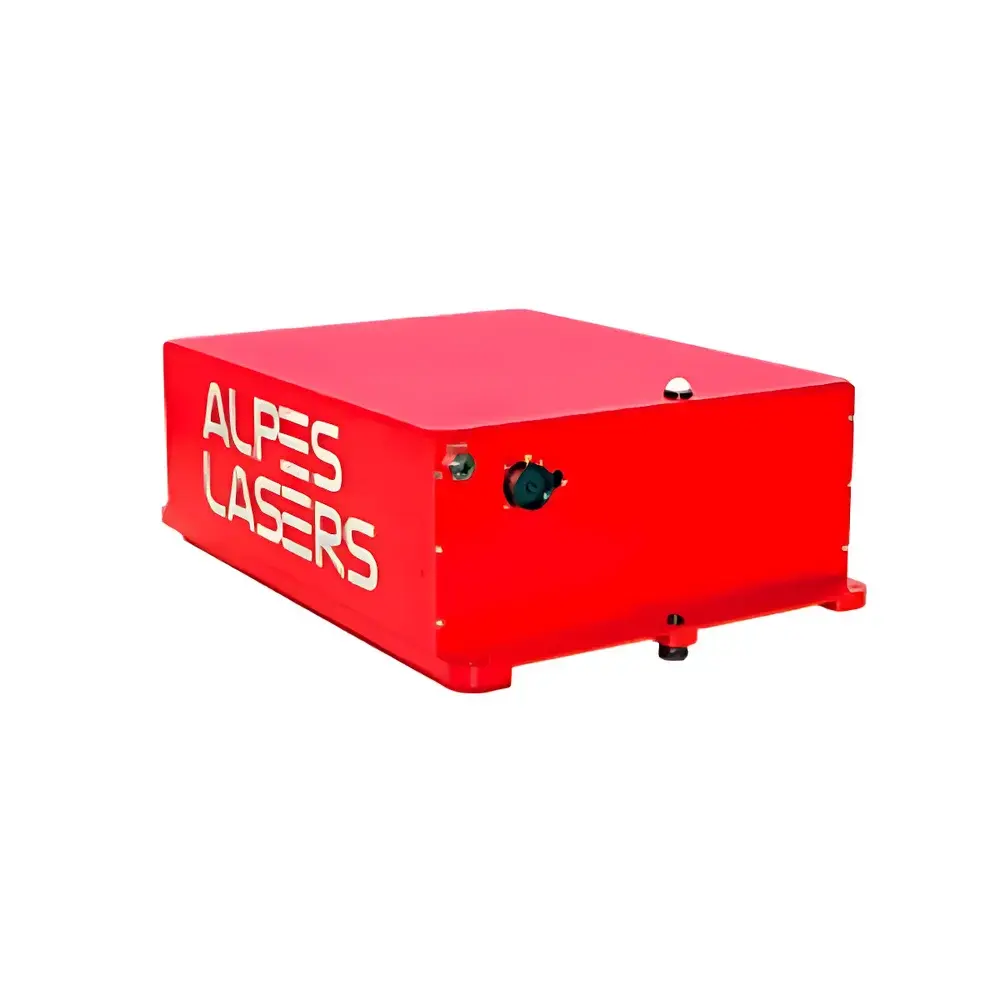
Alpes Lasers GLIDER Broadly Tunable Mid-Infrared Laser Source (6.7–33 µm)
| Brand | Alpes Lasers |
|---|---|
| Origin | Switzerland |
| Model | GLIDER |
| Tuning Range | 6.7–33 µm (≈300–1500 cm⁻¹, max. ~850 cm⁻¹ per module) |
| Output Mode | Pulsed (standard), CW-capable under specific conditions |
| Interface | Web-based GUI, Linux-based embedded controller, RJ45 Ethernet |
| Data Acquisition | Dual 16-bit synchronized analog input channels |
| Beam Control | Full motorized beam steering |
| Optical Interface | Standard kinematic mounts (e.g., SM1, C-mount compatible) |
| Purge Capability | Full-system gas purge port (N₂ or dry air) |
| Wavelength Monitoring | 12-bit analog real-time wavelength output |
| Fiber Coupling | Optional multimode fiber output (e.g., ZrF₄ or Chalcogenide, core Ø ≥ 400 µm) |
Overview
The Alpes Lasers GLIDER is a broadly tunable mid-infrared (MIR) laser source engineered for high-precision spectroscopic applications requiring spectral coverage from 6.7 to 33 µm (approximately 300 to 1500 cm⁻¹). Based on external-cavity quantum cascade laser (EC-QCL) architecture with Littrow-type grating feedback, the GLIDER delivers single-mode, narrow-linewidth emission across a continuous tuning range of up to ~850 cm⁻¹ per module. Its monolithic, factory-aligned design eliminates user calibration and external driver integration—each unit integrates QCL gain chips, precision mechanics, thermoelectric stabilization, and embedded control electronics within a sealed, vibration-damped enclosure. The system operates primarily in pulsed mode (typically <100 ns pulse width, kHz repetition rates), with select configurations supporting quasi-CW or true CW operation under optimized thermal and drive conditions. This architecture ensures high spectral purity, excellent wavelength reproducibility (<0.05 cm⁻¹ step repeatability), and long-term stability—critical for quantitative absorption spectroscopy, trace gas sensing, and laboratory-grade MIR reference source applications.
Key Features
- Broad spectral coverage: Single-module tuning range extends over 50–300 cm⁻¹; multi-module configurations (up to 4 modules) enable seamless spectral stitching across >1000 cm⁻¹.
- Modular scalability: Interchangeable QCL gain chips (BG-series and narrow-gain variants) allow reconfiguration for application-specific wavelength windows without hardware replacement.
- Embedded Linux controller: Features an onboard ARM-based processor running a real-time Linux OS, enabling local GUI operation via HDMI display/USB peripherals or remote access via Ethernet (RJ45) and standard web protocols (HTTPS, REST API).
- Synchronized data acquisition: Integrated dual 16-bit analog input channels time-stamp detector signals synchronized to both laser pulse trigger and wavelength position—supporting lock-in, rapid-scan, and step-scan methodologies.
- Full beam path control: Motorized mirror stages provide precise, software-controlled beam steering (±5° angular range) and collimation adjustment, facilitating alignment into FTIR spectrometers, multipass cells, or custom optical benches.
- Gas purging infrastructure: Dedicated inlet/outlet ports support continuous inert gas (N₂ or dry air) flow through the optical cavity and housing interior—essential for moisture-sensitive measurements and long-term stability in ambient lab environments.
- Fiber-coupled option: Multimode mid-IR fiber output (ZBLAN or chalcogenide, NA ≥ 0.25) enables flexible integration into portable or process-analytical systems while maintaining >60% coupling efficiency across the tuning band.
Sample Compatibility & Compliance
The GLIDER is designed for use with standard mid-infrared optical components—including KBr, ZnSe, CaF₂, and diamond ATR crystals—and interfaces natively with commercial FTIR spectrometers (e.g., Bruker VERTEX, Thermo Nicolet iS50), photoacoustic cells, and quantum cascade detector arrays. It complies with IEC 60825-1:2014 Class 4 laser safety requirements; integrated interlock circuits, shutter control, and beam dump monitoring ensure full alignment with EN 61000-6-3 (EMC) and ISO 13849-1 functional safety principles. While not certified for GMP production environments, its deterministic wavelength control, audit-trail-capable logging (via system journal), and deterministic pulse timing make it suitable for method development under GLP frameworks. Firmware supports timestamped metadata embedding (wavelength, pulse count, TEC temperature, diode current) for traceable spectral data provenance.
Software & Data Management
The web-based GUI provides intuitive access to all operational parameters—including grating angle, drive current, stage temperature, pulse delay, and acquisition trigger settings—without requiring proprietary drivers or client installation. All configuration states are saved as JSON profiles. Raw analog acquisition data (up to 1 MS/s per channel) is streamed in HDF5 format with embedded calibration metadata. Python SDK and LabVIEW VIs are provided for automated measurement sequences, including wavelength sweeps synchronized to external detectors or gas concentration modulators. System logs retain full command history, error codes, and thermal drift diagnostics—enabling root-cause analysis during method validation or troubleshooting.
Applications
- High-resolution molecular spectroscopy: Identification and quantification of fundamental vibrational modes in organic molecules, polymers, and pharmaceuticals—particularly where overtone/combination bands fall outside near-IR detection limits.
- Trace gas monitoring: Detection of ppb-level atmospheric species (e.g., NH₃, CH₄, NO₂, H₂S) using direct absorption or photoacoustic spectroscopy in open-path or multipass cell configurations.
- Materials characterization: In situ analysis of thin-film coatings, semiconductor dopants, and battery electrolyte decomposition products via reflection-absorption or transmission MIR imaging.
- Instrument development: Serving as a tunable reference source for calibrating dispersive MIR spectrometers, validating detector linearity, or testing new photonic sensor architectures.
- Defense & security: Standoff detection of explosives precursors and chemical warfare agent simulants using backscattered MIR signatures.
FAQ
What is the typical linewidth of the GLIDER output?
The instantaneous linewidth is <0.003 cm⁻¹ (FWHM) under optimized grating resolution settings; effective resolution depends on scan speed and detector bandwidth.
Can the GLIDER be used in vacuum environments?
The standard enclosure is not vacuum-rated; however, custom vacuum-compatible versions with CF flange interfaces and non-outgassing materials are available upon request.
Is wavelength calibration traceable to NIST standards?
Yes—factory calibration uses a stabilized HeNe reference and a high-finesse Fabry–Pérot interferometer; users receive a calibration certificate with uncertainty budget per ISO/IEC 17025 guidelines.
Does the system support third-party DAQ hardware synchronization?
Yes—TTL-compatible sync outputs (pulse trigger, wavelength step, frame start) and programmable delay generators enable deterministic triggering of external oscilloscopes, digitizers, or lock-in amplifiers.
What maintenance is required for long-term operation?
No routine optical alignment or consumable replacement is needed; periodic verification of TEC performance and purge gas dew point is recommended every 12 months under continuous operation.






