
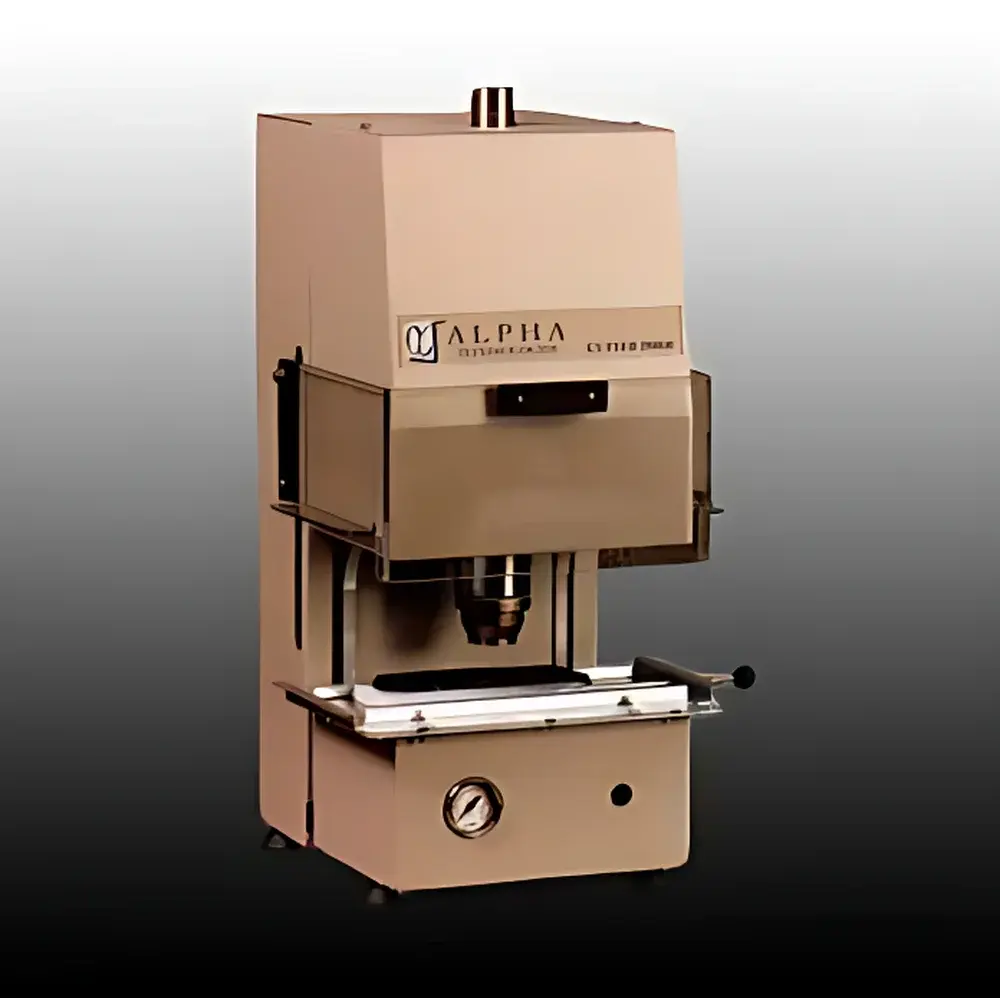
ALPHA 2000R Sample Cutter for Rubber Testing
| Brand | ALPHA |
|---|---|
| Origin | USA |
| Model | 2000R |
| Operation | Pneumatic Dual-Action |
| Sample Type | Uncured Rubber Compounds |
| Application | Specimen Preparation for MDR, RPA, Viscosity Testers, and Carbon Black Dispersion Analyzers |
| Compliance | Designed for ASTM D5289, ISO 6502, and ISO 289-1 Specimen Geometry Requirements |
| Footprint | Compact Benchtop Design |
Overview
The ALPHA 2000R Sample Cutter is a precision-engineered benchtop instrument designed specifically for the reproducible preparation of standardized test specimens from uncured rubber compounds. Operating on a dual-action pneumatic principle, it integrates specimen compression, controlled pre-straining (10% elongation), and clean orthogonal cutting in a single, repeatable workflow. Its mechanical architecture is optimized to meet the stringent geometric tolerances required by international standards—including ASTM D5289 (for Moving Die Rheometer testing), ISO 6502 (rubber vulcanization characterization), and ISO 289-1 (Mooney viscosity specimen dimensions). Unlike manual or hydraulic cutters, the 2000R eliminates operator-induced variability by automating both compression and cutting sequences, ensuring consistent thickness, edge integrity, and dimensional fidelity across batches—critical for high-sensitivity rheological and dispersion analysis.
Key Features
- Dual-action pneumatic actuation: Simultaneous compression and cutting ensures uniform specimen density and eliminates shear-induced distortion during sectioning.
- Benchtop footprint: Compact design (W × D × H: 320 × 380 × 240 mm) enables integration into QC labs, R&D workstations, and automated MDR/RPA cell preparation lines without dedicated floor space.
- Two-stage operation: First stage compresses and cools the uncured compound using a chilled preformer; second stage stretches the specimen by precisely 10% prior to blade engagement—mimicking standard uniaxial strain conditions used in dispersion evaluation protocols.
- Modular tooling interface: Preformer and cutter assemblies mount directly onto a shared aluminum tabletop, allowing rapid reconfiguration between 2000R (standard geometry) and optional 2000M (modified geometry) configurations without recalibration.
- Stainless-steel blade system with adjustable depth stop: Ensures repeatable cut thickness (±0.02 mm tolerance) and minimizes rubber adhesion or smearing at specimen edges.
Sample Compatibility & Compliance
The 2000R accommodates a broad range of uncured elastomer formulations—including natural rubber (NR), SBR, BR, EPDM, and thermoplastic elastomers—with fillers up to 60 phr carbon black or silica. It produces specimens conforming to ISO 289-1 Type A (disc-shaped, Ø 45 mm × 2 mm thick) and ASTM D5289 Type B (toroidal, Ø 40 mm × 4 mm cross-section) geometries. All mechanical tolerances and thermal management parameters are validated per GLP-compliant documentation packages, supporting audit readiness for ISO/IEC 17025-accredited laboratories. The device does not require electrical power for core operation—only clean, dry compressed air (6–8 bar)—reducing facility infrastructure dependencies and enhancing operational safety in solvent-rich environments.
Software & Data Management
While the 2000R operates as a standalone mechanical system, its process parameters—including cycle time, compression force (via regulated air pressure), and pre-strain duration—are fully loggable when integrated with ALPHA’s optional 2000-Series Control Interface Module (sold separately). This module provides RS-485 and Ethernet connectivity, enabling synchronization with LIMS platforms and electronic lab notebooks. Audit trails record operator ID, date/time stamp, batch ID, and air pressure setpoints—fully compliant with FDA 21 CFR Part 11 requirements for electronic records and signatures. Raw parameter logs support retrospective root-cause analysis during method validation or out-of-specification investigations.
Applications
- Preparation of MDR and RPA test specimens for vulcanization kinetics and scorch safety assessment.
- Generation of Mooney viscosity test discs meeting ISO 289-1 dimensional tolerances.
- Production of standardized specimens for carbon black dispersion analysis (e.g., using image analysis per ASTM D7720 or ISO 11345).
- QC sampling in rubber compounding lines where batch-to-batch consistency of uncured morphology must be preserved prior to curing.
- Research-grade specimen fabrication for structure–property correlation studies involving filler network formation under non-vulcanized states.
FAQ
Does the 2000R require calibration? How often should it be verified?
Yes—mechanical verification of blade protrusion depth, preformer compression travel, and pneumatic pressure regulation is recommended quarterly per internal SOPs. Calibration certificates traceable to NIST standards are available upon request.
Can the 2000R cut cured rubber samples?
No. The 2000R is engineered exclusively for uncured, viscoelastic compounds. Attempting to cut vulcanized rubber may damage the blade assembly and void warranty.
Is the 2000R compatible with ISO 17987-2 for dispersion imaging workflows?
Yes—the specimen flatness, edge definition, and surface homogeneity produced by the 2000R meet the optical requirements specified in ISO 17987-2 Annex B for high-magnification digital microscopy of filler distribution.
What maintenance is required for long-term reliability?
Daily wipe-down of the preformer and cutter surfaces with isopropyl alcohol; monthly lubrication of pneumatic cylinder seals using food-grade silicone grease; annual inspection of blade sharpness and replacement if micro-chipping exceeds 0.1 mm.



