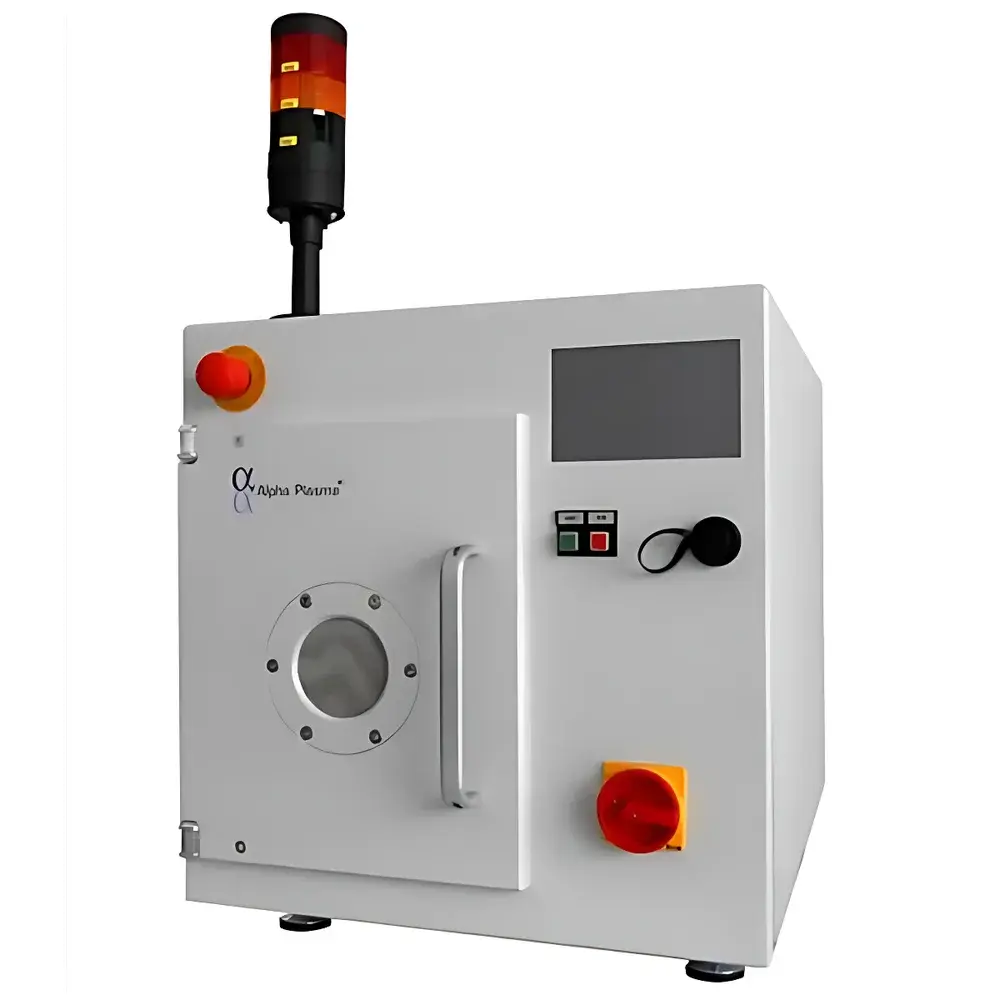
ALPHA AL8 Microwave Plasma Cleaner
| Brand | Alpha Plasma |
|---|---|
| Origin | Germany |
| Model | AL8 |
| Plasma Source | 2.45 GHz microwave, 600 W |
| Chamber Volume | 18 L (250 × 250 × 290 mm, aluminum) |
| External Dimensions | 530 × 600 × 550 mm |
| Gas Delivery | 1 standard mass flow-controlled line (MKS digital controller) |
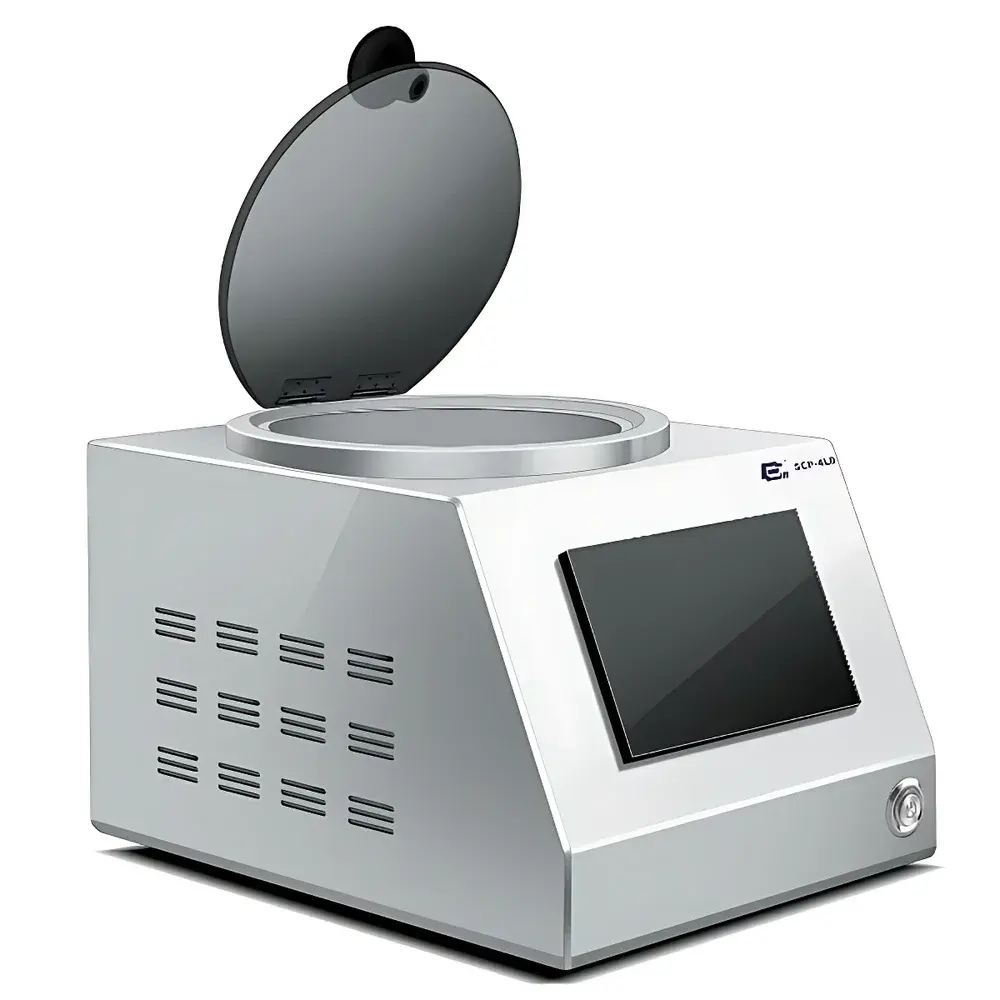
| Vacuum Door | Hinged with UV- and microwave-shielded viewport |
| Control Interface | 7" GUI touchscreen, Windows CE OS |
| Optional | Dry pump system, tri-color status tower light, up to 4 gas lines, ECR-enhanced plasma source, motorized rotating stage (Ø200 mm, variable speed) |
Overview
The ALPHA AL8 is a high-precision microwave plasma cleaning system engineered for semiconductor fabrication environments where ultra-clean surface preparation, photoresist stripping, and native oxide removal are critical process steps. Operating at the industrial standard 2.45 GHz microwave frequency, the AL8 generates high-density, low-damage plasma via electron cyclotron resonance (ECR)-compatible excitation—enabling efficient dissociation of process gases (e.g., O₂, CF₄, Ar/O₂ mixtures) without significant ion bombardment or thermal loading on sensitive substrates. Its compact 18 L aluminum chamber (250 × 250 × 290 mm) is optimized for batch processing of wafers up to 200 mm diameter, mask plates, and MEMS components, while maintaining stable vacuum integrity down to ≤1 × 10⁻² mbar. Designed and manufactured in Germany, the AL8 complies with IEC 61000-6-3 (EMC emission) and IEC 61000-6-4 (industrial immunity) standards, and integrates safety interlocks aligned with SEMI S2-0215 requirements for plasma tool operation.
Key Features
- 600 W solid-state microwave generator with automatic impedance matching for stable plasma ignition and sustained power delivery across varying pressure and gas composition conditions.
- Aluminum chamber with electropolished interior surfaces and integrated RF/UV shielding—minimizing particle generation and preventing electromagnetic leakage through the observation window.
- Hinged front access door with multi-layer fused silica viewport, incorporating both UV-absorbing dopants and conductive mesh for simultaneous optical monitoring and operator safety.
- Digital MKS mass flow controller (MFC) for precise, repeatable gas dosing; factory-calibrated for ±1% full-scale accuracy with temperature compensation.
- 7-inch resistive touchscreen interface running Windows CE OS, supporting recipe-based operation, real-time parameter logging (pressure, forward/reflected power, gas flow), and USB export of process data.
- Modular architecture enabling field-upgradable options: dry scroll vacuum pump package (oil-free, <10⁻³ mbar base pressure), tri-color status tower (red = fault, yellow = standby, green = active), and ECR magnetic field coil assembly for enhanced plasma uniformity.
Sample Compatibility & Compliance
The AL8 accommodates flat, rigid substrates including silicon, quartz, sapphire, and ceramic wafers (≤200 mm), photomasks, and packaged IC substrates. Its rotating stage option (Ø200 mm, 0–20 rpm continuous adjustment) ensures uniform plasma exposure across non-planar or edge-sensitive samples. The system supports Class 100 cleanroom integration via HEPA-filtered exhaust routing and conforms to ISO 14644-1 cleanliness classification when operated with appropriate ventilation. Process validation documentation—including IQ/OQ protocols, traceable calibration certificates for MFC and pressure gauges, and compliance statements for RoHS, REACH, and WEEE—is provided upon request. For regulated environments, audit-ready electronic logs meet FDA 21 CFR Part 11 requirements when paired with optional secure user authentication and electronic signature modules.
Software & Data Management
The embedded Windows CE platform hosts a dedicated plasma control application with hierarchical user roles (Operator, Engineer, Administrator), password-protected parameter editing, and versioned recipe storage (up to 100 protocols). All process events—including start/stop timestamps, alarm triggers, manual overrides, and sensor readouts—are time-stamped and stored locally with cyclic overwrite protection. Data export supports CSV and XML formats compatible with LIMS and MES systems. Remote diagnostics via Ethernet (TCP/IP) enable predictive maintenance alerts based on cumulative microwave duty cycle and pump performance trends. Optional software add-ons include GLP-compliant electronic lab notebook (ELN) integration and automated report generation per ISO/IEC 17025 clause 7.8.
Applications
- Photoresist ashing and post-etch residue removal prior to metrology or deposition steps.
- Surface activation of SiO₂, SiNₓ, and metal films for improved adhesion in ALD and PVD processes.
- Removal of organic contaminants and hydrocarbon layers from optical components and microfluidic devices.
- Pre-bond cleaning of wafer-level packaging substrates to eliminate interfacial voids.
- MEMS release etch support using low-power, high-selectivity O₂/Ar plasmas.
- Research-grade surface functionalization studies requiring controlled radical flux and minimal substrate damage.
FAQ
What vacuum level can the AL8 achieve with the standard pump configuration?
With the base mechanical roughing pump, the AL8 reaches ≤5 × 10⁻² mbar; with the optional dry scroll pump, base pressure improves to ≤1 × 10⁻³ mbar.
Is remote operation supported over Ethernet or RS-232?
Yes—Ethernet TCP/IP communication is standard; Modbus RTU over RS-232 is available as an optional firmware module.
Can the AL8 be integrated into a cluster tool or factory automation system?
The system provides SECS/GEM protocol support via optional software license and meets SEMI E30/E40 interface specifications for host communication.
What safety certifications does the AL8 hold for use in EU semiconductor fabs?
It carries CE marking per Machinery Directive 2006/42/EC and EMC Directive 2014/30/EU, with additional conformity to EN 60204-1 (electrical safety) and EN 61326-1 (EMC for industrial environments).
How often does the microwave waveguide require maintenance or cleaning?
Under normal operation with clean process gases, the waveguide requires inspection every 1,000 hours; no routine cleaning is needed unless process byproducts (e.g., fluorocarbon polymers) accumulate—monitored via reflected power trend analysis.