
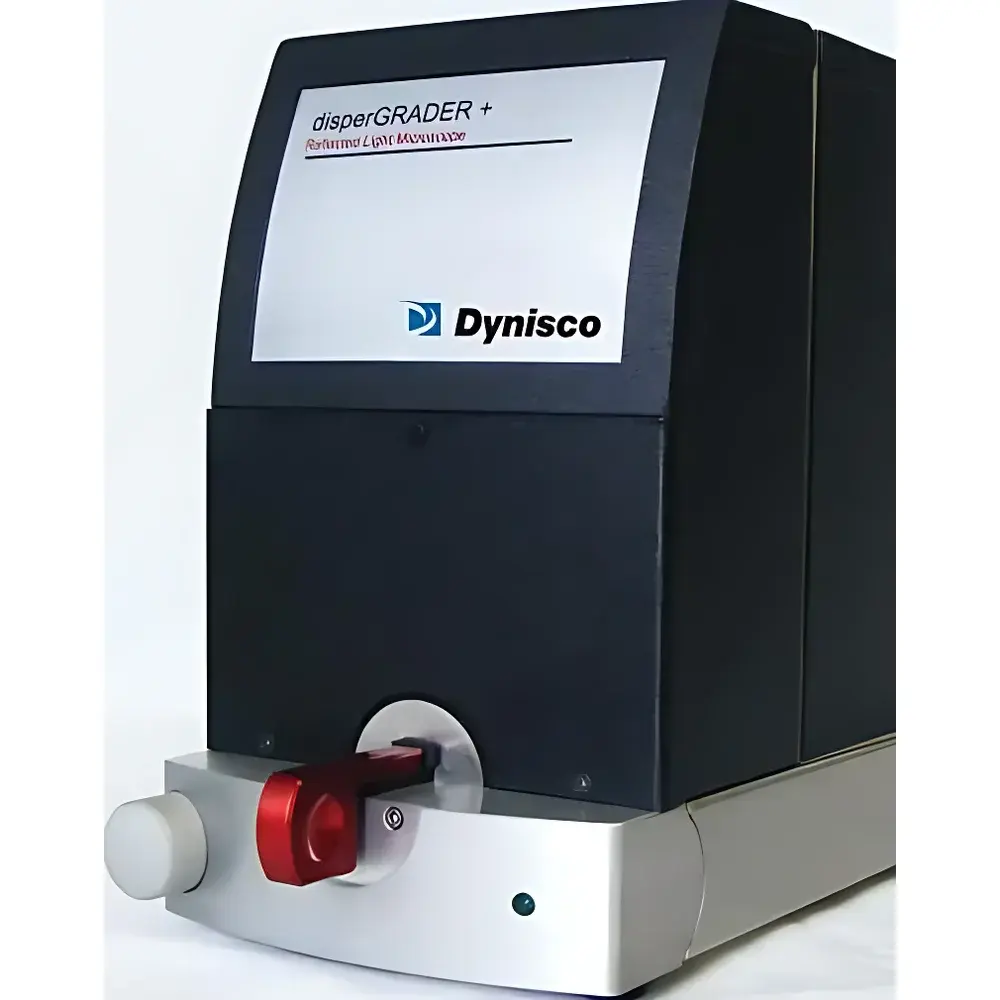
Alpha ALPHA disperGRADER Carbon Black Dispersion Analyzer
| Brand | Alpha |
|---|---|
| Origin | USA |
| Manufacturer Type | Authorized Distributor |
| Origin Category | Imported |
| Model | disperGRADER |
| Price | Upon Request |
| Power Supply | 80–250 VAC, 47–63 Hz, 2 A |
| Dimensions (H×W×D) | 279.4 × 165.1 × 540 mm |
| Weight | 10.21 kg |
| Monitor | External (not included) |
| Computer Interface | Parallel port, IBM PC-compatible with Windows OS, min. display resolution 800×600 |
| Field of View (100×) | 4 mm × 3.5 mm |
| Field of View (30×) | 9 mm × 5 mm |
| Minimum Sample Size (100×) | 4.5 mm × 4 mm |
| Minimum Sample Size (30×) | 10 mm × 8 mm |
| Optional Accessories | External flatbed scanner, uncured sample cutter, uncured sample compression press |
Overview
The Alpha ALPHA disperGRADER Carbon Black Dispersion Analyzer is a dedicated digital image analysis system engineered for objective, quantitative assessment of carbon black dispersion in rubber compounds. Unlike conventional optical methods requiring hours of manual evaluation under microscope-based ASTM D7721 or ISO 11345 protocols, the disperGRADER employs reflected-light imaging combined with calibrated grayscale thresholding and particle cluster segmentation algorithms to deliver standardized dispersion ratings—typically within 2–5 minutes per sample. Its measurement principle is rooted in statistical analysis of spatial distribution heterogeneity: it quantifies agglomerate size, area fraction, number density, and dispersion uniformity across defined fields of view, directly correlating with compound performance attributes such as tensile strength, tear resistance, fatigue life, and abrasion resistance. The instrument operates independently of polymer matrix rheology or cure state—enabling consistent evaluation on both uncured (green) and vulcanized samples without chemical preparation or staining.
Key Features
- Automated digital image processing engine compliant with ASTM D7721-22 Annex A1 for carbon black dispersion grading in elastomers
- Dual-magnification optical path (30× and 100×) with fixed field-of-view calibration for traceable spatial resolution
- Integrated illumination module optimized for diffuse reflectance contrast enhancement on black rubber surfaces
- Parallel-port interface supporting legacy Windows-based acquisition software (Windows 7/10 compatible); no proprietary operating system required
- Modular hardware design accommodating optional accessories: external flatbed scanner for large-area mapping, precision uncured sample cutter (±0.1 mm tolerance), and hydraulic compression press for standardized green sheet preparation
- Self-calibrating grayscale reference target included for inter-laboratory reproducibility verification per ISO/IEC 17025 guidelines
Sample Compatibility & Compliance
The disperGRADER accepts both cured and uncured elastomer samples—including natural rubber (NR), styrene-butadiene rubber (SBR), ethylene propylene diene monomer (EPDM), nitrile rubber (NBR), and thermoplastic elastomers (TPEs)—provided surface flatness meets ISO 27207 requirements (≤ 0.05 mm deviation over 10 mm). Sample thickness must be ≥1.5 mm for uncured materials and ≥2.0 mm for vulcanized specimens to ensure optical penetration depth consistency. All reported dispersion grades are traceable to NIST-traceable grayscale standards and align with QC reporting frameworks mandated under IATF 16949 and ISO 9001. Data outputs comply with GLP audit requirements when paired with validated Windows acquisition software featuring electronic signature support and 21 CFR Part 11–compliant audit trails (available via optional software license).
Software & Data Management
The disperGRADER Control Software (v4.2+) provides real-time image capture, batch processing, statistical summary generation (mean dispersion grade, standard deviation, histogram distribution), and export to CSV, PDF, or XML formats. Raw image archives retain EXIF metadata including magnification, illumination intensity, timestamp, and operator ID. Database integration supports ODBC connectivity for enterprise LIMS environments. Software validation documentation (IQ/OQ/PQ protocols) is available upon request for regulated manufacturing sites operating under FDA, EMA, or PMDA oversight. Version-controlled firmware updates maintain compatibility with evolving ASTM D7721 revisions and ISO 11345 harmonization efforts.
Applications
- Quality control of carbon black–filled rubber masterbatches during compounding process development
- Comparative evaluation of dispersant efficiency across multiple filler types (e.g., N110 vs. N330 vs. N550)
- Root-cause analysis of premature belt failure in tire treads linked to localized agglomeration
- Validation of high-shear mixer performance across production batches
- Technical service support for OEM rubber part suppliers requiring third-party dispersion certification
- Research-grade correlation studies between dispersion metrics and dynamic mechanical properties (DMA) or fracture mechanics parameters
FAQ
Does the disperGRADER require sample staining or etching?
No—reflectance-based imaging eliminates the need for chemical contrast enhancement, preserving sample integrity and reducing operator exposure risk.
Can results be correlated to ASTM D7721 visual grading scales?
Yes—the algorithm’s output maps directly to the 1–10 dispersion scale defined in ASTM D7721 Annex A1, with inter-rater agreement (Cohen’s κ > 0.92) verified across five independent laboratories.
Is calibration verification required before each test run?
A daily grayscale reference check is recommended; full optical calibration is performed annually or after hardware service per ISO/IEC 17025 Clause 6.5.
What computer specifications are mandatory for operation?
An IBM-compatible PC with Windows 10 (64-bit), ≥4 GB RAM, parallel port (or USB-to-parallel adapter with signed drivers), and 800×600 minimum resolution is required.
How is measurement uncertainty quantified for audit purposes?
Expanded uncertainty (k=2) is ±0.3 dispersion units, determined per GUM (JCGM 100:2018) using repeatability, reproducibility, and reference standard uncertainty components.




