ALPHA D2020 Density Tester for Rubber & Plastics
| Brand | ALPHA |
|---|---|
| Origin | USA |
| Model | D2020 |
| Measurement Principle | Hydrostatic Weighing (Air/Water Dual-Weight Method) |
| Density Range | 1.05–2.00 g/cm³ |
| Compliance | ISO 2781 |
| Temperature Compensation | Yes (liquid density correction vs. bath temperature) |
| Sample Throughput | 20-position automated carousel |
| Software Integration | Eclipse Daisy v5.x and Enterprise LIMS (barcode-enabled, specification limits, auto-reporting, audit-trail capable) |
| Pre-wetted carrier protocol | Yes |
| Readout Speed | <3 sec per sample post-stabilization |
| Regulatory Context | Supports GLP/GMP workflows with 21 CFR Part 11–compliant electronic records (when deployed with validated LIMS configuration) |
Overview
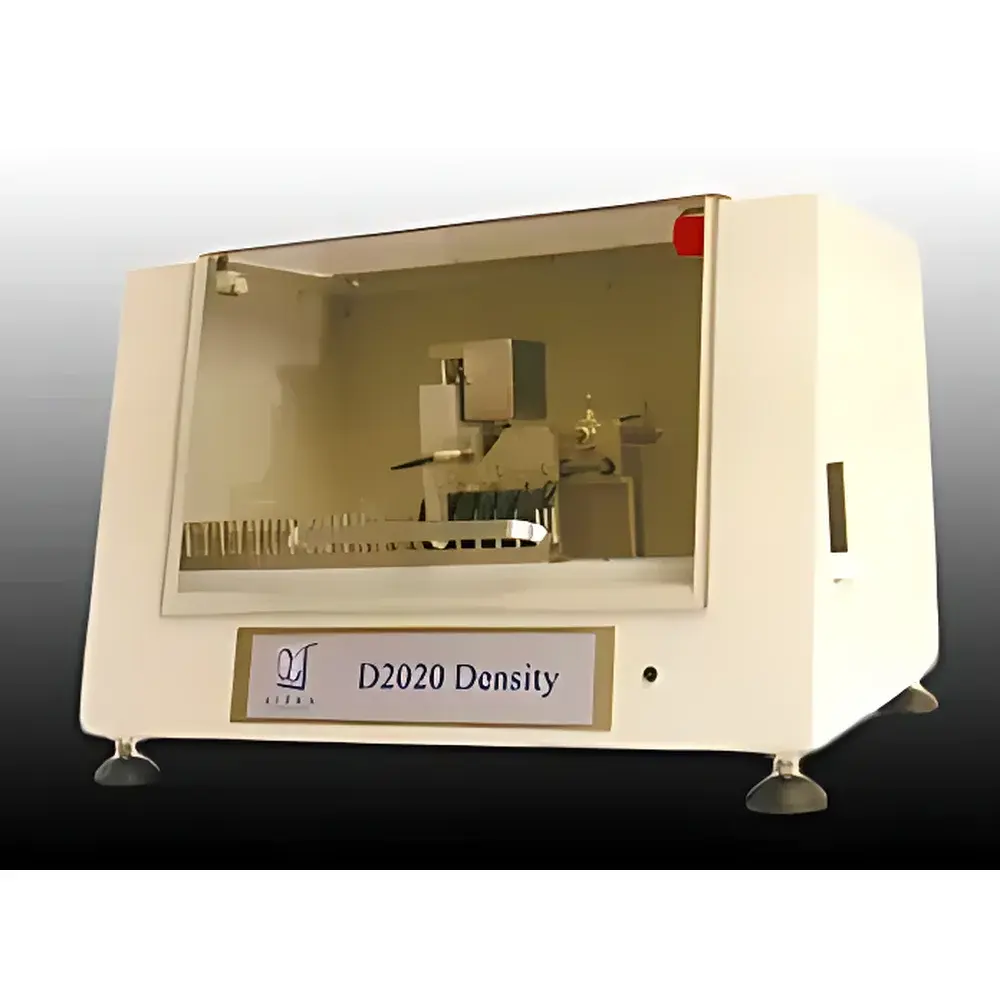
The ALPHA D2020 Density Tester is an automated hydrostatic weighing system engineered specifically for high-reproducibility density and specific gravity determination of vulcanized rubber compounds and thermoplastic elastomers within the range of 1.05–2.00 g/cm³. It implements the dual-weight principle defined in ISO 2781:2018 — “Rubber, vulcanized or thermoplastic — Determination of density” — wherein each specimen is weighed first in air and subsequently immersed in distilled water at a controlled temperature. The instrument calculates density using Archimedes’ principle, correcting for buoyancy, air density, and water density as a function of real-time bath temperature. Its robust mechanical architecture incorporates a precision analytical balance (0.1 mg resolution), thermostatically regulated water bath (±0.1 °C stability), and pneumatically actuated immersion mechanism to eliminate operator-induced variability. Designed for QC laboratories in tire manufacturing, compound development, and rubber product certification, the D2020 delivers traceable, repeatable results under routine production conditions.
Key Features
- 20-position automated sample carousel enabling unattended batch processing without manual repositioning
- Pre-wetted carrier protocol minimizes surface tension artifacts and reduces moisture absorption bias in porous rubber specimens
- Real-time liquid density compensation based on integrated PT100 temperature sensor in the immersion bath
- Dual-sensor environmental monitoring: ambient temperature and humidity logged alongside each measurement for metrological traceability
- Integrated anti-vibration base and draft shield enclosure ensure stability during microgram-level weighing operations
- Modular hardware design supports field-upgradable firmware and calibration certificate management via USB or Ethernet
Sample Compatibility & Compliance
The D2020 accommodates standard ISO 2781 test specimens (cylindrical or cuboidal, minimum volume ≥1 cm³) prepared from cured rubber sheets, extruded profiles, or molded parts. Specimens must be free of surface defects, coatings, or trapped air voids; porous samples require pre-conditioning per ASTM D297 Annex A. The system complies fully with ISO 2781:2018 requirements for apparatus accuracy, temperature control, and calculation methodology. When operated with validated Enterprise LIMS, it satisfies data integrity expectations of FDA 21 CFR Part 11 (electronic signatures, audit trails, change control) and supports GLP/GMP documentation standards including raw data archiving, user access logs, and calibration history linkage.
Software & Data Management
Eclipse Daisy software provides instrument control, real-time visualization of weight stabilization curves, and automated ISO 2781-compliant reporting with uncertainty estimation (k=2). Enterprise LIMS integration enables barcode-driven sample registration, configurable specification limits (e.g., ±0.005 g/cm³ tolerance), auto-generation of batch summary reports (PDF/CSV), and bidirectional data exchange with SAP QM or LabWare LIMS environments. All measurement metadata — including balance diagnostics, temperature drift logs, and operator ID — are embedded in structured XML output. Audit trail functionality records timestamped events for every critical action: method load, calibration execution, result approval, and report export.
Applications
- Quality control of carbon black–filled rubber compounds where density correlates directly with filler dispersion homogeneity and crosslink density
- Verification of formulation consistency across production lots of EPDM, SBR, NBR, and silicone elastomers
- Supporting ASTM D792 and ISO 1183-1 for comparative density analysis in R&D labs
- Input parameter for finite element modeling of rubber component compression set and dynamic stiffness
- Statistical process control (SPC) charting using X-bar/R charts generated from daily density trends
- Regulatory submission packages requiring ISO 2781–traceable physical property data
FAQ
Does the D2020 require external calibration weights or certified reference materials?
No — the system includes internal motorized calibration mass deployment and supports external verification using NIST-traceable stainless steel density standards (e.g., 316L SS, ρ = 7.99 g/cm³).
Can the D2020 measure filled thermoplastics such as PP+CaCO₃ or ABS+glass fiber?
Yes, provided the material is non-porous, dimensionally stable in water, and falls within the 1.05–2.00 g/cm³ range; surface sealing may be required for hygroscopic composites.
Is temperature compensation mandatory, or can it be disabled?
Compensation is enabled by default and cannot be disabled — ISO 2781 mandates water density correction at the actual immersion temperature, and the D2020 enforces this requirement algorithmically.
What LIMS vendors are pre-validated for integration with Enterprise LIMS?
LabWare, Thermo Fisher SampleManager, and Siemens Opcenter Quality are supported through documented API specifications and joint validation protocols.
How is compliance with 21 CFR Part 11 verified during installation qualification?
IQ/OQ documentation includes test scripts for electronic signature enforcement, audit trail generation, and role-based access control — executed jointly by ALPHA Field Application Engineers and client QA teams.
Related Products