
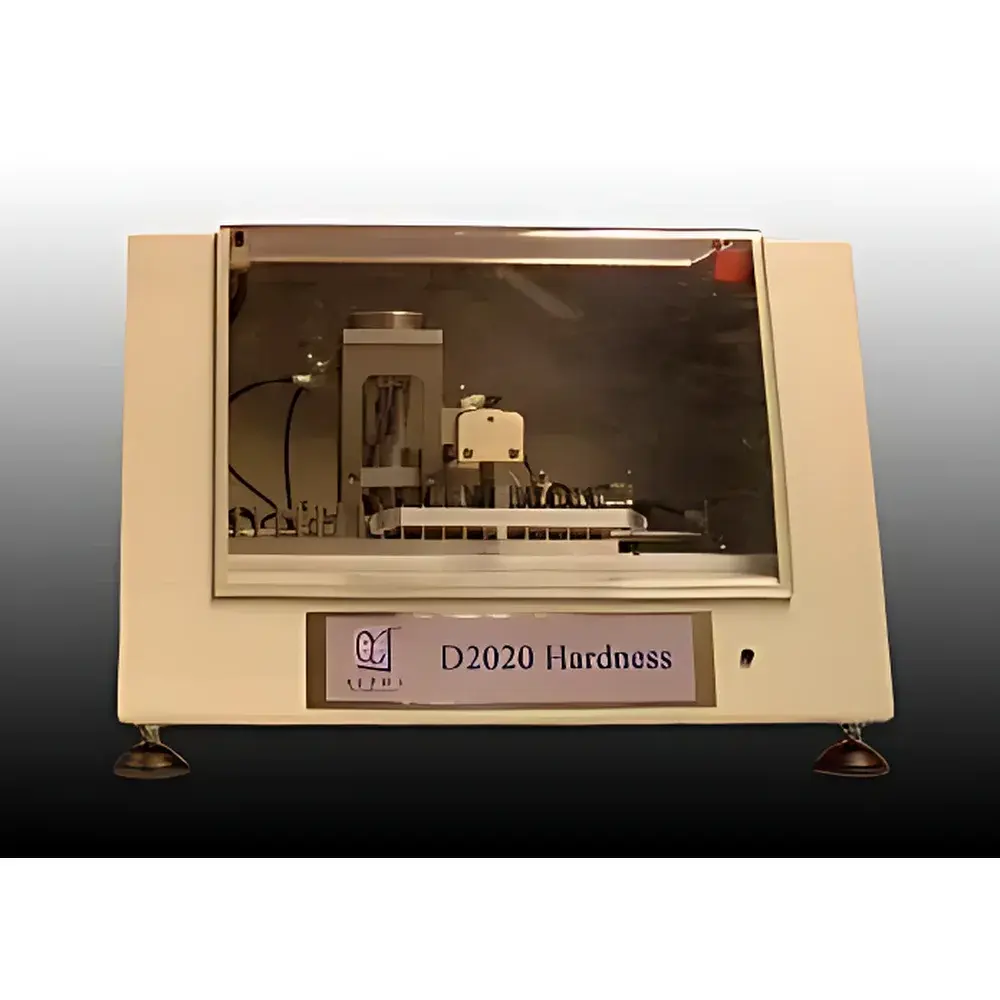
ALPHA D2020 International Rubber & Shore A Hardness Tester
| Brand | ALPHA |
|---|---|
| Origin | USA |
| Model | D2020 |
| Compliance | ASTM D1415, ISO 48, DIN 53519, NF T46-003, BS 903-A26 (International Rubber Hardness) |
| Automation | Fully automated 20-sample queue |
| Test Modes | Pre-configured 1-, 3-, or 5-point indentation sequences |
| Software Integration | Eclipse Daisy and Enterprise LIMS compatible |
| Hardness Head Design | Low-friction, maintenance-optimized indenter assembly |
| Optional Accessory | D2020 Density Tester module |
Overview
The ALPHA D2020 is a fully automated benchtop hardness testing system engineered for high-reproducibility measurement of elastomeric and polymeric materials according to two internationally recognized methodologies: International Rubber Hardness (IRH) and Shore A hardness. Unlike manual durometers or semi-automated systems, the D2020 eliminates operator-induced variability through programmable sample handling, closed-loop force control, and traceable displacement sensing. Its dual-mode architecture enables laboratories to perform both IRH (per ASTM D1415, ISO 48, DIN 53519, NF T46-003, and BS 903 Part A26 Method N) and Shore A (per ASTM D2240, ISO 7619, DIN 53505, NF T46-052, and BS 903 Part A57) tests on a single platform—without mechanical reconfiguration. The instrument employs a precision-ground indenter head with low-friction linear guidance and calibrated spring loading, ensuring consistent contact geometry and minimal hysteresis across thousands of cycles. All mechanical actuation is driven by servo-controlled linear stages with sub-micron positional resolution, enabling repeatable indentation depth control within ±0.002 mm.
Key Features
- Fully automated 20-position sample carousel with barcode or RFID sample tracking capability
- Programmable test sequences: 1-, 3-, or 5-point indentation per specimen, configurable per standard requirements
- Dual-standard compliance: Simultaneous support for International Rubber Hardness (IRH) and Shore A protocols
- Low-maintenance indenter head featuring hardened steel conical tip (IRH) and truncated cone (Shore A), both mounted on a thermally stable aluminum housing
- Integrated load cell and LVDT-based displacement sensor with NIST-traceable calibration certificate included
- Real-time force–displacement curve acquisition at 100 Hz sampling rate for post-test analysis of viscoelastic recovery
- Modular design accommodating optional D2020 Density Tester add-on for concurrent density/hardness correlation studies
Sample Compatibility & Compliance
The D2020 accommodates flat, parallel-faced specimens ranging from 10 mm to 100 mm in diameter and 4 mm to 25 mm in thickness. It supports vulcanized rubber, thermoplastic elastomers (TPE), silicone gels, polyurethane foams, and cured elastomer composites. All test routines adhere strictly to the procedural constraints defined in referenced standards—including dwell time (15 s ± 0.5 s for IRH; 15 s ± 1 s for Shore A), indentation speed (0.8 mm/s ± 0.1 mm/s), and environmental conditioning requirements (23 °C ± 2 °C, 50 % RH ± 5 % RH per ISO 23529). The system is validated for GLP and GMP environments and supports 21 CFR Part 11-compliant electronic signatures when paired with Enterprise LIMS.
Software & Data Management
Eclipse Daisy software provides intuitive workflow-driven test setup, real-time monitoring, and automated report generation compliant with ISO/IEC 17025 documentation requirements. Each test record includes raw sensor data, metadata (operator ID, calibration status, ambient conditions), and pass/fail flags against user-defined specification limits. Enterprise LIMS integration enables bidirectional data exchange via HL7 or REST API, supporting audit trail logging, role-based access control, and long-term archival in accordance with FDA and EMA data integrity guidelines. All calibration events, maintenance logs, and software version histories are embedded into the electronic record.
Applications
- Quality control of automotive sealing compounds and vibration-damping mounts
- R&D evaluation of novel elastomer formulations under accelerated aging protocols
- Regulatory submission testing for medical-grade silicone tubing and catheter materials
- Supplier qualification audits requiring multi-laboratory reproducibility (ASTM E691-compliant interlab studies)
- Correlation modeling between hardness, tensile modulus, and compression set performance
- Validation of production-line consistency across shift changes and equipment transfers
FAQ
Does the D2020 require daily recalibration?
No—calibration verification is performed automatically before each test batch using an integrated reference block traceable to NIST SRM 2459. Full recalibration is recommended annually or after any mechanical service event.
Can the system test curved or irregular surfaces?
The D2020 is designed exclusively for flat, parallel specimens per ISO 48 and ASTM D2240. Curved samples must be mounted on flat backing plates meeting minimum thickness and rigidity specifications.
Is the D2020 compatible with existing laboratory information systems?
Yes—via native OPC UA and configurable CSV/Excel export, plus certified connectors for Thermo Fisher SampleManager, LabVantage, and Waters Empower.
What maintenance is required beyond routine cleaning?
Annual preventive maintenance includes indenter tip inspection, linear stage lubrication, and sensor linearity verification—typically completed onsite by ALPHA-certified field engineers.
How is operator training delivered?
Initial deployment includes 2-day on-site training covering SOP development, troubleshooting, and audit readiness preparation, followed by quarterly virtual refresher sessions.





