
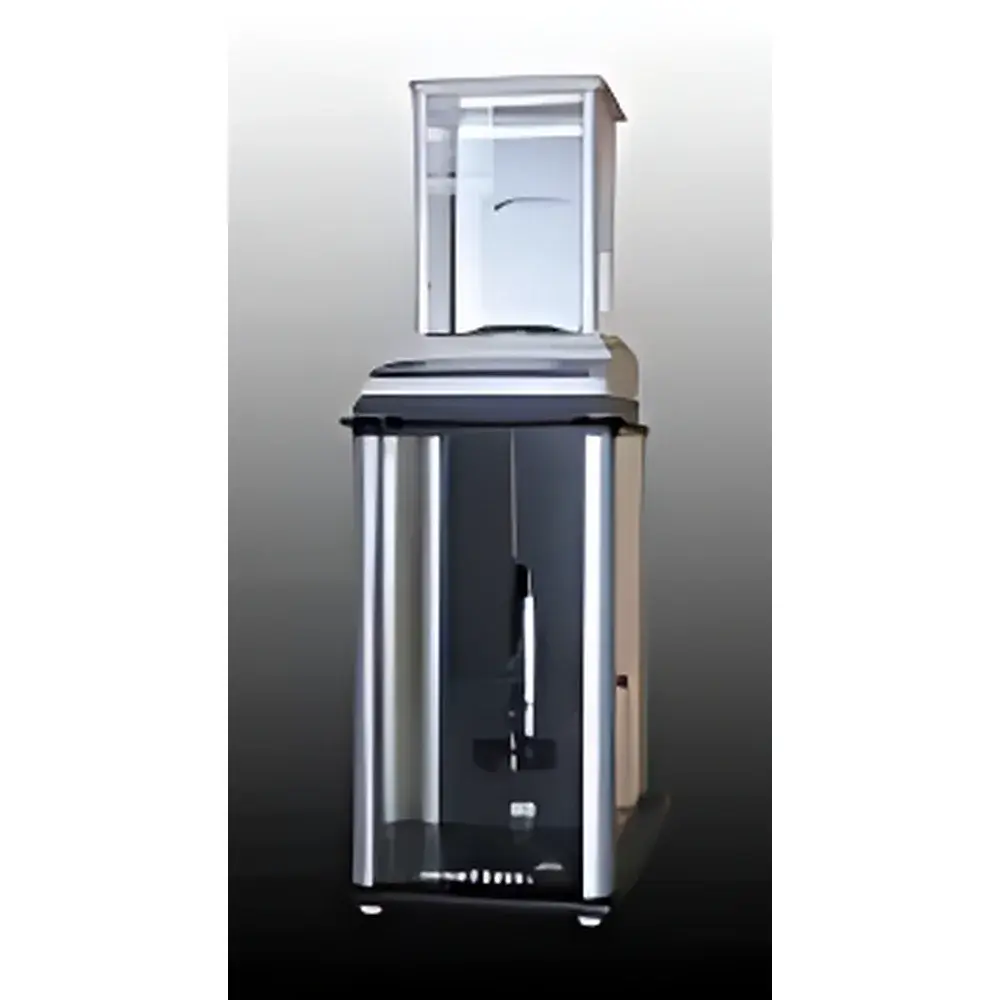
ALPHA densiTECH+ Automatic Density Analyzer for Rubber & Plastics
| Brand | ALPHA |
|---|---|
| Origin | USA |
| Model | densiTECH+ |
| Measurement Principle | Hydrostatic Weighing (ASTM D297, ISO 2781, ASTM D792) |
| Sample Throughput | Up to 4 specimens/min |
| Density Accuracy | ±0.025% of reading |
| Mass Resolution | 0.0001 g |
| Applicable Materials | Cured rubber compounds, thermoplastic elastomers, carbon-black-filled polymers, vulcanizates |
| Compliance | ASTM D297–23, ISO 2781:2015, ISO 1183–1:2019, USP <841> (Density of Solids) |
Overview
The ALPHA densiTECH+ Automatic Density Analyzer is an engineered solution designed specifically for high-throughput, traceable density determination of cured rubber and thermoplastic elastomer compounds in industrial quality control and R&D laboratories. Based on the hydrostatic weighing principle—commonly referred to as Archimedean displacement—the instrument delivers repeatable, operator-independent results by precisely measuring buoyant force in a calibrated immersion fluid (typically distilled water or ethanol). This method complies with internationally recognized standards including ASTM D297–23 (Standard Test Methods for Rubber Products—Chemical Analysis), ISO 2781:2015 (Rubber—Determination of Density), and ISO 1183–1:2019 (Plastics—Methods for Determining the Density of Non-Cellular Plastics). Unlike manual pycnometers or generic digital density meters, the densiTECH+ integrates a high-resolution analytical balance (0.0001 g readability) with automated sample handling, temperature-stabilized fluid bath control, and programmable sequence logic—enabling consistent measurement of vulcanized rubber sheets, molded test plaques, and extruded profiles without manual immersion or drying steps.
Key Features
- Integrated 0.0001 g precision analytical balance with draft shield and internal calibration mass
- Automated immersion cycle with motorized lift stage and fluid-level sensing to minimize operator variability
- Temperature-controlled liquid bath (±0.1 °C stability) compliant with ASTM D297 requirements for thermal equilibrium
- Configurable measurement sequences supporting up to 4 samples per minute under standard operating conditions
- Rugged stainless-steel sample cradle compatible with irregular geometries and carbon-black-loaded rubber specimens
- Self-diagnostic routines for buoyancy correction, air density compensation, and fluid density validation
Sample Compatibility & Compliance
The densiTECH+ is validated for use with sulfur-cured natural rubber (NR), styrene-butadiene rubber (SBR), ethylene propylene diene monomer (EPDM), nitrile rubber (NBR), and thermoplastic polyolefin (TPO) blends containing carbon black loadings up to 60 phr. Specimen dimensions must fall within 10–50 mm in length/width and 2–10 mm in thickness to ensure full submersion and stable suspension. The system meets regulatory expectations for GLP and GMP environments: audit trails are timestamped and user-identifiable; all raw mass values (air weight, immersed weight, fluid temperature) are stored unaltered; and calibration records adhere to ISO/IEC 17025 documentation protocols. Optional 21 CFR Part 11 compliance package includes electronic signatures, role-based access control, and immutable data archiving.
Software & Data Management
The included densiTECH Control Suite (v3.2+) runs on Windows 10/11 and supports both standalone operation and networked deployment. It provides real-time visualization of density trends, statistical process control (SPC) charts (X̄–R, Cp/Cpk), and batch-level reporting aligned with ISO 10012 requirements. All measurements export to CSV, PDF, or LIMS-compatible XML formats. Raw data files retain metadata such as operator ID, environmental conditions (ambient temperature/humidity), balance serial number, and fluid lot traceability. Software updates are delivered via secure HTTPS channel with SHA-256 signature verification.
Applications
- Quality assurance of carbon black dispersion uniformity via density deviation analysis in compounded rubber batches
- Verification of crosslink density in vulcanization process development (correlation with Mooney viscosity and swelling ratio)
- In-process monitoring of filler loading consistency in extrusion and calendering lines
- Material qualification per OEM specifications (e.g., automotive Tier-1 supplier PPAP submissions)
- Research-grade comparative studies of polymer blend homogeneity and phase separation kinetics
FAQ
Does the densiTECH+ require daily recalibration?
No—internal automatic calibration is triggered at user-defined intervals (e.g., every 2 hours) or upon significant ambient temperature shift (>1 °C). Manual calibration using certified weights is recommended weekly or after transport.
Can it measure porous or foamed rubber samples?
Not without modification: standard operation assumes non-porous, impermeable specimens. Optional vacuum impregnation module (densiTECH-VAC) is available for closed-cell elastomers per ASTM D3574 Annex A.
Is third-party validation support provided?
Yes—ALPHA offers IQ/OQ documentation templates, on-site installation qualification (IQ), and operational qualification (OQ) services performed by ISO 17025-accredited field engineers.
What immersion fluids are supported?
Deionized water (standard), ethanol (for low-density TPEs), and halocarbon-based fluids (for high-temperature testing up to 60 °C); fluid density must be entered or auto-detected via integrated densitometer.
How is carbon black dispersion correlated to density readings?
Inhomogeneous dispersion introduces localized voids or agglomerates, resulting in statistically significant inter-sample density variance (>0.05% RSD across n=10 replicates); this deviation serves as an indirect QC metric when combined with image analysis per ASTM D7720.






