
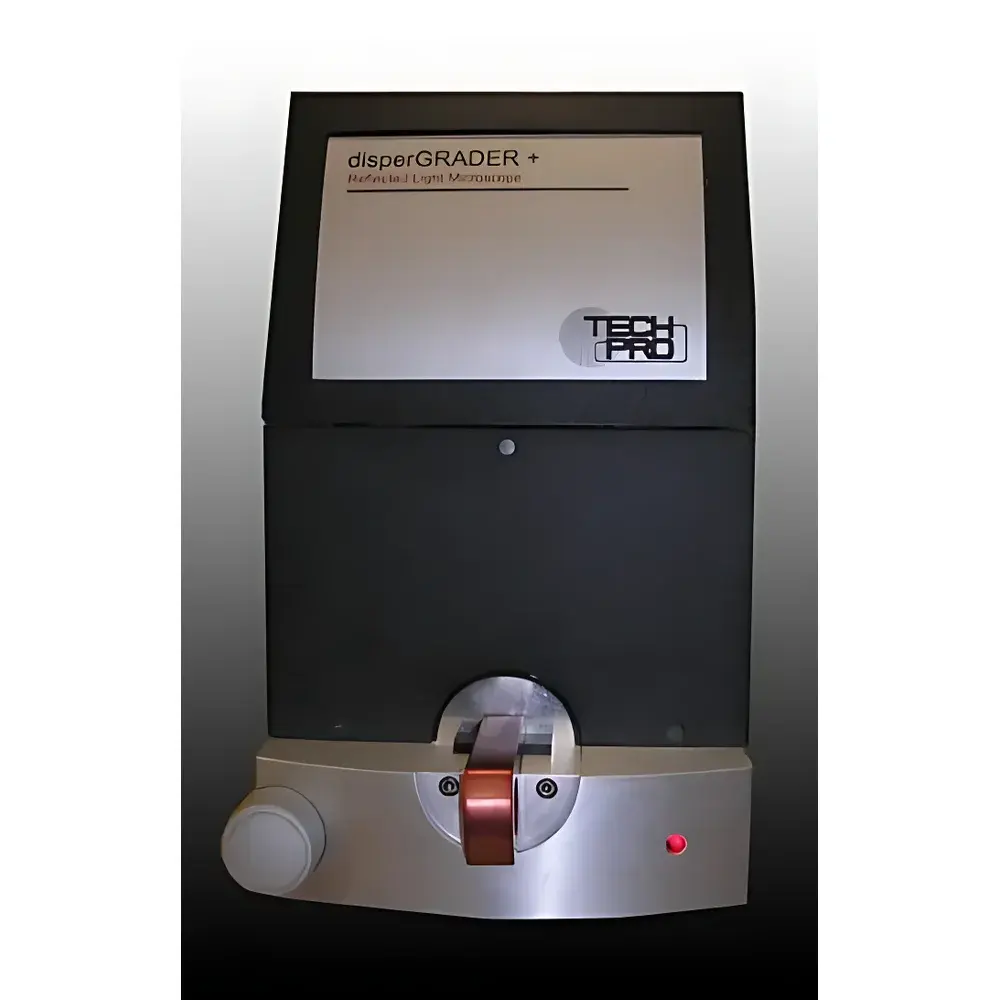
ALPHA DG+ Carbon Black Dispersion Analyzer
| Brand | ALPHA |
|---|---|
| Origin | USA |
| Manufacturer Type | Authorized Distributor |
| Origin Category | Imported Instrument |
| Model | DG+ |
| Pricing | Available Upon Request |
Overview
The ALPHA DG+ Carbon Black Dispersion Analyzer is a purpose-built, non-destructive optical instrumentation system engineered for quantitative assessment of carbon black dispersion in rubber compounds—both uncured and vulcanized. Unlike conventional rheological or Mooney viscosity measurements—which reflect bulk viscoelastic behavior influenced by polymer architecture, filler loading, curative systems, and mixing history—the DG+ directly quantifies the spatial distribution and agglomerate morphology of carbon black particles at the microstructural level. It employs high-resolution reflected-light imaging combined with calibrated grayscale analysis and deterministic image segmentation algorithms to deliver objective, operator-independent dispersion ratings per ASTM D7846–21 (“Standard Test Method for Carbon Black Dispersion in Rubber Using Digital Image Analysis”). The instrument operates on the principle that light reflectance intensity correlates inversely with local carbon black concentration: well-dispersed regions appear uniformly dark (low reflectance), while agglomerates scatter light more strongly, yielding higher pixel intensity values. This enables rapid (<3 min per sample), repeatable (RSD < 3.5% across replicate scans) evaluation without sectioning, staining, or vacuum coating.
Key Features
- Reflectance-based optical imaging platform optimized for elastomeric matrices, eliminating dependence on sample conductivity or surface conductivity treatments
- Automated image acquisition and real-time dispersion grading using ISO/IEC 17025-aligned algorithms compliant with ASTM D7846–21 Annex A2
- Dual-mode operation: supports both flat-sheet specimens (1–3 mm thick) and cured tire tread cutouts (up to 10 mm thickness with optional depth-compensation module)
- Integrated calibration verification via NIST-traceable gray-scale reference targets mounted in-field before each measurement session
- Ruggedized aluminum chassis with vibration-damped optical bench; designed for integration into QC laboratories operating under ISO 9001 and IATF 16949 frameworks
- No consumables required—no solvents, no etchants, no metallization steps—reducing operational cost and EHS exposure
Sample Compatibility & Compliance
The DG+ accommodates raw compound sheets, extruded strips, molded plaques, and post-cure tire components without modification. Compatible with natural rubber (NR), styrene-butadiene rubber (SBR), butadiene rubber (BR), ethylene propylene diene monomer (EPDM), and silica-reinforced formulations when carbon black is the primary conductive filler. All measurement protocols adhere to GLP principles: full audit trail logging (operator ID, timestamp, calibration status, image hash), electronic signature support, and data export in CSV and TIFF formats for long-term archival. The system meets FDA 21 CFR Part 11 requirements for electronic records and signatures when deployed with validated network configuration and role-based access control.
Software & Data Management
DG+ Control Suite v4.2 (Windows 10/11 x64) provides guided workflow navigation, batch processing, statistical process control (SPC) charting (X̄–R, Cpk), and comparative overlay analysis across historical lots. Raw images are stored with embedded EXIF metadata—including lens aperture, exposure time, illumination uniformity coefficient, and auto-threshold confidence score. Export modules support LIMS integration via HL7 and ASTM E1384-compliant XML schemas. Software validation documentation (IQ/OQ/PQ protocols) and 21 CFR Part 11 configuration files are supplied with each installation.
Applications
- Quality release testing of masterbatch and final compound batches prior to extrusion or molding
- Root-cause analysis of premature tread wear or cracking linked to poor filler dispersion
- Process optimization of internal mixers (Banbury), two-roll mills, and continuous mixers via correlation with rotor energy input and dump temperature
- Supplier qualification of carbon black grades (e.g., N110, N220, N330) across lot-to-lot variability
- Supporting ISO/TS 16949 clause 8.5.1.1 (Control of production process) through documented dispersion capability studies (Cp/Cpk ≥ 1.33)
- Research applications in nanocomposite development, including hybrid filler systems (carbon black + silica + graphene oxide)
FAQ
Does the DG+ require sample preparation such as cryo-microtomy or etching?
No. Specimens are imaged in their as-processed state—no sectioning, staining, or surface treatment is necessary.
Can the DG+ quantify dispersion in silica-filled compounds?
It is optimized for carbon black. Silica dispersion requires complementary techniques (e.g., TEM or XRD) due to its low optical contrast in rubber matrices.
Is calibration traceable to national standards?
Yes. Each system ships with NIST-traceable gray-scale reference tiles (SRM 2036), and annual recalibration services are available through ALPHA’s ISO/IEC 17025-accredited service center.
What is the minimum detectable agglomerate size?
Under standard configuration (20× objective), the system resolves features ≥15 µm; optional 50× lens upgrade extends resolution to ≥6 µm.
How does DG+ dispersion rating correlate with mechanical performance?
Empirical correlations exist with tensile strength (R² = 0.89), tear resistance (R² = 0.82), and DIN abrasion loss (R² = 0.77) across SBR/NR blends, as validated in peer-reviewed publications (Rubber Chemistry and Technology, Vol. 95, 2022).





