
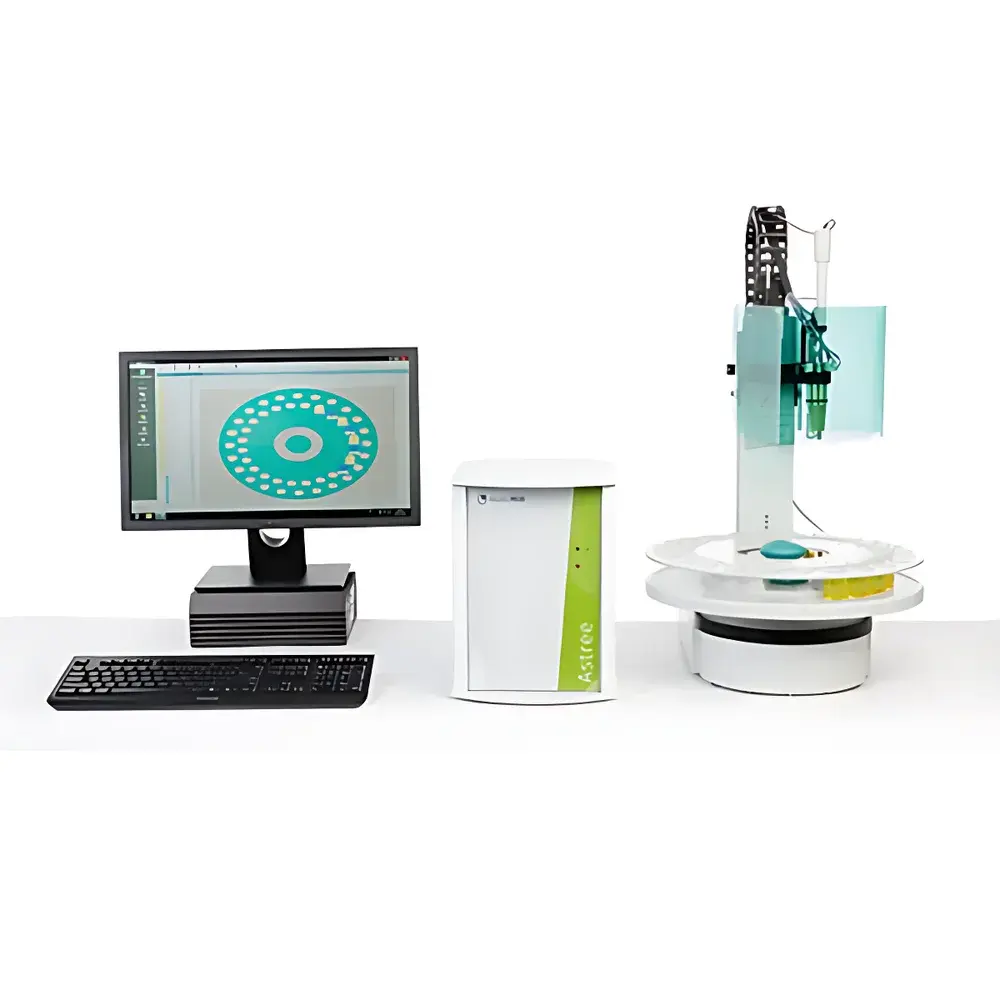
Alpha MOS ASTREE Electronic Tongue System
| Brand | Alpha MOS |
|---|---|
| Origin | France |
| Model | ASTREE Electronic Tongue |
| Product Type | Taste Analysis System |
| Sensor Technology | ChemFET-based Liquid Sensor Array (7-channel) |
| Power Supply | 100–120 VAC / 220–240 VAC, 40 VA |
| Operating Temperature | 15–25 °C (±3 °C daily fluctuation) |
| Dimensions | 260 × 300 × 100 mm (L×W×H) |
| Weight | 25 kg |
| Sampling Frequency | 10 Hz |
| Interface | RS232 |
| Sample Throughput | 1 sample per 3 minutes |
| Sample Capacity | 16-position (min. 80 mL) or 48-position (min. 20 mL) programmable tray |
| Temperature-Controlled Tray | Optional |
| Software | AlphaSoft v9+ (Windows® 7/10 compatible), including PCA, DFA, PLS-DA, and hierarchical clustering modules |
| Compliance | Designed for GLP-compliant laboratories |
Overview
The Alpha MOS ASTREE Electronic Tongue System is a validated, potentiometric multisensor platform engineered for objective, reproducible taste profiling of liquid and soluble solid samples. Unlike conventional sensory panels, the ASTREE operates on the principle of cross-reactive electrochemical sensing: seven chemically modified field-effect transistor (ChemFET) sensors—each functionalized with distinct organic membranes—generate differential potential responses when immersed directly in test solutions. These responses reflect collective interactions with ions, polar molecules, and low-molecular-weight taste compounds (e.g., amino acids, organic acids, salts, bitter alkaloids, nucleotides). The resulting multidimensional signal pattern is not a quantitative assay of individual analytes, but a holistic fingerprint representing the overall gustatory profile—enabling discrimination, classification, and trend analysis across formulations, batches, or processing conditions. The system is purpose-built for R&D, quality control, and regulatory support in food & beverage, pharmaceuticals, cosmetics, and agrochemical sectors where taste masking, flavor stability, ingredient substitution, or off-taste detection are critical.
Key Features
- Seven-channel ChemFET sensor array with orthogonal membrane chemistries—designed for broad-spectrum sensitivity to sour (H⁺), salty (Na⁺/K⁺), bitter (alkaloids, polyphenols), umami (glutamate, IMP), and sweet (sugars, artificial sweeteners) modalities.
- Integrated programmable autosampler with temperature-controlled tray options, magnetic stirring, and timed immersion cycles—ensuring consistent sensor-sample contact time and minimizing carryover.
- Real-time data acquisition at 10 Hz resolution via RS232 interface, synchronized with precise timing protocols for kinetic response capture.
- Modular hardware architecture: compact main unit (260 × 300 × 100 mm, 25 kg), low-power consumption (40 VA), dual-voltage compatibility (100–120 VAC / 220–240 VAC), and operation within tightly controlled ambient conditions (15–25 °C, ±3 °C daily variation).
- Robust mechanical design supporting long-term stability—sensors undergo automated cleaning and recalibration routines between runs to maintain inter-day reproducibility.
Sample Compatibility & Compliance
The ASTREE accepts aqueous solutions, beverages, extracts, emulsions, suspensions, and homogenized slurries—provided solids are fully dissolved or dispersed to avoid sensor fouling. Samples requiring pH adjustment, dilution, or filtration must be prepared consistently per SOP to preserve multivariate integrity. The system complies with Good Laboratory Practice (GLP) framework requirements: AlphaSoft software implements role-based user authentication, electronic signatures, full audit trail logging (including method parameters, sensor status, calibration records, and raw signal timestamps), and data export in CSV and proprietary .ast formats. While not certified as medical device or IVD equipment, its architecture aligns with FDA 21 CFR Part 11 expectations for electronic records and signatures in regulated environments. It is routinely deployed in facilities adhering to ISO 22000, ICH Q5E, and USP guidelines for analytical method validation in sensory-related applications.
Software & Data Management
AlphaSoft v9+ serves as the unified control, acquisition, and chemometric analysis environment. It provides real-time monitoring of all seven sensor signals, automatic baseline correction, and integrated preprocessing (smoothing, alignment, normalization). Advanced multivariate tools include Principal Component Analysis (PCA) for exploratory visualization, Discriminant Function Analysis (DFA) for supervised classification, Partial Least Squares Discriminant Analysis (PLS-DA) for predictive modeling, and hierarchical clustering for batch grouping. Results are rendered as taste maps (2D/3D score plots), radar charts, relative intensity scores (0–100 scale per taste modality), and statistical confidence ellipses. All processing workflows are scriptable and exportable, supporting traceability from raw voltage traces to final interpretation—essential for internal validation reports and regulatory submissions.
Applications
- Formulation optimization: Quantifying impact of sweetener blends, salt reduction, or bitterness-masking agents in functional foods and oral pharmaceuticals.
- Batch-to-batch consistency monitoring: Detecting subtle deviations in fermentation broths, dairy products, coffee extracts, or herbal infusions beyond human panel capability.
- Shelf-life assessment: Tracking taste drift during accelerated aging studies via temporal trajectory mapping in PCA space.
- Raw material screening: Rapid evaluation of supplier variability in fruit concentrates, yeast extracts, or hydrolyzed proteins.
- Masking efficacy verification: Objective measurement of placebo vs. active ingredient taste interference in pediatric suspensions or chewables.
FAQ
How does the ASTREE differ from a gas chromatography–olfactometry (GC-O) system?
The ASTREE measures aqueous-phase ionic and molecular interactions via potentiometry—not volatile compound separation. It addresses taste (gustation), whereas GC-O targets odor (olfaction); the two modalities are complementary but physicochemically distinct.
Can the system quantify absolute concentrations of tastants like sucrose or NaCl?
No. It delivers relative, pattern-based discrimination—not quantitative assay. Calibration models may correlate sensor patterns with concentration ranges under strict experimental control, but such models require rigorous validation per ICH Q2(R2).
What maintenance is required for the ChemFET sensors?
Sensors undergo automated rinsing with deionized water and reference solution between samples. Lifetime exceeds 2,000 measurements with proper handling; replacement is recommended after 12–18 months of continuous use or if signal noise exceeds 5 mV RMS.
Is method transfer possible between different ASTREE units?
Yes—provided identical sensor lots, standardized sample prep protocols, and matched AlphaSoft versioning. Cross-unit reproducibility studies (per ISO 5725) are advised for multi-site deployments.
Does Alpha MOS provide method development support?
Yes. Alpha MOS offers application-specific consulting, including experimental design (DoE), sensor selection guidance, and chemometric model validation services aligned with ASTM E178 and ISO 11095 standards.




