
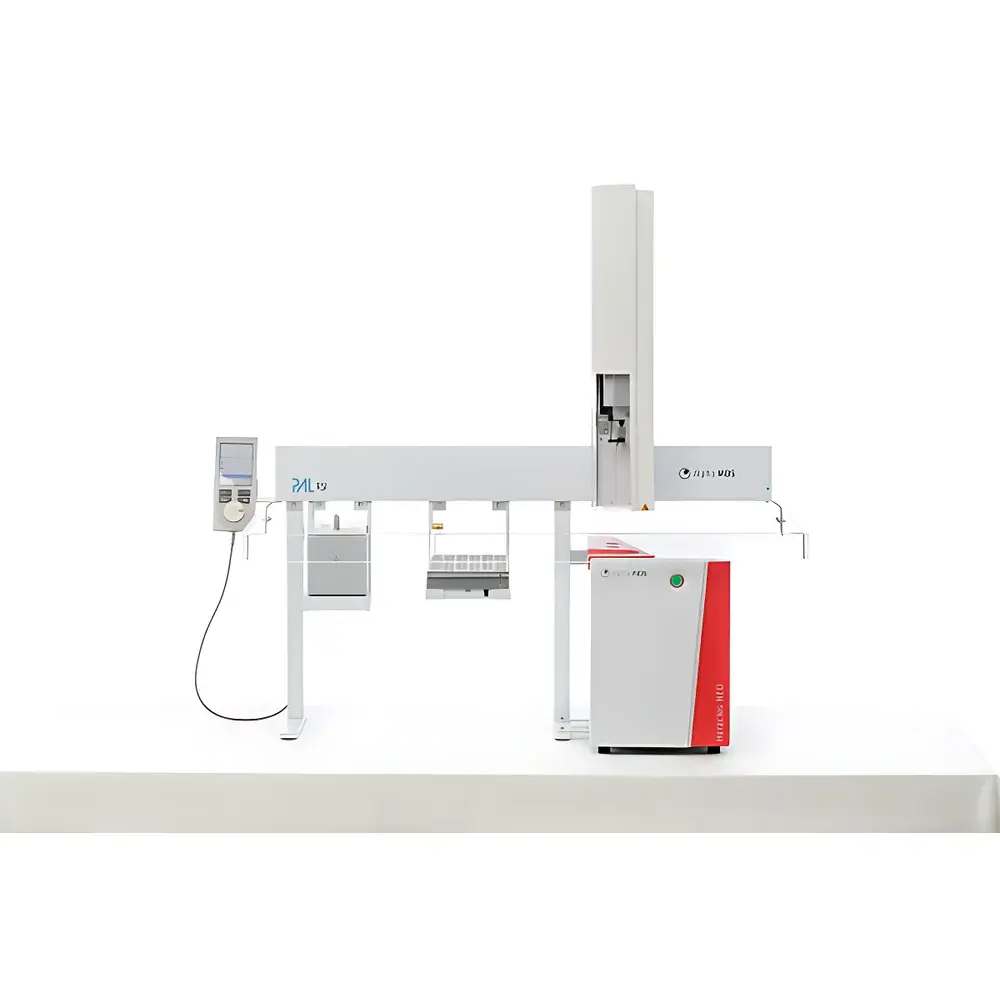
Alpha MOS Heracles NEO Dual-Channel Fast Gas Chromatography Electronic Nose
| Brand | Alpha MOS |
|---|---|
| Origin | France |
| Model | Heracles NEO 100/150 |
| Type | Olfactory Analysis System (Electronic Nose) |
| Detection Principle | Dual-channel fast gas chromatography with flame ionization detection (FID) and/or photoionization detection (PID) |
| Column Technology | Optimized capillary columns with enhanced stationary phase stability |
| Thermal Management | Active temperature regulation for improved retention time reproducibility and baseline stability |
| Data Processing | Multivariate statistical analysis (PCA, DFA, PLS-DA), AroChemBase v7 molecular database (>15,000 compounds) |
| Software Platform | AlphaSoft v15 with Sensory ID algorithm, MMI Pro v1.0 operator interface |
| Compliance | Designed to support GLP/GMP workflows |
Overview
The Alpha MOS Heracles NEO is a dual-channel fast gas chromatography-based electronic nose engineered for high-throughput, reproducible olfactory profiling of volatile organic compounds (VOCs). Unlike conventional single-column GC systems, the Heracles NEO integrates two parallel, independently programmable capillary GC channels—each equipped with optimized stationary phases and precision thermal control—to enable simultaneous separation and detection of complex odorant mixtures in under 90 seconds. Its core measurement principle relies on rapid thermal desorption followed by dual-channel GC-FID (flame ionization detection) or optional GC-PID (photoionization detection), delivering robust chromatographic fingerprints that serve as digital odor signatures. These fingerprints are then subjected to multivariate pattern recognition algorithms embedded in AlphaSoft v15, enabling objective, quantitative discrimination between samples based on chemical composition rather than subjective sensory evaluation. The system is purpose-built for industrial laboratories requiring trace-level VOC profiling across R&D, quality assurance, and production line monitoring—particularly where batch consistency, off-odor detection, formulation optimization, or competitor benchmarking are critical performance metrics.
Key Features
- Dual-channel fast GC architecture: Independent temperature programming per channel enables method flexibility and redundancy—critical for method validation and long-term operational continuity.
- Enhanced thermal management system: Active column oven stabilization minimizes retention time drift (<0.02 min over 48 h), ensuring chromatographic reproducibility required for statistical model deployment in QA/QC environments.
- Dynamic range extension: Detector electronics upgraded to deliver 35× wider linear dynamic range without compromising limit of detection—enabling simultaneous quantification of major and trace-level volatiles within a single run.
- Automated system conditioning: AlphaSoft v15 initiates pre-sequence cleaning protocols—including trap regeneration and column purging—based on elapsed standby time, reducing carryover and improving baseline integrity.
- Sensory ID algorithm: A patented, integration-free data processing module that aligns chromatograms automatically and generates PASS/FAIL outputs against reference models—eliminating manual peak integration and accelerating release decisions.
- MMI Pro v1.0 interface: Role-based, simplified operator dashboard designed for production-floor use—restricting access to validated methods only, minimizing procedural errors, and supporting untrained personnel in routine testing.
Sample Compatibility & Compliance
The Heracles NEO accommodates gaseous, headspace, and liquid-phase samples via interchangeable autosamplers (e.g., HS-100 for headspace, GAS-200 for gas standards, LIQ-300 for liquids). Sample introduction is fully automated and thermally controlled to ensure consistent vaporization kinetics. All hardware and software components comply with IEC 61000-6-3 (EMC) and IEC 61010-1 (safety) standards. When deployed with audit trail logging, electronic signatures, and role-based permissions enabled, the system supports regulatory compliance frameworks including ISO/IEC 17025, ASTM E2721 (standard practice for electronic nose data reporting), and FDA 21 CFR Part 11 for electronic records and signatures. It is routinely used in food & beverage, pharmaceutical, cosmetics, and packaging industries where GLP- or GMP-aligned documentation of odor-related deviations is mandatory.
Software & Data Management
AlphaSoft v15 serves as the unified analytical platform, integrating instrument control, real-time chromatogram visualization, multivariate modeling (PCA, DFA, PLS-DA, SIMCA), and report generation. AroChemBase v7—a curated, searchable molecular database containing >15,000 VOCs with retention index references and mass spectral correlations—enables compound-level annotation when coupled with library matching and retention index calibration. All data files are stored in vendor-neutral HDF5 format with embedded metadata (method parameters, calibration history, user actions), facilitating third-party integration and long-term archival. Version-controlled method templates, encrypted project folders, and configurable export options (CSV, PDF, XML) ensure traceability and interoperability with LIMS and ELN systems.
Applications
- Batch-to-batch consistency verification in food manufacturing—detecting fermentation anomalies, lipid oxidation markers, or microbial spoilage volatiles.
- Rapid raw material screening in pharma excipient supply chains—identifying solvent residues or degradation products outside specification.
- Competitive product benchmarking—mapping odor space differences between branded and generic formulations using PCA loadings and clustering.
- Off-odor root cause analysis—correlating sensory panel findings with VOC profiles to isolate contamination sources (e.g., packaging migrants, cleaning agent residuals).
- Stability study monitoring—tracking time-dependent VOC evolution in accelerated aging trials to predict shelf-life endpoints.
- Regulatory dossier support—generating reproducible, auditable odor fingerprints for submissions requiring analytical justification of organoleptic claims.
FAQ
What distinguishes Heracles NEO from conventional electronic noses?
Unlike metal-oxide or polymer-sensor-based e-noses, Heracles NEO employs dual-channel fast GC as its core transduction mechanism—delivering chemically resolved, retention-time-stable fingerprints rather than non-specific resistance or capacitance changes.
Can Heracles NEO quantify target compounds?
Yes—when calibrated with certified standards, it supports semi-quantitative and quantitative analysis using internal standardization or external calibration curves, compliant with ISO 11337 and ASTM D7213 protocols.
Is AroChemBase searchable by functional class or odor descriptor?
Yes—compounds are annotated with CAS numbers, retention indices, odor descriptors (e.g., “fruity”, “musty”), functional groups, and chemical classes, enabling targeted queries beyond exact mass or RI matching.
How does Sensory ID handle sample variability in production environments?
Sensory ID applies robust Mahalanobis distance thresholds and outlier detection logic to account for normal process variation—reducing false positives while maintaining sensitivity to genuine chemical deviations.
What level of IT infrastructure is required to deploy AlphaSoft v15 in a regulated lab?
AlphaSoft supports Windows Server 2016+ with SQL Server database backend; network deployment, domain authentication, and centralized license management are fully supported for enterprise-scale rollouts.




