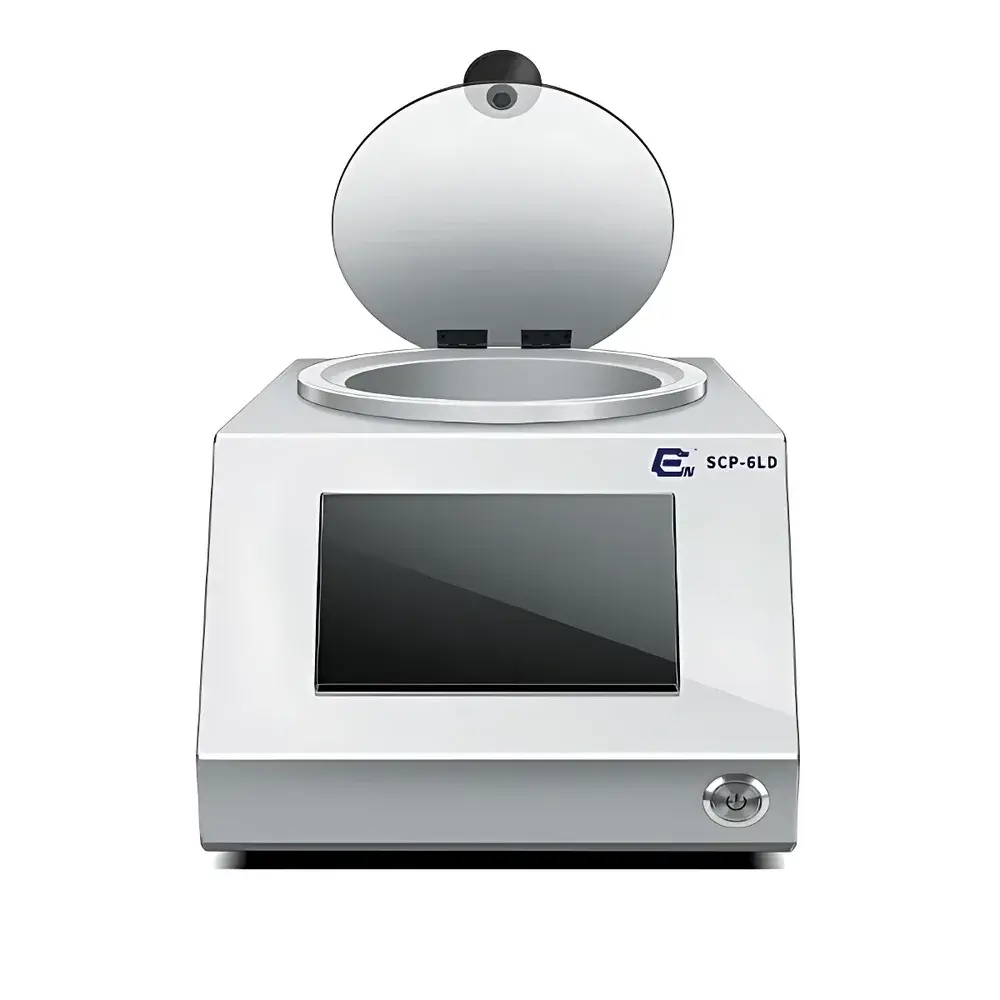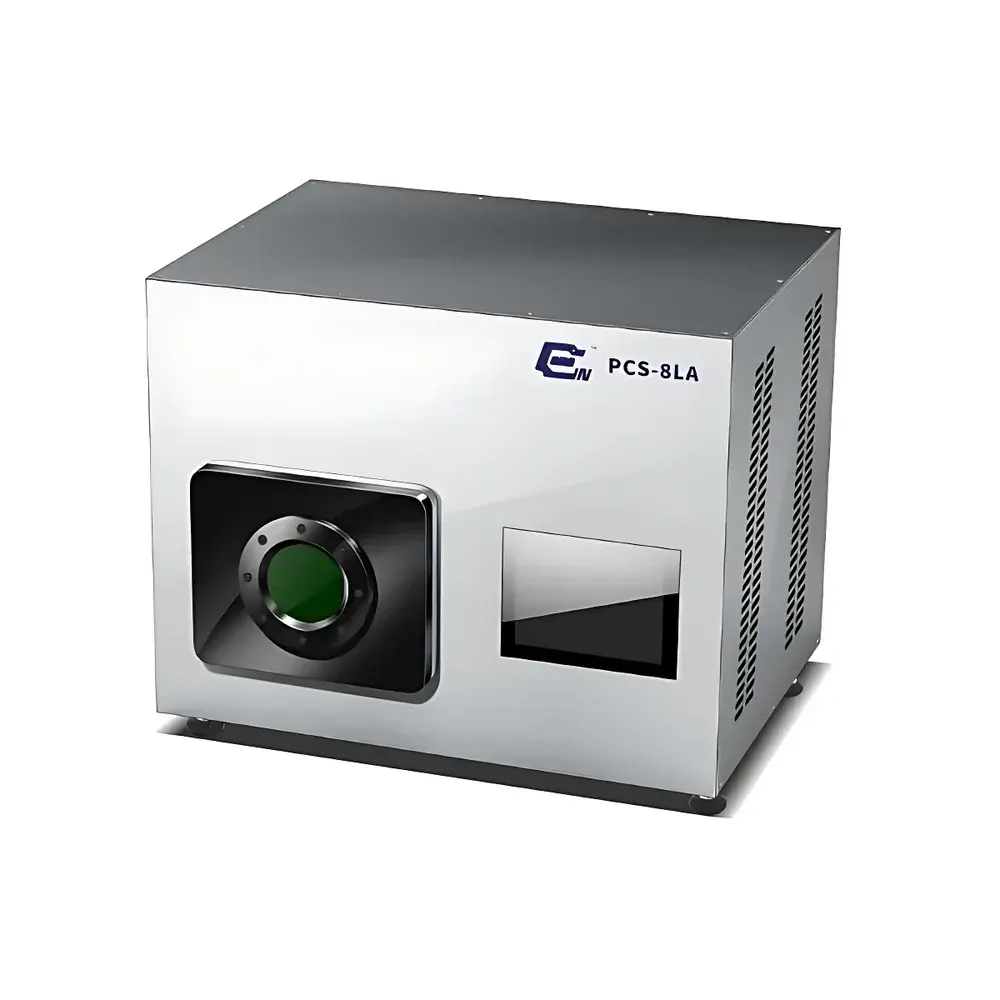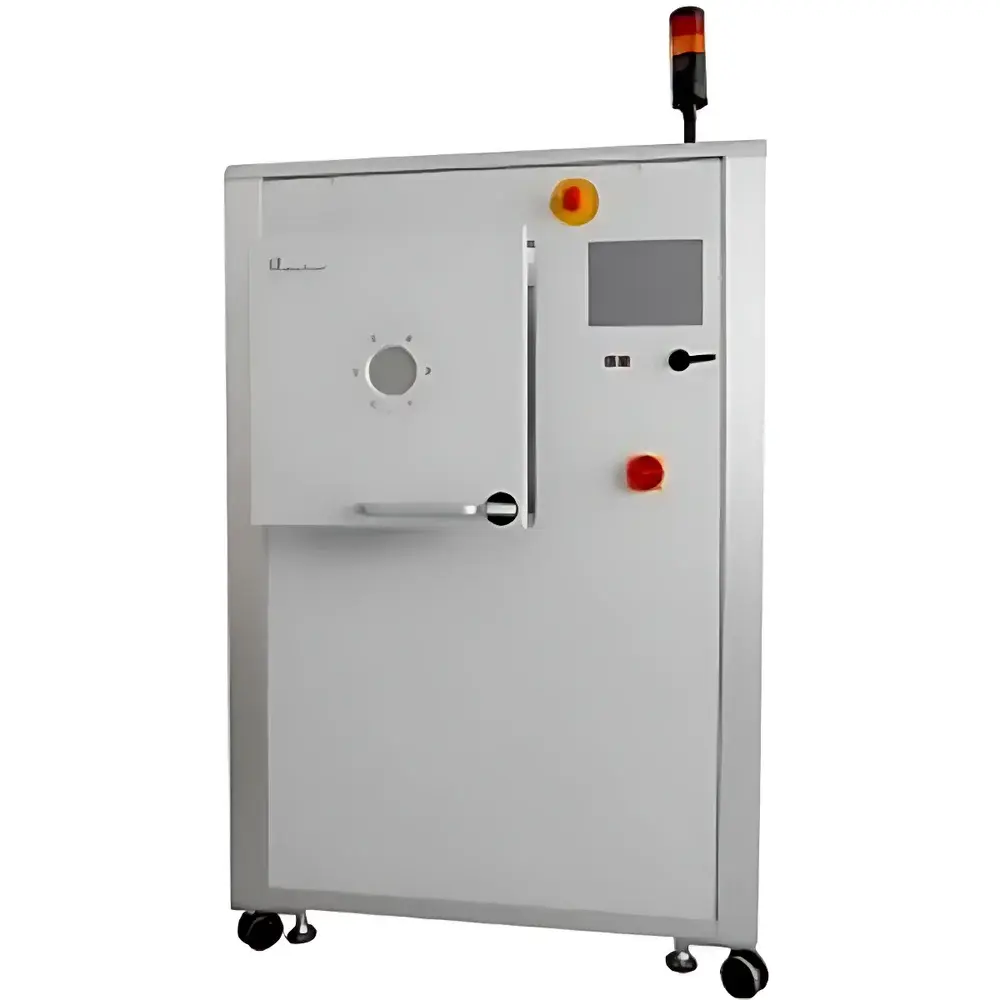
Alpha Plasma AL76 Compact Microwave Plasma Cleaner
| Brand | Alpha Plasma |
|---|---|
| Origin | Germany |
| Model | AL76 |
| Plasma Source | 2.45 GHz microwave, 1200 W |
| Chamber Volume | 76 L (400 × 400 × 490 mm, aluminum) |
| External Dimensions | 1050 × 800 × 2020 mm (incl. tri-color status tower) |
| Gas Inlets | 3 standard mass flow-controlled lines (MKS digital controllers) |
| Optional | 4th gas line, ECR enhancement, φ350 mm adjustable-speed rotating stage, dry pump package, UV/microwave-shielded viewport, hinged + drawer-type vacuum door |
Overview
The Alpha Plasma AL76 Compact is a benchtop-integrated microwave plasma cleaning system engineered for high-reproducibility surface activation, organic residue removal, and native oxide reduction in semiconductor packaging and microelectronic fabrication environments. Operating at the industrial standard frequency of 2.45 GHz, the system generates high-density, low-pressure plasma via waveguide-coupled microwave excitation—enabling efficient dissociation of process gases (e.g., O₂, Ar, H₂, CF₄, or N₂) without internal electrodes. This electrodeless configuration eliminates particle generation and sputtering contamination, making the AL76 particularly suitable for pre-bonding and pre-molding surface preparation where trace metallic or carbonaceous contamination must be avoided. Its compact 76 L aluminum chamber supports batch processing of wafers up to 8″, leadframes, substrates, and discrete packages—meeting throughput requirements for both R&D validation and pilot-line production.
Key Features
- 2.45 GHz microwave plasma source with 1200 W nominal power output, delivering stable electron density >1 × 10¹¹ cm⁻³ under typical operating conditions (1–10 Pa)
- Electrodeless cavity design fabricated from anodized aluminum, minimizing metal ion leaching and ensuring long-term vacuum integrity
- Dual-mode vacuum access: front-mounted hinged door combined with bottom drawer-style loading—optimized for operator ergonomics and cleanroom gowning compatibility
- UV- and microwave-shielded borosilicate viewport with integrated optical filter (λ 60 dB), enabling real-time plasma emission monitoring without radiation exposure
- Three independently controlled gas inlets equipped with MKS digital mass flow controllers (MFCs), offering ±0.5% full-scale accuracy and 0.1 sccm minimum resolution
- 10.4-inch resistive touchscreen GUI running Windows CE 6.0 with embedded recipe management, event logging, and password-protected user roles (Operator, Engineer, Administrator)
- Modular architecture supporting optional ECR (electron cyclotron resonance) magnetic field enhancement for higher ionization efficiency in inert or mixed-gas chemistries
Sample Compatibility & Compliance
The AL76 accommodates substrates ranging from bare silicon wafers and ceramic packages to flexible PCBs and MEMS assemblies. Its uniform plasma distribution—validated per IEC 60601-2-67 Annex D methodology—ensures consistent treatment across 350 mm diameter rotating stages (optional). Chamber geometry and gas dynamics are optimized for conformal cleaning of high-aspect-ratio features (e.g., TSVs, fine-pitch solder bumps). The system complies with CE marking requirements (2014/30/EU EMC Directive, 2014/35/EU LVD), and its control firmware supports audit-ready data integrity protocols aligned with ISO 9001:2015 and ISO/IEC 17025:2017 documentation practices. When configured with optional dry pump and validated gas delivery, it meets baseline prerequisites for GLP-compliant process qualification in packaging development labs.
Software & Data Management
The embedded Windows CE platform hosts AlphaPlasma Control Suite v3.2—a deterministic real-time application enabling synchronized control of RF power ramping, gas sequencing, pressure regulation, and stage rotation. All process parameters—including actual power delivery, chamber pressure (capacitance manometer), MFC setpoints vs. readings, and elapsed time—are timestamped and stored locally with SHA-256 checksum integrity verification. Export formats include CSV (for SPC analysis) and XML (for LIMS integration). Audit trail functionality records user login/logout events, parameter modifications, and emergency stop triggers—fully compliant with FDA 21 CFR Part 11 requirements when paired with network-authenticated domain accounts and electronic signature modules.
Applications
- Pre-die attach surface activation to enhance epoxy adhesion strength and reduce void formation in flip-chip and wire-bonded assemblies
- Removal of photoresist residues and post-etch polymer scum prior to underfill dispensing or molding compound encapsulation
- Oxide thinning and hydrophilicity enhancement on SiO₂/SiN surfaces for improved wafer-level bonding yield
- Surface decontamination of ceramic substrates (Al₂O₃, AlN) and LTCC carriers used in RF module packaging
- Plasma-assisted cleaning of stencil masks and probe cards to extend maintenance intervals and reduce defect density
FAQ
What vacuum level can the AL76 achieve with the standard pump configuration?
With the base mechanical roughing pump, the system reaches ≤5 × 10⁻² mbar; with the optional dry scroll pump package, ultimate pressure improves to ≤1 × 10⁻³ mbar.
Is remote monitoring supported via Ethernet or RS-232?
Yes—the system includes a 10/100 Mbps Ethernet port and isolated RS-232 interface, both supporting Modbus TCP and ASCII command sets for factory automation integration.
Can the AL76 be qualified for Class 100 cleanroom operation?
Yes—when equipped with HEPA-filtered purge gas lines and static-dissipative chamber coatings, it meets ISO 14644-1 Class 5 (Class 100) particulate limits during idle and active operation.
Does the rotating stage option support programmable acceleration/deceleration profiles?
Yes—rotation speed (0–25 rpm) and ramp rate (0.1–5 rpm/s) are fully programmable per recipe step, with position feedback via optical encoder.
Are calibration certificates provided for the MKS mass flow controllers?
Each MFC is supplied with NIST-traceable calibration documentation valid for 12 months from shipment, including as-found/as-left data and uncertainty budgets.