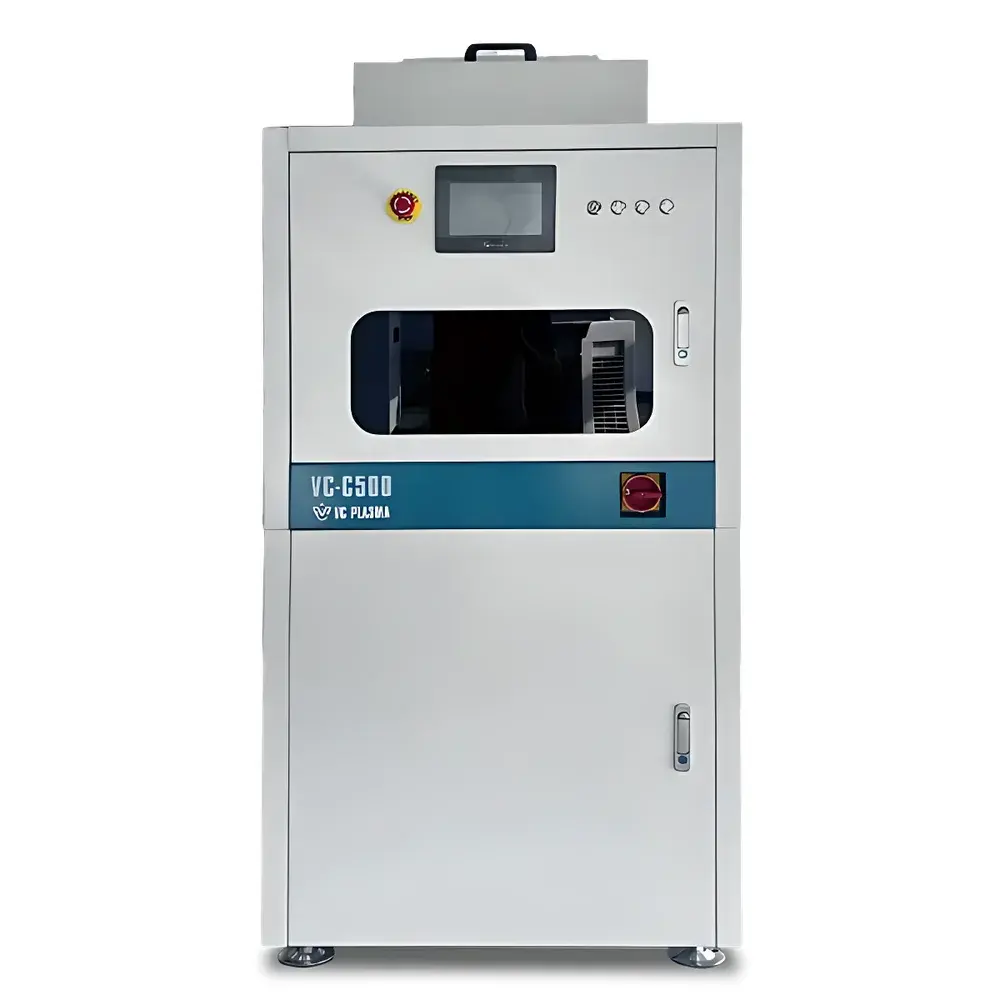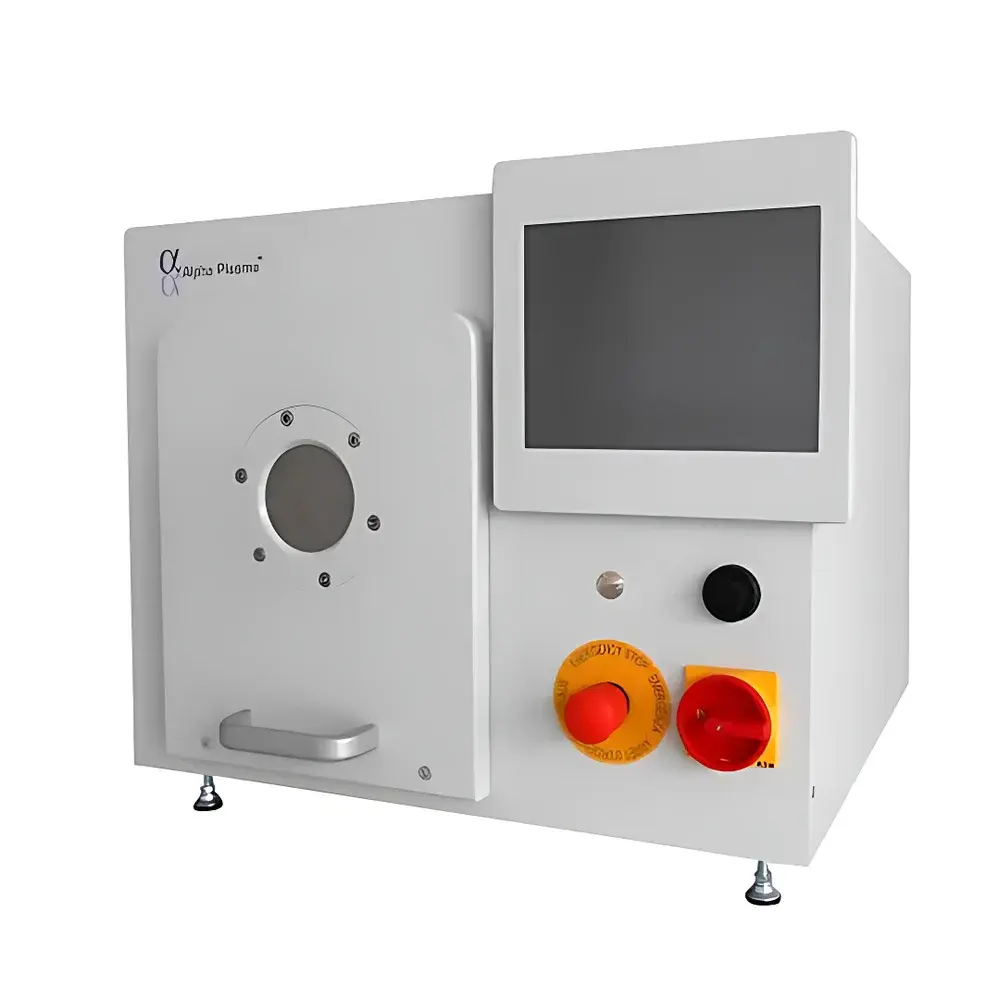
Alpha Plasma Q235 Microwave Plasma Resist Stripper
| Brand | Alpha Plasma |
|---|---|
| Origin | Germany |
| Model | Q235/Q240 |
| Plasma Source | 2.45 GHz microwave, 600 W |
| Chamber | Quartz, Ø235 mm × 260 mm L |
| Max Wafer Size | 200 mm (8″) |
| Dimensions (L×W×H) | 460 × 590 × 550 mm |
| Gas Inlets | 2 standard + optional up to 4 |
| Mass Flow Controllers | Digital MKS type |
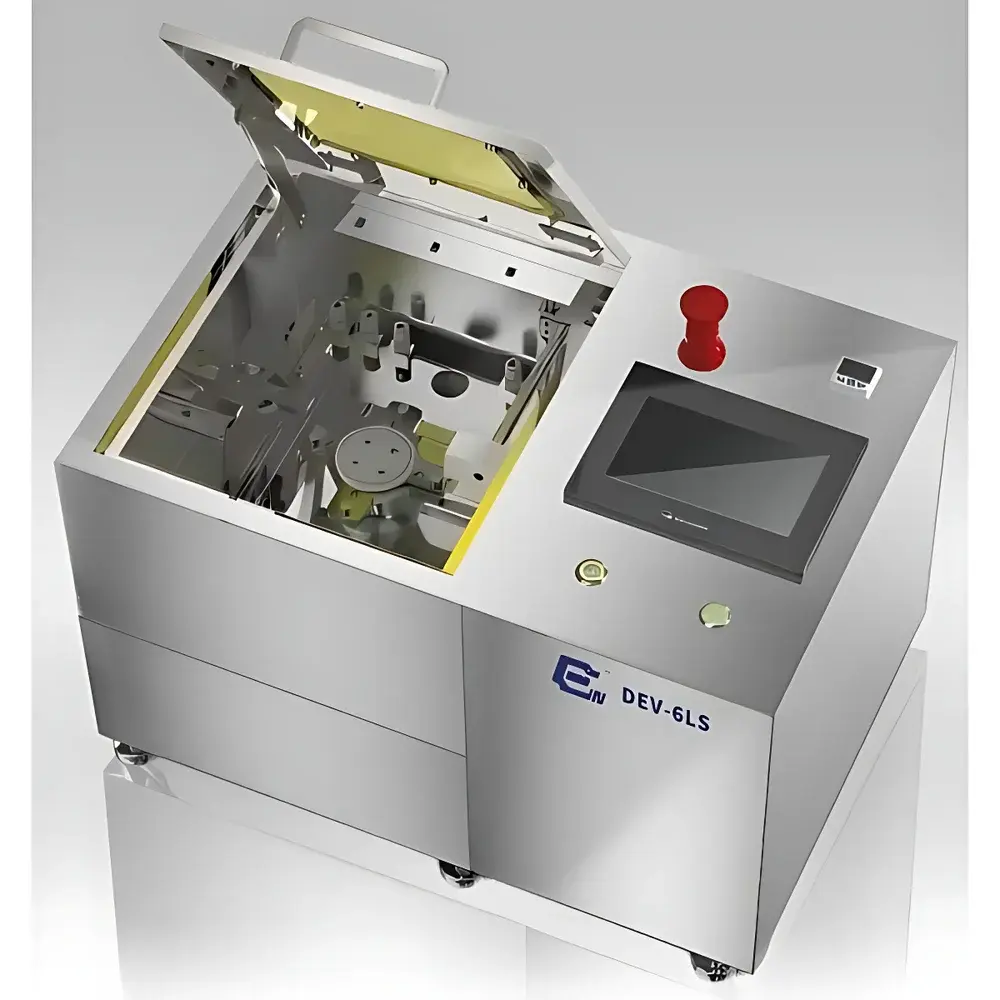
| Chamber Door | Drawer-type with UV/microwave-shielded viewport |
| Substrate Holder | Temperature-controlled wafer chuck |
| Control Interface | 7″ GUI touchscreen, Windows CE OS |
| Optional | Dry vacuum pump system, Faraday cage, quartz boat, tri-color status beacon |
Overview
The Alpha Plasma Q235 is a benchtop microwave plasma resist stripper engineered for precision photoresist removal in semiconductor R&D, pilot-line fabrication, and low-volume production environments. Operating at the industrial standard frequency of 2.45 GHz, the system generates high-density, low-pressure plasma via waveguide-coupled microwave excitation—enabling efficient, non-thermal ashing of organic resists without substrate damage or metal line erosion. Unlike RF-based plasma systems, the microwave architecture delivers superior plasma uniformity across the entire 200 mm (8″) wafer area, minimizing edge effects and ensuring reproducible etch rates. The quartz chamber (Ø235 mm × 260 mm) provides chemical inertness, thermal stability, and optical transparency for real-time process monitoring—critical for process development and DOE validation. Designed to ISO 14644-1 Class 5 cleanroom compatibility, the Q235 integrates seamlessly into controlled microfabrication workflows where particle control, gas purity, and process repeatability are governed by SEMI S2/S8 safety and environmental standards.
Key Features
- 2.45 GHz microwave plasma source delivering stable 600 W power output with <±2% power regulation for high inter-run reproducibility
- Quartz cylindrical chamber (Ø235 mm × 260 mm) optimized for uniform field distribution and minimal standing-wave interference
- Drawer-type front access door with laminated borosilicate viewport featuring integrated UV-blocking and microwave-shielding coatings (≥60 dB attenuation at 2.45 GHz)
- Temperature-regulated electrostatic chuck (ESC) with ±0.5 °C stability over full operating range (25–120 °C), enabling thermally sensitive resist stripping
- Dual-channel digital mass flow controllers (MKS Series) with 0.5–10 sccm range and ≤1% full-scale accuracy for precise O₂, N₂, CF₄, or forming gas dosing
- 7-inch resistive touchscreen HMI running Windows CE 6.0 with embedded recipe management, real-time parameter logging, and USB export capability
- Modular gas manifold supporting expansion from 2 to 4 independent gas lines—pre-wired for future integration of auxiliary chemistries (e.g., H₂, Ar, SF₆)
Sample Compatibility & Compliance
The Q235 accommodates wafers up to 200 mm diameter on standard quartz boats or custom carriers; substrates include Si, SiO₂, SiNₓ, GaAs, and patterned metal stacks (Al, Cu, TiN). Its low-ion-energy plasma regime preserves underlying dielectrics and avoids trench undercutting—making it suitable for post-lithography, post-etch, and post-metallization cleaning per SEMI F28 (Photoresist Stripping Test Method) and ASTM F390 (Semiconductor Wafer Surface Cleanliness). Vacuum integrity meets ISO 2859-1 sampling plans for leak rate verification (<1×10⁻⁷ mbar·L/s He). All electrical interfaces comply with IEC 61000-6-3 (EMC emissions) and IEC 61000-6-4 (immunity), while mechanical design adheres to SEMI S2-0217 human safety requirements—including interlocked door sensors and emergency stop circuitry certified to EN 60204-1.
Software & Data Management
The embedded Windows CE platform hosts a dedicated process control application supporting up to 99 user-defined recipes, each with programmable ramp/soak sequences, gas switching logic, and pressure setpoints. All operational parameters—including forward/reflected microwave power, chamber pressure, gas flows, chuck temperature, and runtime—are timestamped and stored locally with ≥10,000-cycle retention. Audit trail functionality satisfies GLP/GMP traceability requirements: user login authentication, change logs, and electronic signatures are available as optional firmware modules compliant with FDA 21 CFR Part 11 Annex 11 guidelines. Data export supports CSV and XML formats for integration with MES platforms such as Siemens Opcenter or Applied Materials EnduraLink.
Applications
- Photoresist ashing after lithographic patterning (positive/negative resists, including chemically amplified types)
- Residue removal following reactive ion etching (RIE) of SiO₂, SiNₓ, or low-k dielectrics
- Surface activation prior to ALD or PVD deposition
- Post-CMP organic contaminant removal without aqueous chemistry
- MEMS release etching using oxygen-based plasma for sacrificial layer removal
- Failure analysis sample preparation—preserving topography and interface integrity for SEM/FIB cross-sectioning
FAQ
What wafer sizes does the Q235 support?
The system is configured for 100 mm, 150 mm, and 200 mm (8″) wafers; maximum usable diameter is 200 mm with quartz boat loading.
Is the Q235 compatible with corrosive process gases like NF₃ or Cl₂?
Standard configuration supports O₂, N₂, Ar, CF₄, and forming gas; NF₃ and Cl₂ require optional corrosion-resistant internal coatings and stainless-steel gas lines—contact technical support for material compatibility review.
Can the system be integrated into a factory automation environment?
Yes—SECS/GEM communication protocol support is available via optional RS-422 or Ethernet interface; SECS-II message sets conform to SEMI E30 and E37 standards.
Does the Q235 meet electromagnetic compatibility requirements for cleanroom deployment?
Yes—the unit carries CE marking per EMC Directive 2014/30/EU and includes a factory-installed Faraday cage option to suppress radiated emissions in shared tool bays.
What maintenance intervals are recommended for the microwave generator and vacuum system?
Microwave magnetron lifetime exceeds 10,000 hours; dry pump service is recommended every 6 months or 2,000 operating hours—logbook templates and PM checklists are included in the documentation package.
Related Products