
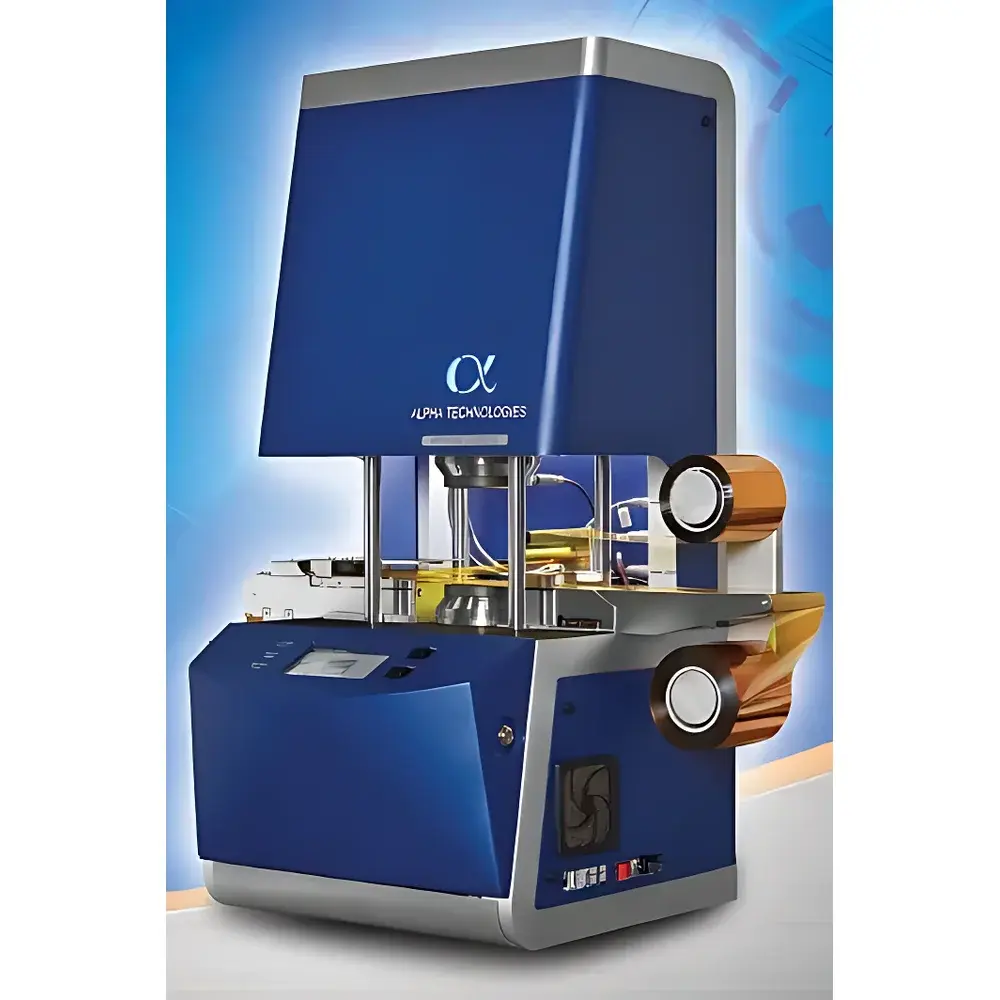
Alpha Premier MDR Unrotor Vulcanizometer
| Brand | ALPHA (USA) |
|---|---|
| Origin | USA |
| Model | Premier MDR |
| Compliance | ASTM D5289, ISO 6520, DIN 53529 |
| Oscillation Frequency | 100 CPM (1.677 Hz) |
| Oscillation Amplitude | ±0.2°, ±0.5°, ±1.0°, ±3.0° (standard ±0.5°) |
| Temperature Range | 40–230 °C (100–446 °F) |
| Torque Range | 0.01–225 dN·m |
| Cavity Volume | ~1.43 cm³ (87.5 mm³ nominal |
| recommended sample volume | 1.84 cm³ / 112.5 mm³) |
| Pressure Channel | 0–8300 kPa (0–1200 psi) |
| Power Supply | 100–130 VAC ±10%, 60 ±3 Hz, 10 A or 200–260 VAC ±10%, 50 ±3 Hz, 5 A |
| Automation Options | 5-position manual test station or 16–144-position automated sample handling system |
| Software | Ultima Enterprise Pathfinder (Eclipse optional) |
Overview
The Alpha Premier MDR Unrotor Vulcanizometer is an industry-standard instrument for the precise characterization of rubber compound cure behavior under controlled thermal and dynamic mechanical conditions. Engineered for high reproducibility and long-term stability, it operates on the principle of oscillating disk rheometry—measuring torque response of uncured elastomer samples subjected to sinusoidal shear deformation within a sealed, temperature-regulated cavity. Unlike rotor-based systems, the unrotor design eliminates mechanical wear at the drive interface, ensuring consistent calibration integrity over thousands of test cycles. Its core application lies in quantifying scorch time (ts₁, ts₂), cure rate (maximum slope of torque curve), state-of-cure (ML, MH, MH−ML), viscoelastic parameters (S″@ML, tan δ@MH), and pressure evolution (PL, PH) during vulcanization—data essential for formulation development, quality control, and process validation in tire, automotive sealing, and industrial rubber manufacturing.
Key Features
- Dynamic Symmetry Architecture: Four-column rigid frame with dynamically balanced upper beam minimizes structural resonance and ensures mechanical stability across wide temperature ranges and extended duty cycles.
- Smart Alignment System: Precision-machined cavity alignment mechanism guarantees repeatable mold closure force and uniform gap geometry—critical for eliminating torque drift due to misalignment-induced shear gradient errors.
- Smart-Seal Technology (Optional): Eliminates reliance on elastomeric O-rings by integrating pressure-compensated metal-to-metal sealing surfaces, reducing maintenance intervals and improving inter-laboratory data comparability over multi-year deployments.
- Rapid Change™ Oscillation Angle Adjustment: Eccentric cam-driven amplitude selection enables on-the-fly switching between ±0.2°, ±0.5°, ±1.0°, and ±3.0° (up to ±7.17°) without recalibration—supporting both low-strain linear viscoelastic analysis and high-amplitude nonlinear characterization.
- Dual-Zone Forced-Air Cooling: Independent thermal regulation of upper and lower platens achieves ≤30 s temperature transitions between 100 °C and 150 °C, enabling accurate simulation of multi-stage cure profiles per ASTM D5289 Annex A2.
- Optimized Dual-Conical Cavity Design: Redesigned groove geometry and surface finish minimize specimen slippage during oscillation, enhancing measurement fidelity for high-hardness compounds (Shore A >90) and filled elastomers.
Sample Compatibility & Compliance
The Premier MDR accommodates standard ASTM/ISO-compliant rubber specimens (1.84 cm³ recommended volume) in its dual-conical cavity (1.43 cm³ nominal volume). It supports natural rubber (NR), synthetic elastomers (SBR, BR, EPDM, FKM), thermoplastic vulcanizates (TPVs), and silica- or carbon-black-filled compounds. All hardware and firmware comply with ASTM D5289–22, ISO 6520:2021, and DIN 53529–2:2018. The system meets GLP/GMP environmental monitoring requirements when operated within validated HVAC-controlled laboratories and supports FDA 21 CFR Part 11 compliance through Ultima Enterprise Pathfinder’s electronic signature, role-based access control, and immutable audit trail functionality.
Software & Data Management
Ultima Enterprise Pathfinder provides full-cycle test orchestration—from method definition and real-time torque/temperature/pressure visualization to automated report generation in PDF, CSV, and XML formats. Eclipse software offers advanced rheological modeling (e.g., Arrhenius activation energy mapping, kinetic curve fitting) and integration with enterprise LIMS via ASTM E1482-compliant interfaces. All raw data—including time-stamped torque, temperature, pressure, and derivative curves—are stored with metadata (operator ID, calibration certificate ID, ambient conditions) and support retrospective reprocessing without loss of traceability. Audit logs record every user action, parameter change, and calibration event with timestamp and IP address.
Applications
- Accelerated aging studies correlating cure kinetics with service life prediction models
- Raw material qualification—comparing batch-to-batch consistency of accelerators, curatives, and fillers
- Process window definition for injection molding, extrusion, and compression molding operations
- Development of low-volatile organic compound (VOC) formulations requiring precise scorch safety margins
- Regulatory submission packages for medical-grade elastomers (ISO 10993-12 compliant testing protocols)
- Failure analysis of premature crosslinking or reversion phenomena in high-temperature applications
FAQ
Does the Premier MDR require periodic torque calibration using physical standards?
Yes—though Smart-Seal and Dynamic Symmetry reduce drift frequency, NIST-traceable torque calibration is recommended every 6 months or after 500 test cycles, per ISO/IEC 17025 guidelines.
Can the system operate unattended overnight with full data integrity?
Yes—when configured with the 16–144 position automation module and scheduled via Ultima Enterprise, all tests execute with full 21 CFR Part 11 audit logging and automatic error recovery.
Is pressure measurement mandatory for all ASTM D5289 tests?
No—pressure channel usage is optional but required for Annex B (pressure-dependent cure analysis) and essential for closed-cavity reversion studies.
What is the minimum sample mass required for valid results?
A minimum of 1.84 cm³ (≈3.5 g for typical NR compounds) is required to ensure complete cavity filling and avoid air entrapment artifacts.
How does the dual-conical cavity improve measurement robustness versus traditional parallel-plate designs?
It enforces radial confinement and axial symmetry during oscillation, minimizing edge effects and normal force fluctuations that compromise low-torque resolution in stiff compounds.




