
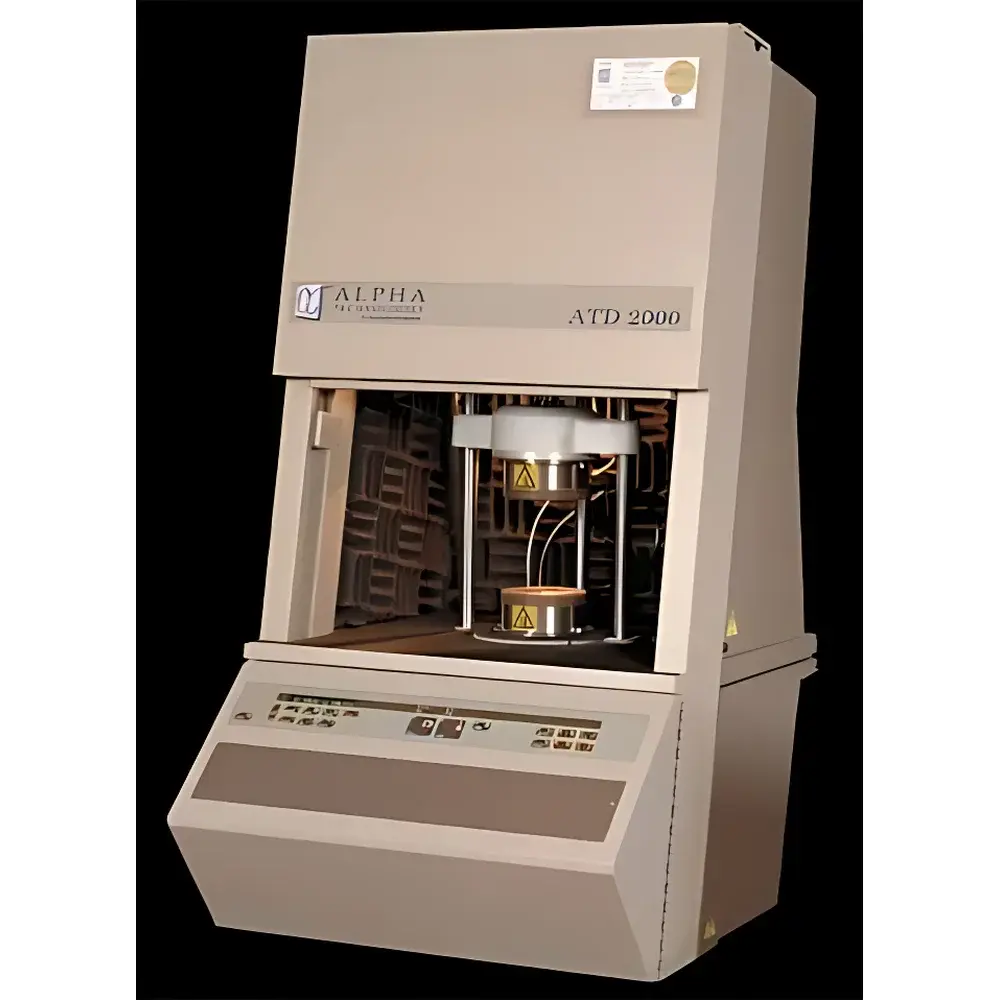
Alpha Technologies ATD2000 ESR™ Aerospace-Grade Viscoelastic Cure Monitor
| Brand | Alpha Technologies |
|---|---|
| Origin | USA |
| Model | ATD2000 ESR™ |
| Application | In-process viscoelastic cure monitoring of aerospace prepregs |
| Compliance | Supports Material State Management™ (MSM) framework per SAE AMS2750, ASTM D5992, and FAA AC 20-107B guidance |
| Software | PACE™ Process Analytics & Control Environment with real-time data streaming and GLP-compliant audit trail |
Overview
The Alpha Technologies ATD2000 ESR™ is a precision-engineered, aerospace-qualified viscoelastic cure monitor designed for real-time assessment of thermoset resin systems during the entire curing cycle—from B-staged prepreg handling through final consolidation and post-cure. Operating on the principle of dynamic mechanical analysis (DMA) via oscillatory shear rheometry under controlled thermal ramping, the ATD2000 ESR™ measures complex modulus (G*, G′, G″), phase angle (δ), and tan δ as functions of time and temperature. Unlike conventional DSC or dielectric sensors, this system captures true viscoelastic transitions—including gel point, vitrification, and crosslink density evolution—by embedding a miniature, calibrated torsional oscillator directly within a sealed, inert capsule containing the uncured material sample. Its design enables direct correlation between measured rheological inflection points and established aerospace process specifications such as Boeing BAC 5312, Airbus AITM 1-0003, and Lockheed Martin LM-1001.
Key Features
- Encapsulated sample geometry: Prepreg specimens are sealed in inert, hermetically sealed capsules to prevent volatiles loss, oxidation, and moisture ingress—critical for high-performance epoxy, BMI, and cyanate ester systems used in primary and secondary aircraft structures.
- Real-time viscoelastic profiling: Continuous acquisition at user-defined intervals (as low as 10-second resolution) delivers time–temperature–modulus trajectories aligned with autoclave or oven thermal profiles.
- Patented modular fixture system: Tool-less, repeatable sample loading ensures positional consistency and eliminates operator-induced variability across replicate runs; fixtures are autoclavable and chemically resistant to aggressive resin chemistries.
- ESR™ (Embedded Sensor Rheometry) architecture: Integrates a miniaturized, temperature-compensated torsional transducer with embedded Pt1000 RTD for synchronized thermal–mechanical measurement—no external calibration drift over extended operational cycles.
- Material State Management™ (MSM) integration: Output parameters map directly to the AvPro-developed MSM decision matrix, enabling automated determination of “cure readiness,” “rework window,” and “out-of-spec deviation” per OEM-defined thresholds.
Sample Compatibility & Compliance
The ATD2000 ESR™ accommodates standard aerospace prepreg formats—including unidirectional tape, woven fabric, and non-crimp fabrics—with nominal thicknesses from 0.1 mm to 3.0 mm. It supports both solvent-based and solvent-free systems, including toughened epoxies (e.g., Cytec CYCOM® 5250-4), bismaleimides (e.g., Hexcel RTM6), and phenolic resins. All hardware and firmware comply with electromagnetic compatibility (EMC) requirements per MIL-STD-461G and environmental ruggedness per MIL-STD-810H. Data integrity meets FDA 21 CFR Part 11 and EU Annex 11 expectations via PACE™ software’s electronic signature, role-based access control, and immutable audit trail generation.
Software & Data Management
The PACE™ Process Analytics & Control Environment provides an ISO/IEC 17025-aligned interface for configuring test protocols, visualizing cure kinetics, and exporting structured datasets (CSV, XML, HDF5). Real-time dashboards display critical state variables—including storage modulus crossover (G′ = G″), peak tan δ, and rate-of-modulus change—superimposed on reference thermal schedules. Automated report generation includes full metadata (operator ID, lot traceability, instrument calibration status, ambient conditions), supporting internal QA audits and third-party certification reviews (e.g., Nadcap AC7122). Raw data files retain native timestamp resolution and are archived with SHA-256 checksums for long-term reproducibility.
Applications
- Qualification of new prepreg lots against baseline rheological fingerprints prior to layup
- Determination of optimal debulk hold times and ramp rates for out-of-autoclave (OOA) processing
- Root cause analysis of void formation or interlaminar weakness linked to incomplete vitrification
- Validation of rework protocols following exposure to elevated humidity or thermal excursions
- Supporting digital twin development for predictive cure modeling in composite manufacturing execution systems (MES)
FAQ
What materials are compatible with the ATD2000 ESR™?
The system is validated for carbon-fiber and glass-fiber reinforced thermosets used in civil and military aviation, including epoxy, BMI, cyanate ester, and phenolic matrices. Metallic or highly conductive fillers require pre-validation due to potential eddy-current interference.
Does the ATD2000 ESR™ require periodic recalibration?
Yes—annual traceable calibration to NIST-traceable torque and temperature standards is recommended; factory calibration certificates include uncertainty budgets per ISO/IEC 17025.
Can the system be integrated into an existing MES or SCADA infrastructure?
Yes—via OPC UA or RESTful API endpoints provided by PACE™, enabling bidirectional data exchange with Siemens Opcenter, Rockwell FactoryTalk, or custom Python-based orchestration layers.
Is operator training included with purchase?
Alpha Technologies provides a two-day onsite application workshop covering sample preparation, protocol definition, failure mode interpretation, and audit documentation—delivered by certified aerospace process engineers.





