
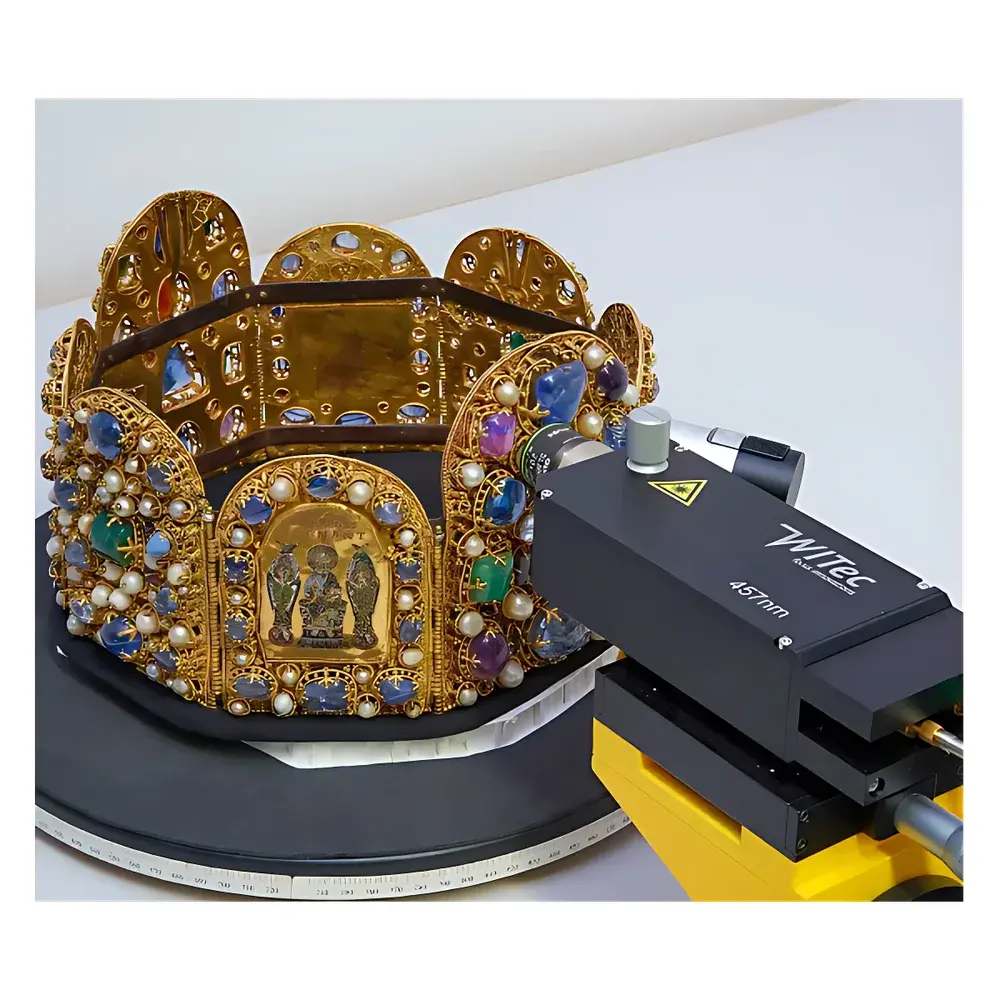
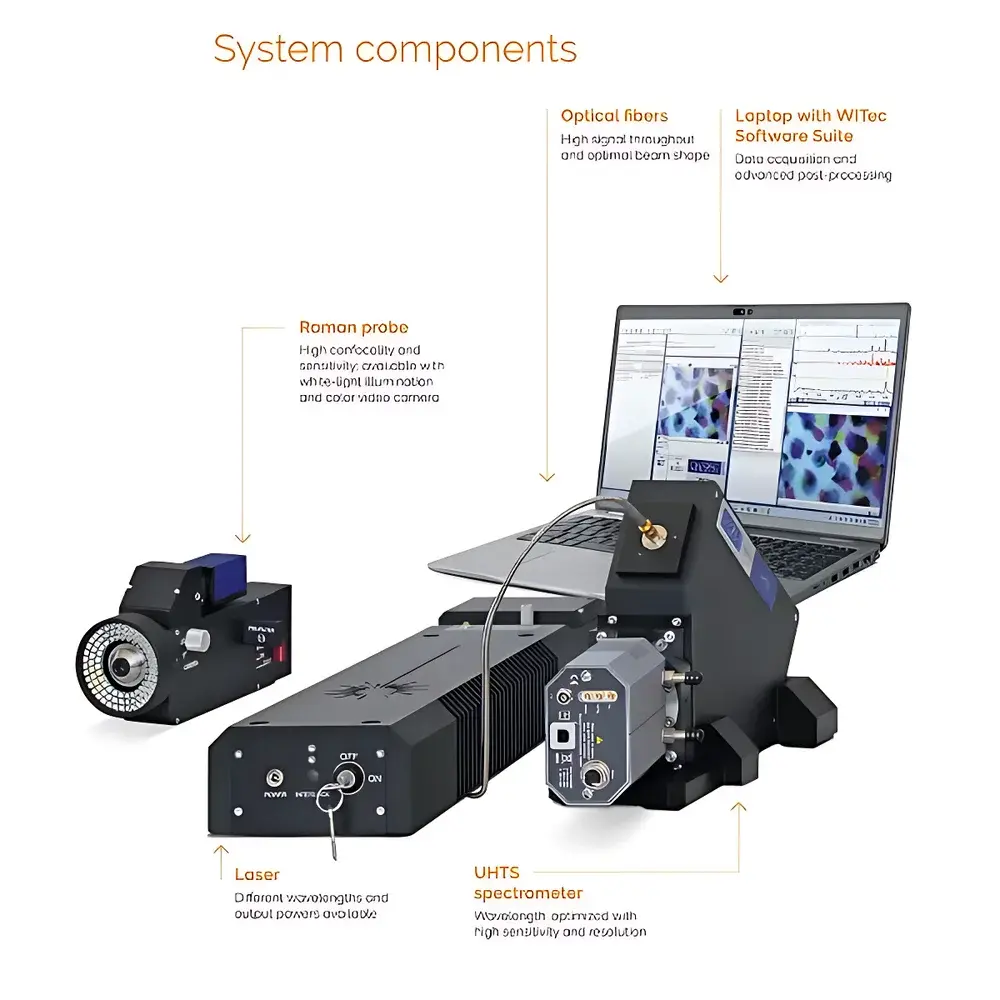
alphaCART Mobile Confocal Raman System by WITec
| Brand | Oxford Instruments |
|---|---|
| Origin | Germany |
| Manufacturer Type | Authorized Distributor |
| Origin Category | Imported |
| Model | alphaCART |
| Instrument Type | Portable Confocal Raman Microscope |
| Laser Options | 532 nm, 633 nm, 785 nm (custom wavelengths available) |
| Spectral Range | ~90–3500 cm⁻¹ (laser-dependent) |
| Spatial Resolution | Diffraction-limited |
| Spectral Resolution | High across full range |
| Detector | Scientific-grade low-noise CCD spectrometer camera |
Overview
The alphaCART Mobile Confocal Raman System is a research-grade, fiber-coupled confocal Raman microscope engineered by WITec and distributed globally by Oxford Instruments. Unlike conventional benchtop Raman microscopes constrained by sample size, geometry, or environmental accessibility, the alphaCART redefines analytical flexibility by decoupling the optical core from fixed-stage constraints. Its fundamental architecture employs a high-precision, fiber-delivered excitation path combined with a modular, motorized probe head—enabling true in situ, non-invasive chemical imaging and spectroscopic analysis of objects that cannot be relocated to a laboratory environment. The system operates on the principle of confocal Raman scattering: laser light is focused through a high-numerical-aperture objective onto the sample; backscattered Raman photons are collected via the same objective, spatially filtered by a confocal pinhole, and dispersed by a high-throughput spectrometer. This optical configuration ensures diffraction-limited spatial resolution and exceptional rejection of out-of-focus fluorescence and ambient background—critical for analyzing heterogeneous materials, layered structures, or samples behind optical barriers such as quartz windows, reaction cells, or protective glass enclosures.
Key Features
- Fiber-coupled modular design: Separates laser source, spectrometer, and detector from the handheld or positionable probe head—maximizing signal integrity while enabling unrestricted placement in confined or unconventional spaces.
- Confocal optical architecture: Delivers diffraction-limited lateral resolution and axial sectioning capability, essential for depth-resolved chemical mapping and suppression of fluorescence interference in pigments, minerals, or biological matrices.
- Multi-wavelength excitation: Standard options include 532 nm, 633 nm, and 785 nm lasers, each optimized for specific applications—e.g., 785 nm for minimizing fluorescence in organic and cultural heritage samples; 532 nm for high Raman cross-section in inorganic crystals and semiconductors.
- Integrated white-light illumination and high-resolution color CMOS camera: Enables precise visual navigation, region-of-interest selection, and correlation of optical morphology with spectral data—without requiring separate alignment procedures.
- Scientific-grade detection: Equipped with a thermoelectrically cooled, low-noise CCD spectrometer camera ensuring high signal-to-noise ratio even for weak Raman scatterers such as gases in sealed vessels or transient species in catalytic reactors.
- Expandable platform: Fully compatible with WITec’s alpha300 series accessories—including motorized XYZ stages, temperature-controlled sample holders, and electro-optic polarization modulators—supporting future upgrades without hardware replacement.
Sample Compatibility & Compliance
The alphaCART is routinely deployed in environments where ISO/IEC 17025-compliant measurement traceability and GLP-aligned documentation are required. Its ability to acquire reproducible, spatially resolved Raman spectra through optical interfaces satisfies ASTM E1840 and ISO 21348 standards for non-destructive compositional analysis. It has been validated for use in conservation science (per CEN/TS 16475), geological fieldwork (aligned with USGS spectral library protocols), and in-process monitoring of catalytic reactions under controlled atmospheres. The system supports audit-trail-enabled data acquisition when operated with WITec Suite under FDA 21 CFR Part 11-compliant configurations (with optional electronic signature modules). No physical contact with the sample is required, making it suitable for fragile artifacts, museum specimens, reactor linings, or high-value industrial components—all analyzed in their native state and environment.
Software & Data Management
Data acquisition, real-time processing, and quantitative analysis are managed through WITec Suite—a modular, scriptable software platform designed for advanced Raman hyperspectral imaging workflows. Core capabilities include live time-series acquisition for kinetic studies, automated multi-point mapping, multivariate curve resolution (MCR), and physics-based background subtraction algorithms optimized for glass-substrate interference or thermal emission artifacts. All raw spectra are stored in vendor-neutral HDF5 format with embedded metadata (laser power, integration time, objective ID, calibration coefficients), ensuring long-term FAIR (Findable, Accessible, Interoperable, Reusable) compliance. Export options include CSV, ASCII, and .spc formats compatible with third-party chemometric tools (e.g., MATLAB, Python scikit-learn, Unscrambler). Software licensing includes remote maintenance, firmware updates, and access to WITec’s application-specific method libraries.
Applications
- Cultural heritage science: In situ identification of pigments, binders, and degradation products on frescoes, manuscripts, or polychrome sculptures—through protective glazing or display cases.
- Geochemistry and planetary analog studies: Direct mineral phase identification on large rock specimens, meteorite fragments, or pressurized fluid inclusions within diamond-anvil cells.
- Materials science: Mapping stress distribution in composite laminates, detecting interfacial reactions in battery electrode stacks, or characterizing 2D material heterostructures on wafer-scale substrates.
- Process analytical technology (PAT): Real-time monitoring of crystallization, polymerization, or gas-phase reactions inside stainless-steel reactors equipped with sapphire viewports.
- Forensic trace evidence analysis: Non-contact identification of illicit substances, explosives residues, or counterfeit pharmaceuticals on irregular surfaces or within transparent packaging.
FAQ
Can the alphaCART perform depth profiling through transparent containers?
Yes—the confocal pinhole and high numerical aperture optics enable optical sectioning at sub-micron axial resolution, allowing sequential acquisition of Raman spectra from defined depths beneath glass, quartz, or polymer windows.
Is spectral calibration traceable to NIST standards?
Yes—each system ships with factory calibration using certified NIST-traceable reference standards (e.g., silicon, cyclohexane), and WITec Suite supports user-initiated recalibration with secondary standards.
What safety certifications does the system meet?
All laser modules comply with IEC 60825-1:2014 Class 3R or Class 1 (enclosed operation) requirements; the transport case meets IP65 dust/water resistance and ISTA 3A shipping durability standards.
How is thermal drift managed during extended measurements?
The spectrometer and CCD detector are actively temperature-stabilized; WITec Suite includes real-time spectral shift correction using internal reference lines or external calibration sources.
Can the system integrate with existing lab infrastructure?
Yes—via Ethernet or USB 3.0, the alphaCART supports synchronization with external triggers (e.g., furnace controllers, pump signals) and can export metadata to LIMS or ELN platforms using RESTful API endpoints.





