
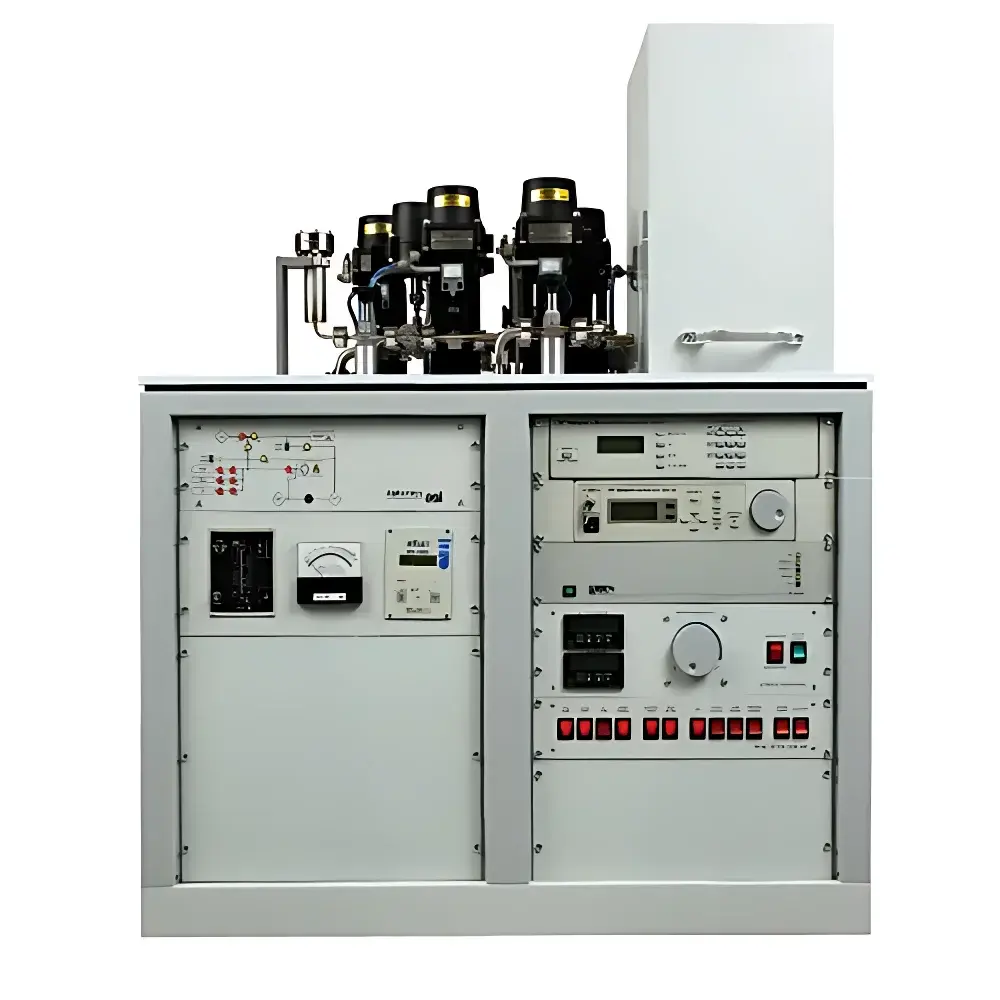
Alphachron He-3 Quadrupole Mass Spectrometer for (U-Th)/He Geochronology
| Brand | ASI |
|---|---|
| Origin | USA |
| Model | Alphachron He-3 |
| Configuration | Integrated Laser-Heating Gas Extraction & QMS System |
| Detection | ³He and ⁴He Isotopes |
| Compliance | Designed for ASTM D7956-15 (He Extraction), ISO/IEC 17025 Traceable Operation |
| Software | Alphachron Control Suite v4.2 with Audit Trail & 21 CFR Part 11 Optional Modules |
Overview
The Alphachron He-3 Quadrupole Mass Spectrometer is a purpose-built, turnkey analytical platform engineered for high-precision (U-Th)/He thermochronometry. It operates on the fundamental principle of quantitative helium isotope measurement—specifically ³He and ⁴He—following controlled thermal extraction from mineral lattices. The system integrates laser-driven and resistive heating gas release with ultra-high-vacuum quadrupole mass spectrometry, enabling direct isotopic ratio determination without cryogenic separation or noble gas purification traps. Designed exclusively for geochronological applications, it targets low-abundance helium in U- and Th-bearing minerals—including apatite, zircon, titanite, garnet, magnetite, and pyrite—where radiogenic ⁴He accumulation reflects time-integrated thermal history of the Earth’s crust. Its architecture eliminates manual gas transfer steps, reducing atmospheric contamination risk and improving reproducibility across multi-sample batches.
Key Features
- 915 nm diode laser heating module with precision focusing optics, integrated power supply, and interlocked safety enclosure—optimized for rapid, spatially confined helium release from individual mineral grains.
- Factory-aligned, pre-evacuated gas handling manifold featuring metal-sealed valves, heated transfer lines (up to 150 °C), and calibrated micro-volume extraction chambers to minimize memory effects and background contributions.
- Compact quadrupole mass spectrometer with electron multiplier detection, tuned for mass-to-charge resolution at m/z = 3 and 4, supporting detection limits < 1 × 10⁻¹⁵ mol of ⁴He per analysis.
- Modular thermal extraction options: standard laser heating plus optional quartz-halogen furnace for step-heating protocols or bulk mineral digestion support.
- Fully automated sample sequencing via programmable script engine—each position on the 24-sample carousel accepts user-defined heating profiles, dwell times, and MS acquisition parameters.
- Robust mechanical design compliant with ISO 14644-1 Class 6 cleanroom assembly standards; all vacuum components certified to UHV (< 1 × 10⁻⁸ mbar base pressure) performance.
Sample Compatibility & Compliance
The Alphachron He-3 accommodates standard 25 mm aluminum or copper sample holders with recessed cavities for single-grain or multi-grain mounts. Mineral separates must be cleaned via standard HNO₃/HF leaching and ultrasonic rinsing prior to loading. The system supports both air-ablation and vacuum-compatible mounting media (e.g., silver foil, graphite stubs). All operational protocols align with ASTM D7956-15 (“Standard Practice for Helium Extraction from Minerals for (U-Th)/He Dating”) and are compatible with ISO/IEC 17025 accredited laboratory workflows. Data acquisition logs include full metadata tagging (operator ID, timestamp, vacuum status, filament emission current), satisfying GLP/GMP documentation requirements when configured with optional 21 CFR Part 11-compliant audit trail and electronic signature modules.
Software & Data Management
The Alphachron Control Suite v4.2 provides unified control of laser power, furnace temperature ramps, valve sequencing, and mass spectrometer scanning. Real-time partial pressure monitoring enables dynamic adjustment of integration windows during helium release peaks. Raw ion signals are processed using built-in isobaric interference correction algorithms (e.g., ³He⁺ vs. HD⁺, ⁴He⁺ vs. H₂O⁺), with calibration against NIST-traceable helium standards (SRM 2628a). Export formats include ASCII tab-delimited files for downstream age calculation in HeCalc, AgeCalc, or custom Python-based inversion models. Database integration supports SQL-based lab information management systems (LIMS), and raw data files are stored with SHA-256 checksums to ensure long-term integrity.
Applications
This instrument serves as the primary analytical engine in low-temperature thermochronology laboratories worldwide. Its principal use cases include reconstructing exhumation histories in orogenic belts, constraining timing of hydrocarbon charge in sedimentary basins, evaluating fracture network evolution in geothermal reservoirs, and resolving paleoaltimetry through apatite (U-Th)/He age-elevation relationships. In petroleum systems analysis, it delivers critical constraints on trap formation timing relative to migration windows. In tectonic studies, paired zircon and apatite datasets enable multi-diffusion domain modeling of cooling rates over 60–120 °C ranges. The system also supports method development for (U-Th)/He dating of non-traditional phases such as monazite and xenotime under collaborative research agreements.
FAQ
What mineral grain sizes are optimal for analysis on the Alphachron He-3?
Grains between 60–120 µm diameter yield optimal signal-to-noise for apatite and zircon; smaller fractions (< 40 µm) require extended integration times and careful background subtraction.
Can the system measure other noble gases besides helium?
No—the Alphachron He-3 is dedicated exclusively to ³He and ⁴He detection; its mass filter, detector gain, and gas handling are optimized for this dual-isotope pair only.
Is external ICP-MS integration required for uranium and thorium quantification?
Yes—(U-Th)/He age calculation requires independent U and Th concentration data, typically obtained via solution-mode ICP-MS after HF-HNO₃ digestion of the same mineral aliquot used for helium extraction.
How is system background characterized and corrected?
Background is measured daily via blank runs on empty crucibles under identical thermal and vacuum conditions; values are subtracted automatically during peak integration using linear interpolation between pre- and post-extraction baselines.
Does the instrument support remote operation and monitoring?
Yes—via secure TLS-encrypted web interface; real-time vacuum status, laser power output, and ion current trends are accessible through browser-based dashboards with configurable alert thresholds.





