
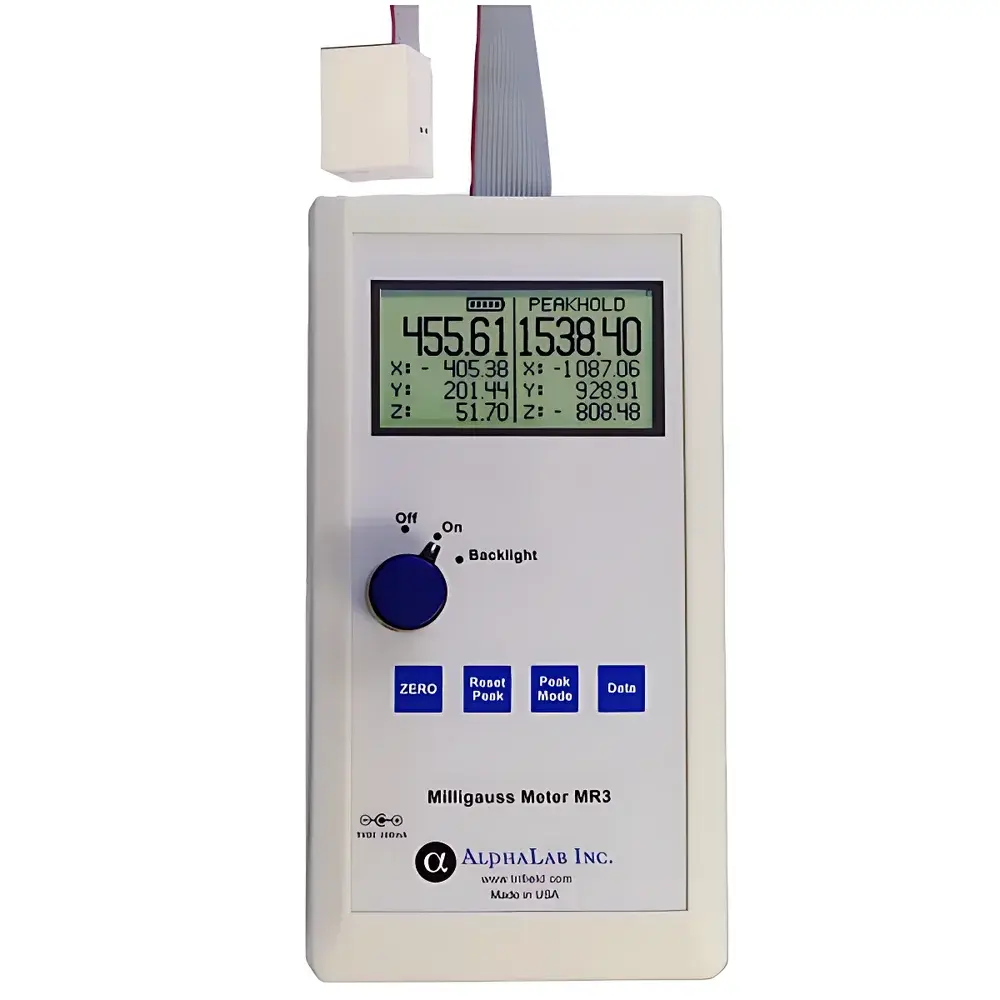
AlphaLab MR3 Triaxial Magnetoresistive Milligauss Meter
| Brand | AlphaLab |
|---|---|
| Origin | USA |
| Model | MR3 |
| Measurement Principle | Magnetoresistive (MR) Sensor Array |
| Axes | X, Y, Z (orthogonal vector components) |
| Full-Scale Range | ±1999.99 mG (±199.999 µT) |
| Resolution | 0.01 mG (1 nT) |
| Accuracy | ±0.5% of reading + ±0.50 mG offset error |
| Sampling Rate | 2 Hz (updates per second) |
| Temperature Stability | Offset TC < 0.01 mG/°C |
| Repeatability | ±0.01 mG (1 nT) at constant temperature |
| Sensor Geometry | Three MR sensors embedded in a 25 mm cube, positioned ~4 mm below surface, with mechanical X/Y/Z axis markings on housing |
| Cable Length | 100 cm flexible coaxial cable |
| Power | 4 × AA alkaline batteries (included, ~40 h operation) or universal AC adapter (included) |
| Data Logging | Internal storage of X/Y/Z/M and peak values |
| Display | Simultaneous readout of instantaneous and peak values for all four parameters (X, Y, Z, M) |
| Compliance | CE-marked |
Overview
The AlphaLab MR3 Triaxial Magnetoresistive Milligauss Meter is an engineered solution for precise, vector-resolved static magnetic field measurement in laboratory, industrial, and field-deployable environments. Based on solid-state magnetoresistive (MR) sensor technology, the MR3 captures orthogonal magnetic flux density components—X, Y, and Z—in real time, computing and displaying the resultant magnitude (M = √(X² + Y² + Z²)) with sub-nanotesla resolution. Unlike Hall-effect or fluxgate-based instruments, MR sensors offer superior low-field sensitivity, excellent thermal stability, and minimal power consumption—making the MR3 especially suited for applications requiring high reproducibility in ambient or thermally variable conditions. Its compact 25 mm cubic sensor head—integrated into a 100 cm flexible cable assembly—enables spatially resolved mapping of magnetic gradients without mechanical coupling interference. Designed and assembled in the United States, the MR3 meets international electromagnetic compatibility (EMC) and safety requirements (CE, RoHS), supporting traceable measurements under ISO/IEC 17025-aligned quality systems.
Key Features
- True triaxial vector measurement: Simultaneous acquisition of X, Y, Z components and scalar magnitude (M) at 2 Hz sampling rate
- High-resolution metrology: 0.01 mG (1 nT) resolution across full ±1999.99 mG range, with ±0.5% reading accuracy and ±0.50 mG absolute offset error
- Thermally robust architecture: Offset temperature coefficient < 0.01 mG/°C; gain drift < 0.0015%/°C—enabling stable operation across 15–35°C ambient ranges
- Onboard data logging: Stores time-stamped X/Y/Z/M and peak-hold values internally; supports both buffered download and live USB streaming
- Intuitive dual-mode display: Real-time numeric readouts plus visual peak-hold tracking with manual reset function for transient event capture
- Field-serviceable power system: Dual-source operation via included 4×AA alkaline batteries (~40 h runtime) or universal AC adapter (100–240 VAC input)
- Calibration-ready design: Sensor axes physically marked on housing with ±2 mm positional tolerance; individual unit calibration reports available upon request
Sample Compatibility & Compliance
The MR3 is optimized for non-invasive measurement of static (DC) magnetic fields generated by permanent magnets, magnetic shielding materials, DC-powered electromagnets, MRI fringe fields, and electronic device emissions. It does not support AC or pulsed field measurement. Its low-noise MR sensor array is insensitive to mechanical vibration and unaffected by typical ambient RF interference—making it suitable for cleanroom, EMC lab, and near-field magnetic imaging tasks. The instrument complies with EN 61326-1:2013 (EMC for laboratory equipment) and EN 61010-1:2010 (safety requirements). While not FDA 21 CFR Part 11-certified out-of-box, its deterministic USB data export protocol supports integration into validated GxP environments when paired with controlled data handling procedures and audit-trail documentation.
Software & Data Management
The MR3 communicates via standard USB 2.0 (no drivers required on Windows/macOS/Linux) using CDC ACM class enumeration. AlphaLab provides free, open-architecture software (MR3 Logger v3.x) for real-time visualization, CSV export, and batch analysis of logged datasets. All acquired data includes timestamps, sensor identification tags, and metadata headers compliant with ASTM E2916-22 (standard guide for digital data acquisition in physical testing). Peak-hold registers are stored separately per axis and magnitude channel, enabling retrospective analysis of maximum exposure events. Raw binary logs may be parsed programmatically using documented packet structure (available in user manual), facilitating integration with LabVIEW, Python (PySerial), or MATLAB-based test automation frameworks.
Applications
- Magnetic shielding validation: Quantifying residual DC field penetration in mu-metal enclosures or Helmholtz coil cancellation systems
- Permanent magnet characterization: Mapping spatial homogeneity, dipole alignment, and edge-field decay profiles
- Electromagnetic interference (EMI) pre-compliance screening: Assessing DC stray fields from power supplies, motors, and transformers prior to formal EMC testing
- Geomagnetic baseline monitoring: Long-term environmental field drift studies in geophysics or archaeomagnetic research
- Quality control of magnetic assemblies: Verifying polarity orientation, field strength consistency, and multi-pole symmetry in sensor calibrators and encoder systems
- Academic physics labs: Vector field visualization experiments, Lorentz force demonstrations, and magnetic material susceptibility estimation
FAQ
What is the effective measurement volume of the MR3 sensor head?
The three MR elements are housed within a 25 mm × 25 mm × 25 mm cube, with active sensing layers located approximately 4 mm beneath each orthogonal face. Due to finite sensor thickness and packaging constraints, the effective centroid differs by ≤ ±2 mm from nominal axis intersections—each unit is manually labeled to indicate measured axis origins.
Can the MR3 measure alternating (AC) magnetic fields?
No. The MR3 is strictly a DC magnetometer. Its analog front-end and signal processing chain are optimized for static and quasi-static fields only. For AC field analysis up to 1 kHz, AlphaLab recommends the AMR-based MR2-AC variant.
Is NIST-traceable calibration included with purchase?
Standard units ship with factory calibration against reference Helmholtz coils calibrated to NIST-traceable standards. A certificate of conformance (not full NIST certificate) is provided. Optional NIST-traceable calibration with uncertainty budget is available as a paid service.
How is sensor axis alignment verified during manufacturing?
Each MR3 undergoes orthogonal alignment verification using a precision 3-axis gimbal stage and calibrated reference field source. Axis orthogonality error is maintained within ±0.2°, and cross-axis sensitivity remains below –40 dB relative to primary axis response.
Does the USB interface support continuous high-speed data streaming?
Yes—streaming mode delivers synchronized X/Y/Z/M samples at 2 Hz with microsecond-level timestamp resolution. For higher-rate acquisition, external hardware synchronization (TTL trigger input) is not supported; users requiring >2 Hz must consider AlphaLab’s PC-based DAQ systems.



