
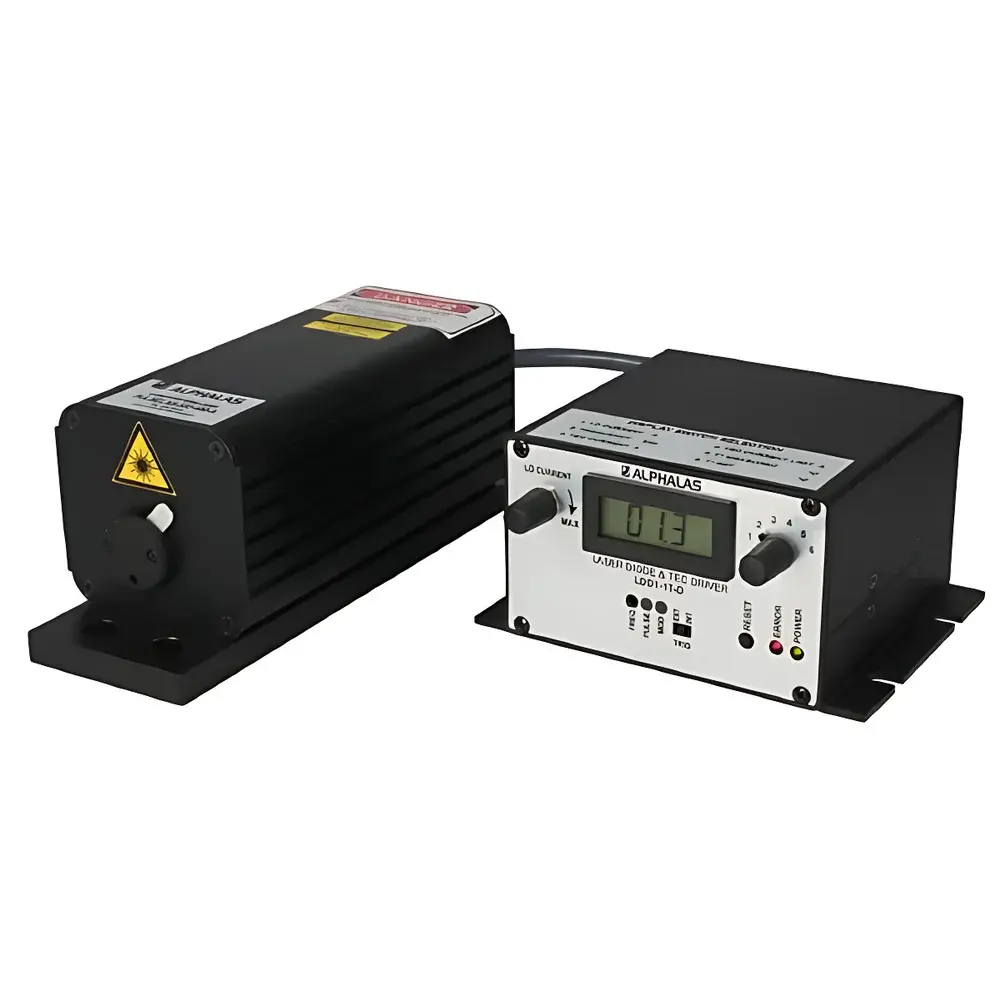
ALPHALAS Actively Q-Switched Diode-Pumped Solid-State (DPSS) Laser
| Brand | ALPHALAS |
|---|---|
| Origin | Germany |
| Type | Actively Q-Switched DPSS Laser |
| Wavelength Options | 1047, 1053, 1062, 1064, 946, 1342 nm (with harmonic generation to 671, 532, 473, 355, 266 nm) |
| Pulse Width | 0.7–3.0 ns |
| Repetition Rate | 0.1 kHz – 100 kHz |
| Average Power | 100 mW – >1 W |
| Pulse Energy | up to 100 µJ @ 1 kHz |
| Beam Mode | TEM₀₀ |
| Compliance | CE, RoHS, ISO 9001-manufactured |
Overview
The ALPHALAS Actively Q-Switched Diode-Pumped Solid-State (DPSS) Laser is an engineered solution for applications demanding high peak power, nanosecond temporal precision, and diffraction-limited beam quality. Based on electro-optic or acousto-optic Q-switching within Nd-doped crystalline gain media (e.g., Nd:YVO₄, Nd:YAG), these lasers generate transform-limited pulses with durations ranging from 0.7 ns to ≤3.0 ns—optimized for nonlinear frequency conversion and time-resolved photonics. Unlike passively Q-switched counterparts, active modulation provides deterministic pulse timing, jitter <100 ps, full repetition rate tunability (from single-shot to 100 kHz), and stable amplitude control over the full operating range. The system architecture integrates thermally stabilized pump diodes, precision cavity alignment, and hermetically sealed optics—ensuring long-term power stability (<±1.5% over 8 h) and minimal mode-hopping under ambient temperature fluctuations (15–30 °C). Designed for integration into OEM instrumentation and laboratory-grade systems, it complies with IEC 60825-1:2014 Class 4 laser safety requirements and meets electromagnetic compatibility standards per EN 61326-1.
Key Features
- Actively controlled Q-switching enabling precise pulse timing, low jitter (<100 ps RMS), and programmable repetition rates from 0.1 kHz to 100 kHz
- TEM₀₀ spatial mode with M² < 1.1 and beam divergence < 1.5 mrad (full angle), ensuring efficient coupling into fibers, nonlinear crystals, and scanning optics
- Multiple fundamental wavelengths: 1047 nm, 1053 nm, 1062 nm, 1064 nm, 946 nm, and 1342 nm—each optimized for specific gain cross-sections and thermal lensing profiles
- Integrated harmonic generation options: second-harmonic (532 nm, 671 nm, 473 nm), third-harmonic (355 nm), and fourth-harmonic (266 nm) outputs with >40% conversion efficiency (at rated fundamental power)
- Industrial-grade thermal management using conductive cooling and PID-regulated TECs, enabling continuous operation at ambient temperatures up to 30 °C without performance degradation
- RS-232 and USB 2.0 digital interfaces supporting remote control of pulse parameters, interlock status, and real-time diagnostics via ASCII command protocol
Sample Compatibility & Compliance
These lasers are compatible with standard optical tables, motorized translation stages, and vacuum-compatible beam delivery paths (with optional vacuum feedthroughs). Beam output is polarization-maintained (linear, >100:1 extinction ratio) and collimated to a 1/e² diameter of 0.8–1.2 mm, facilitating direct use with commercial SHG/BBO/LBO crystals, streak cameras, and photomultiplier tube (PMT) detectors. All units conform to EU Directive 2014/30/EU (EMC), 2011/65/EU (RoHS), and carry CE marking per EN 60825-1:2014. For regulated environments—including GLP-compliant analytical labs and medical device R&D—the laser controller supports audit-trail logging and user-access level configuration (via firmware v3.2+), aligning with FDA 21 CFR Part 11 principles for electronic records and signatures.
Software & Data Management
ALPHALAS provides the LaserControl Suite—a platform-independent application (Windows/macOS/Linux) supporting parameter scripting, pulse train monitoring, and synchronization with external triggers (TTL input/output). Real-time oscilloscope-style waveform capture (up to 1 MS/s sampling) enables pulse shape analysis and drift tracking. Export formats include CSV, HDF5, and MATLAB .mat for post-processing in spectral deconvolution or LIBS calibration workflows. Firmware updates are delivered via signed binary packages with SHA-256 verification; configuration backups preserve all user-defined settings including interlock thresholds, soft-start profiles, and thermal warning limits.
Applications
- Laser-induced breakdown spectroscopy (LIBS): High peak irradiance (>1 GW/cm²) enables robust plasma generation in conductive and dielectric solids—including diamond, sapphire, and composite ceramics
- Time-resolved fluorescence lifetime imaging (FLIM): Sub-nanosecond pulse fidelity supports TCSPC measurements with instrument response functions <120 ps FWHM
- Nonlinear optics: Efficient supercontinuum generation in photonic crystal fibers (PCFs) and optical parametric amplification (OPA) pumping due to broad spectral acceptance and high spatial coherence
- Precision micromachining: Ablation threshold control in brittle materials (e.g., SiC, GaN) enabled by adjustable pulse energy (20–100 µJ) and spot-size optimization
- LIDAR and rangefinding: Low timing jitter and high pulse-to-pulse stability support sub-millimeter distance resolution in coherent detection architectures
- Ultrafast pump-probe spectroscopy: Synchronization-ready trigger outputs enable pump-probe delays down to ±50 ps with external delay generators
FAQ
What distinguishes active Q-switching from passive Q-switching in ALPHALAS DPSS lasers?
Active Q-switching uses externally driven electro-optic or acousto-optic modulators to precisely control cavity Q-factor, enabling deterministic pulse timing, wide repetition rate tuning, and low amplitude jitter—critical for time-gated detection and synchronization-sensitive experiments.
Can these lasers be integrated into automated production lines?
Yes. Digital I/O (TTL sync in/out, interlock, ready signal), RS-232/USB control, and industrial-grade thermal design support 24/7 operation in cleanroom and factory-floor environments per ISO 14644-1 Class 5 specifications.
Is harmonic generation included as standard or optional?
Harmonic modules (SHG, THG, FHG) are configurable options—factory-aligned and pre-characterized for each base wavelength. Output power specifications include harmonic conversion efficiency and long-term stability data per ISO 11551.
Do ALPHALAS actively Q-switched lasers support external cavity seeding or injection locking?
No—these are free-running oscillators optimized for maximum peak power and pulse stability. For seeded operation, ALPHALAS offers separate modelocked oscillator-amplifier systems (e.g., PILAS series) with fiber-coupled seed inputs.
What maintenance is required during typical laboratory operation?
No routine optical alignment or consumable replacement is needed. Recommended annual verification includes power calibration traceable to PTB/NIST standards and thermal sensor validation—documented in the provided service log template.



