
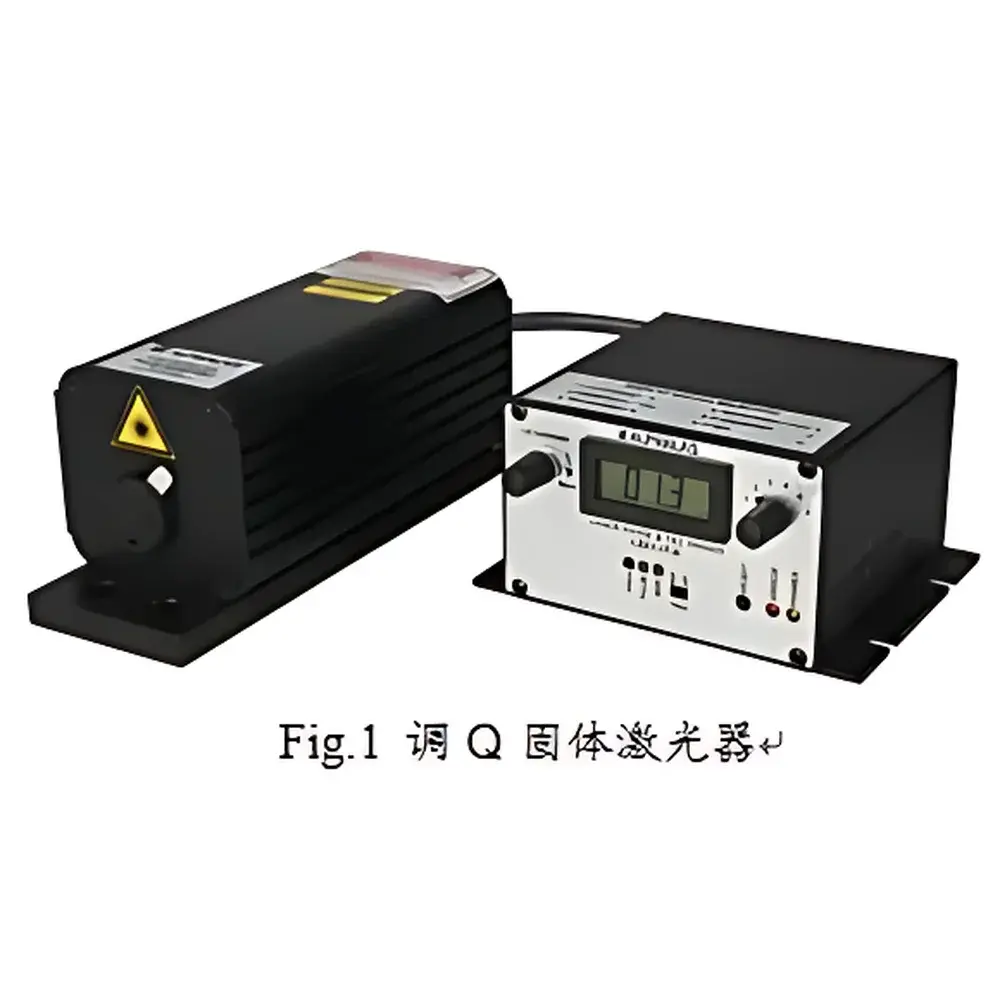
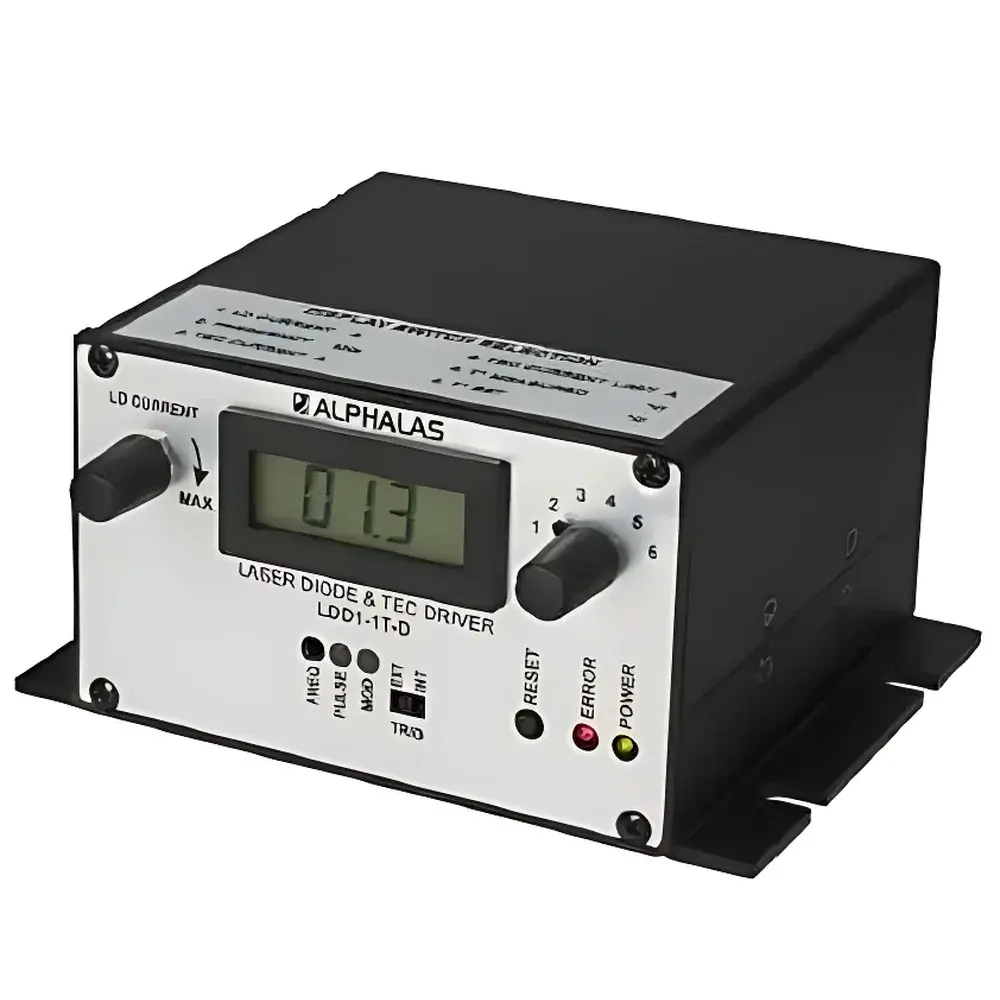
AlphaLas Actively Q-Switched DPSS Laser System
| Brand | AlphaLas |
|---|---|
| Origin | Germany |
| Model | Actively Q-Switched DPSS Lasers |
| Wavelength Options | 1047 nm, 1053 nm, 1062 nm, 1064 nm, 946 nm, 1342 nm (with harmonic generation to 671 nm, 532 nm, 473 nm, 355 nm, 266 nm) |
| Pulse Width | 0.7–3.0 ns |
| Pulse Energy | 20–100 µJ @ 1–25 kHz |
| Average Output Power | 300–1000 mW |
| Repetition Rate | 0–25 kHz |
| Beam Mode | TEM₀₀ |
| Operating Mode | Actively Q-switched solid-state (Nd:YAG, Nd:YVO₄, or similar gain media) |
Overview
The AlphaLas Actively Q-Switched DPSS Laser System is a high-reliability, compact diode-pumped solid-state (DPSS) laser platform engineered for precision pulsed operation across infrared, visible, and ultraviolet spectral regions. Based on active electro-optic or acousto-optic Q-switching of Nd-doped gain media—including Nd:YAG, Nd:YVO₄, and Nd:YLF—the system delivers nanosecond-scale pulses with excellent temporal stability, high peak power (>100 kW typical), and diffraction-limited beam quality (TEM₀₀). Unlike passively Q-switched or mode-locked alternatives, active Q-switching enables precise, jitter-free control over pulse timing and repetition rate—critical for time-resolved spectroscopy, LIBS, LIDAR, and pump-probe experiments requiring synchronization with external triggers or detectors. The lasers operate at fundamental wavelengths including 1047 nm, 1053 nm, 1062 nm, 1064 nm, 946 nm, and 1342 nm, with optional intracavity or external harmonic generation modules enabling stable output at 671 nm (2ω), 532 nm (2ω), 473 nm (2ω), 355 nm (3ω), and 266 nm (4ω). All systems are designed and manufactured in Germany to meet stringent industrial and research-grade optical alignment, thermal management, and long-term operational stability requirements.
Key Features
- Actively Q-switched architecture with low timing jitter (<1 ns RMS) and externally programmable repetition rate (0–25 kHz)
- Diffraction-limited TEM₀₀ output beam profile with M² < 1.1, ensuring optimal focusability for micro-machining and nonlinear frequency conversion
- Integrated thermal stabilization and hermetically sealed optics housing for consistent performance under varying ambient conditions
- Harmonic generation compatibility: factory-aligned SHG, THG, and FHG modules available for 532 nm, 355 nm, and 266 nm outputs with >50% conversion efficiency (at rated fundamental power)
- Modular design supporting OEM integration: TTL/RS-232 trigger interfaces, analog modulation inputs, and interlock-ready safety circuitry compliant with IEC 60825-1 Class 4 requirements
- Low-noise power supply with active current regulation, enabling shot-to-shot energy stability better than ±2% (RMS) over 8-hour continuous operation
Sample Compatibility & Compliance
The AlphaLas Actively Q-Switched DPSS Laser System is compatible with standard optical tables, motorized translation stages, gated ICCD cameras, spectrometers, and time-correlated single-photon counting (TCSPC) modules. Its pulse characteristics satisfy key requirements for ASTM E2912 (Laser-Induced Breakdown Spectroscopy), ISO 11554 (laser beam parameter measurements), and USP (laser-based analytical instrumentation validation). The system conforms to CE marking directives (2014/35/EU Low Voltage Directive and 2014/30/EU EMC Directive), and its optical enclosure meets EN 60825-1:2014 safety classification standards for Class 4 lasers. Optional FDA 21 CFR Part 11-compliant software logging packages are available for GLP/GMP-regulated environments such as pharmaceutical analytical labs or aerospace materials testing facilities.
Software & Data Management
AlphaLas provides the LaserControl Suite—a Windows-based application supporting real-time monitoring of output power, pulse energy, repetition rate, and internal temperature via USB or RS-232. The software includes built-in scripting (Python API support), automated calibration routines, and audit-trail-enabled configuration logging suitable for regulated workflows. All devices feature non-volatile memory for storing up to 16 user-defined operating profiles, each with independent settings for repetition rate, Q-switch delay, and harmonic selection. Data export is supported in CSV, HDF5, and MATLAB-compatible formats, facilitating integration with LabVIEW, Igor Pro, or custom Python analysis pipelines. Remote operation via Ethernet (optional) enables centralized fleet management in multi-laser laboratory infrastructures.
Applications
- Laser-induced breakdown spectroscopy (LIBS) for elemental analysis of conductive and non-conductive solids, including diamond, ceramics, and composites
- Time-resolved fluorescence lifetime imaging (FLIM) and time-gated Raman spectroscopy in biological and chemical sensing
- Precision micromachining and surface texturing of hard materials (e.g., sapphire, silicon carbide, tungsten carbide) using sub-ns ablation thresholds
- Pumping of optical parametric oscillators (OPOs) and supercontinuum generation in photonic crystal fibers
- Atmospheric LIDAR and rangefinding systems requiring high pulse-to-pulse stability and narrow spectral bandwidth (<0.1 nm FWHM)
- Holographic interferometry and digital holography requiring coherent, low-divergence nanosecond illumination
- Ignition studies in combustion research and plasma diagnostics via time-resolved schlieren imaging
FAQ
What distinguishes active Q-switching from passive Q-switching in DPSS lasers?
Active Q-switching uses an external electronic signal to control the Q-switch (e.g., Pockels or acousto-optic cell), enabling deterministic pulse timing, adjustable repetition rates, and synchronization with external instruments—unlike passive methods that rely on saturable absorbers and exhibit stochastic pulse emission.
Can these lasers be integrated into vacuum or cleanroom environments?
Yes. Optional vacuum-compatible versions (CF flange mounting, outgassing-tested materials, and conduction-cooled configurations) are available upon request for ultra-high-vacuum applications such as ion trap excitation or synchrotron beamline pumping.
Is harmonic generation included by default, or is it an add-on option?
Fundamental wavelength operation (e.g., 1064 nm) is standard. Harmonic modules (532 nm, 355 nm, 266 nm) are configurable options—either pre-aligned as integrated units or supplied as field-installable kits with alignment aids and power calibration certificates.
Do these lasers support external triggering with sub-microsecond latency?
Yes. All models provide TTL-compatible external trigger input with <500 ns latency and jitter <1 ns, fully compatible with digital delay generators and fast photodiode feedback loops.
What maintenance is required during routine operation?
No consumables or periodic alignments are required. Recommended preventive maintenance includes quarterly inspection of cooling interface thermal paste (for water-cooled variants) and annual verification of pulse energy calibration using a NIST-traceable pyroelectric sensor.




