
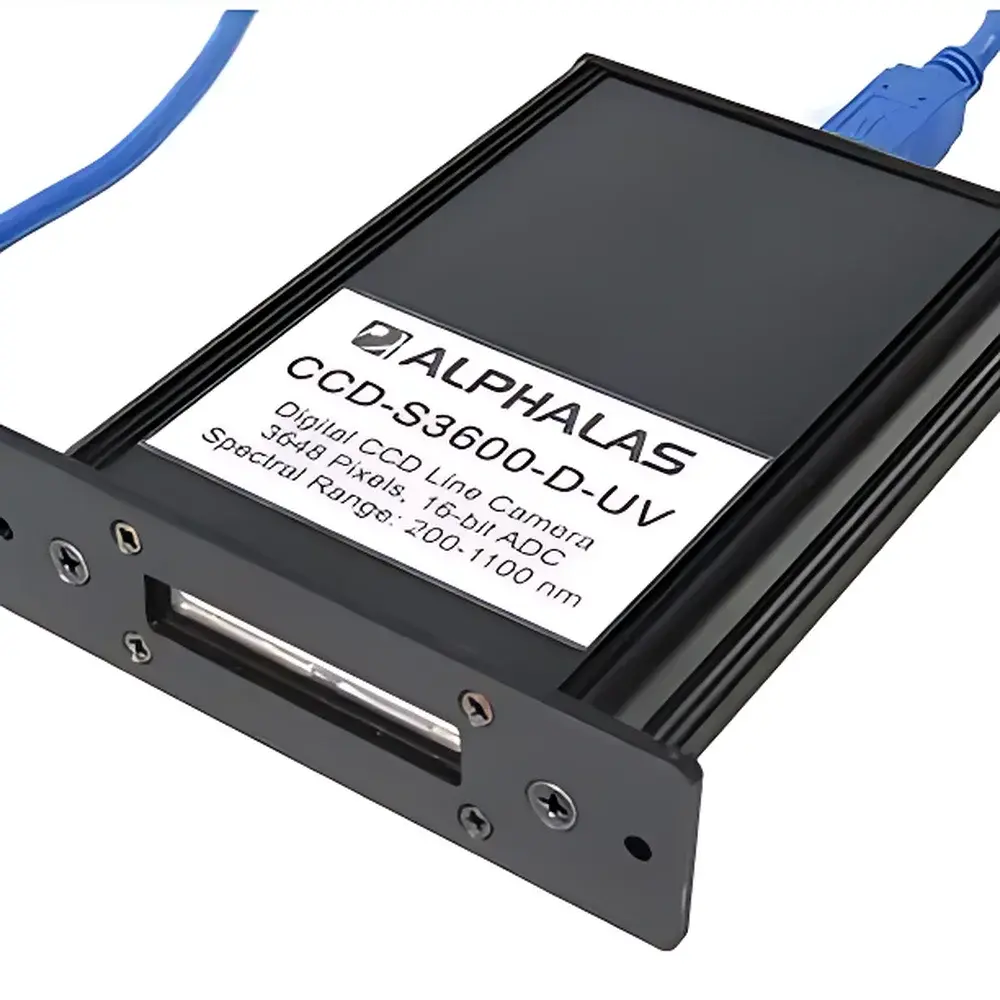
AlphaLas CCD-S3600-D(-UV) High-Performance Digital High-Speed Linear CCD Camera
| Brand | AlphaLas |
|---|---|
| Origin | Germany |
| Model | CCD-S3600-D(-UV) |
| Effective Pixels | 3648 |
| Pixel Size | 7 µm × 200 µm (standard) |
| ADC Resolution | 16-bit |
| Onboard Memory | 32 MB DDR2 |
| Interface | USB 2.0 (bus-powered) |
| Max Frame Rate | 269.5 fps (at full resolution, no frame loss) |
| Trigger I/O | TTL-compatible input & output |
| Spectral Range | 200–1100 nm (standard) |
| Operating Systems | Windows 7/Vista/XP (WHQL-certified), Linux, macOS |
| SDK Support | C/C++, LabVIEW, Python (via wrapper), MATLAB |
Overview
The AlphaLas CCD-S3600-D(-UV) is a high-speed, single-line linear CCD imaging system engineered for precision optical measurement in demanding scientific and industrial environments. Based on a 3648-pixel monochrome linear sensor with 7 µm pixel pitch and high quantum efficiency across UV-VIS-NIR (200–1100 nm), the camera employs a custom FPGA-based acquisition architecture to enable deterministic timing, sub-millisecond integration control, and real-time data streaming without frame drop. Unlike area-scan CCDs, this linear configuration is optimized for continuous scanning applications—such as spectral acquisition, laser beam profiling, time-resolved interferometry, and motion-synchronized inspection—where spatial resolution along one axis and temporal fidelity are critical. Its bus-powered USB 2.0 interface eliminates external power supplies, supporting rapid deployment in portable, embedded, or space-constrained setups—including OEM integration into spectrometers, laser diagnostics platforms, and inline process monitoring systems.
Key Features
- FPGA-driven acquisition engine ensuring deterministic trigger latency (<1 µs jitter) and precise synchronization between exposure, line readout, and external hardware signals
- 16-bit analog-to-digital conversion with programmable gain and offset, delivering >72 dB dynamic range and low-noise performance (typ. <15 e⁻ RMS read noise)
- 32 MB DDR2 onboard memory buffer enabling burst-mode acquisition at maximum frame rate, decoupling host PC performance from sustained data capture
- Dual-trigger capability: independent TTL-compatible input (for start/external sync) and output (for strobe or downstream device coordination)
- Configurable data streaming modes including continuous scan, triggered line burst, and multi-region-of-interest (ROI) readout for selective bandwidth optimization
- Deep-UV option with quartz window and back-thinned sensor coating, extending quantum efficiency down to 190 nm for fluorescence spectroscopy and excimer laser diagnostics
- Compact form factor (92 × 42 × 28 mm) with passive thermal management; operates reliably from 0 °C to 45 °C ambient
Sample Compatibility & Compliance
The CCD-S3600-D(-UV) is compatible with standard optical interfaces including C-mount and M42×0.75 thread adapters, facilitating direct coupling to spectrographs, collimators, and fiber-optic tapers. Its mechanical and electrical design complies with CE, RoHS, and FCC Part 15 Class B requirements. While not certified for medical device use under IEC 62304 or FDA 21 CFR Part 820, the camera’s deterministic timing behavior, reproducible exposure control, and traceable firmware revisioning support GLP/GMP-aligned validation protocols in regulated R&D environments. Raw 16-bit linear data output ensures compliance with ISO/IEC 17025 metrological traceability requirements when used with calibrated light sources and reference standards.
Software & Data Management
The camera ships with a cross-platform SDK supporting Windows (x64/x86, WHQL-signed drivers), Linux (kernel 3.10+), and macOS (10.13+). The API provides low-level register access and high-level acquisition functions in C/C++, with native LabVIEW VIs (including example VIs for 3D interferogram reconstruction), MATLAB wrappers, and Python bindings via ctypes. All drivers include built-in ring-buffer management, timestamping (µs resolution via internal counter), and metadata embedding (exposure time, trigger source, temperature). Firmware updates are delivered via signed USB packets, preserving audit trails required for ISO 9001 or ISO/IEC 17025 documentation. No proprietary runtime or closed binary modules are required—ensuring long-term maintainability and integration into automated test frameworks.
Applications
- Laser beam characterization: M² measurement, 1D intensity profiling, pulse-to-pulse stability analysis in Q-switched and mode-locked systems
- Optical spectroscopy: Grating-based VIS/NIR spectrometers, UV absorption monitoring, Raman line scanning, and time-resolved emission kinetics
- Scientific instrumentation: Fabry–Pérot interferogram acquisition, single-shot autocorrelation of ultrashort pulses, and spatially resolved photoluminescence mapping
- Industrial OEM integration: Web inspection in printing and coating lines, semiconductor wafer edge detection, and high-speed barcode decoding
- Academic research: Undergraduate optics labs (interference/diffraction experiments), graduate-level photonics projects, and synchrotron beamline diagnostics
FAQ
What is the minimum achievable integration time?
The shortest configurable exposure is 1 µs, limited by pixel reset and charge transfer timing constraints inherent to the sensor architecture.
Can the camera operate in master-slave synchronization with other devices?
Yes—via its dedicated TTL trigger output, the camera can serve as a timing master for synchronized acquisition across multiple instruments (e.g., pulsed lasers, galvo scanners, or gated detectors).
Is dark current compensation supported in firmware?
Yes—onboard non-uniformity correction includes user-acquirable dark frame subtraction, with optional temperature-stabilized calibration tables stored in non-volatile memory.
Does the SDK support real-time processing pipelines?
The streaming API enables zero-copy memory access to raw buffers, allowing integration with OpenCV, CUDA-accelerated kernels, or real-time DSP libraries without intermediate file I/O bottlenecks.
How is calibration traceability maintained across firmware updates?
Each firmware release includes a SHA-256 checksum and version-stamped calibration metadata; users may archive factory-provided flat-field and linearity coefficients for audit purposes.




