
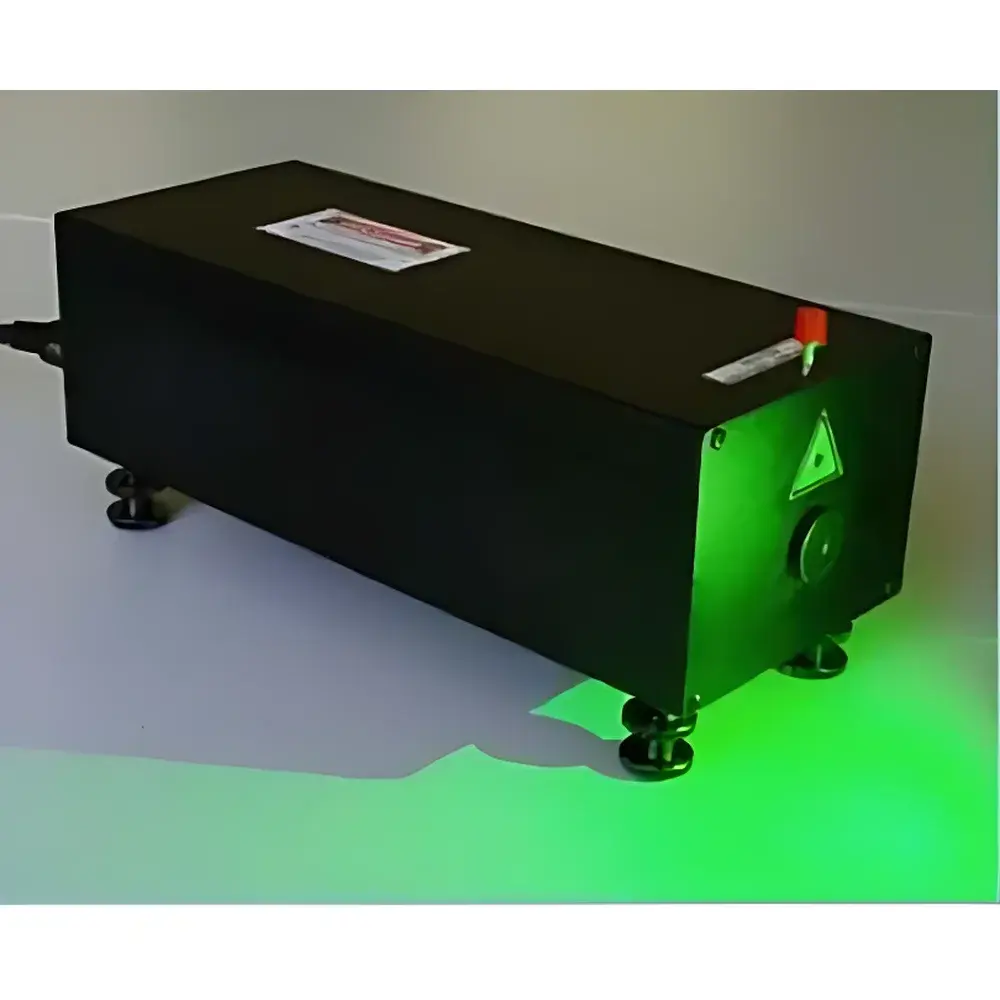
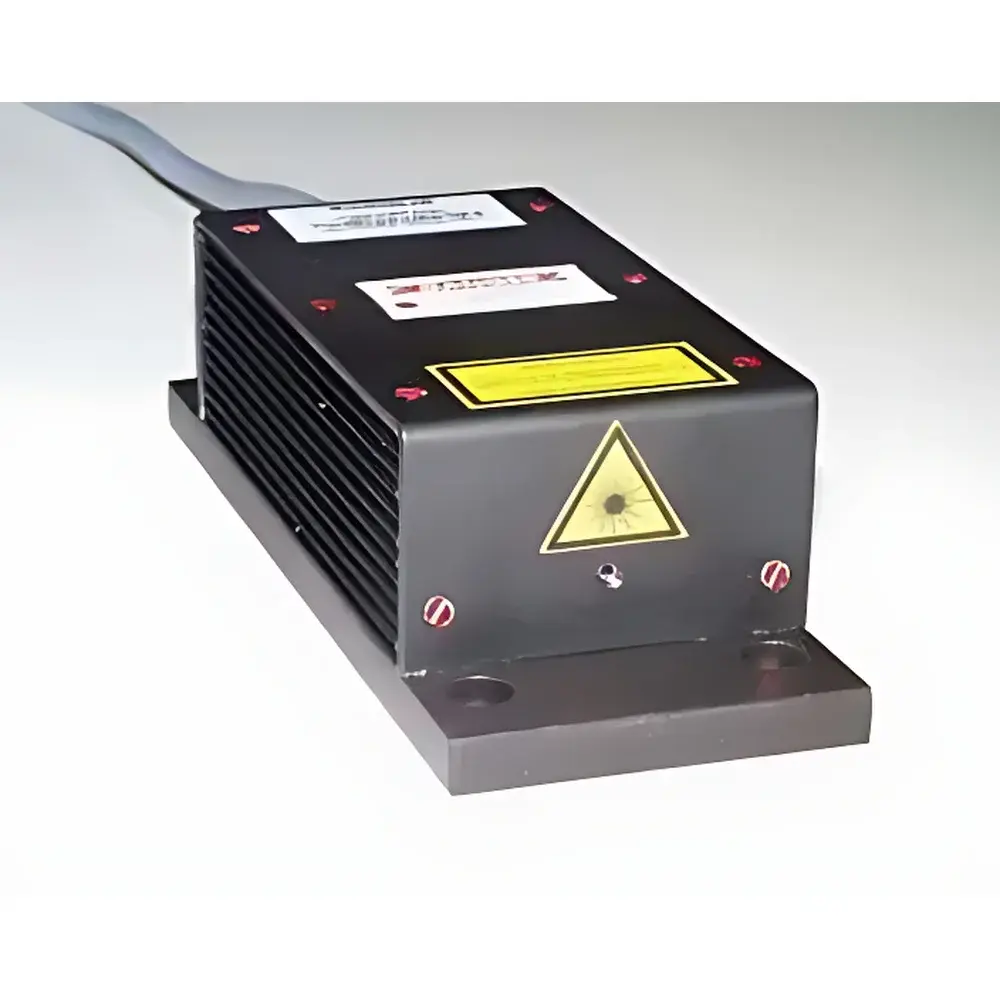
AlphaLas MONOPOWER™ Series CW Single-Frequency DPSS Laser
| Brand | AlphaLas |
|---|---|
| Origin | Germany |
| Model | MONOPOWER™ |
| Light Source Type | Continuous-Wave (CW) Diode-Pumped Solid-State (DPSS) Laser |
| Wavelength | 532 nm (fundamental green) |
| Output Power Range | 10 mW to 10 W |
| Beam Quality | TEM₀₀ (Single Transverse Mode) |
| Relative Intensity Noise (RIN) | < −130 dB/Hz (typ. < 0.5% RMS, 10 Hz–10 MHz) |
| Linewidth | < 1 MHz (single longitudinal mode) |
| Polarization Extinction Ratio | > 100:1 |
| Cooling | Air-cooled (up to 2 W), Water-cooled (≥ 5 W) |
| Operating Temperature | 15–30 °C |
| Warm-up Time | < 15 min to full stability |
| Power Stability (8 hrs) | ±0.5% |
| Beam Diameter (1/e²) | 0.6–1.2 mm (model-dependent) |
| Divergence (full angle) | < 1.5 mrad |
| Modulation Capability | Analog & TTL modulation input (optional) |
| Compliance | CE, RoHS, IEC 60825-1:2014 Class 3B/4 laser safety |
Overview
The AlphaLas MONOPOWER™ Series represents a family of continuous-wave (CW), single-frequency, diode-pumped solid-state (DPSS) lasers engineered for high-stability, narrow-linewidth operation at 532 nm. Based on intracavity frequency-doubling of Nd:YVO₄ or Nd:YAG crystals, these lasers deliver diffraction-limited TEM₀₀ output with exceptional spectral purity and amplitude stability—critical requirements for precision optical metrology and coherent light applications. Unlike broadband arc lamps (e.g., xenon or mercury sources), the MONOPOWER™ is not a polychromatic illumination tool but a monochromatic, coherence-preserving laser source optimized for interferometric, spectroscopic, and nonlinear optical experiments where temporal and spatial coherence, low phase noise, and long-term power repeatability are non-negotiable.
Key Features
- True single-longitudinal-mode (SLM) emission with linewidth < 1 MHz—enabling sub-micron interferometric resolution and efficient nonlinear frequency conversion.
- Ultra-low relative intensity noise (< 0.5% RMS, 10 Hz–10 MHz), achieved via active power stabilization and optimized thermal management—essential for shot-noise-limited detection in Raman spectroscopy and heterodyne measurements.
- TEM₀₀ beam profile with M² < 1.05 ensures optimal coupling into single-mode fibers, confocal microscope objectives, and waveguide structures.
- Modular thermal architecture: air-cooled variants (≤2 W) integrate passive heatsinks and thermoelectric coolers; water-cooled models (≥5 W) employ precision PID-controlled chillers for sub-0.1 °C temperature stability.
- Factory-aligned, sealed resonator design eliminates need for user realignment—ensuring robustness during transport and long-term deployment in shared laboratory environments.
- Comprehensive analog/TTL modulation interface (optional) supports external triggering, power ramping, and synchronization with CCD/CMOS detectors or pulse generators.
Sample Compatibility & Compliance
The MONOPOWER™ is compatible with standard optical tables, kinematic mounts (e.g., Thorlabs KM100), and OEM integration platforms via Ø25.4 mm or Ø30 mm lens tube interfaces. Its 532 nm output couples efficiently into silica-based single-mode fibers (SMF-28), acousto-optic modulators (AOMs), and lithium niobate (LiNbO₃) waveguides used in electro-optic modulation. From a regulatory standpoint, the system complies with IEC 60825-1:2014 for Class 3B (≤500 mW) and Class 4 (>500 mW) laser products, including mandatory interlock circuits, key-controlled enable switches, and emission delay timers. It meets CE marking requirements under the EU Machinery Directive and RoHS 2011/65/EU. For GLP/GMP-regulated labs, optional audit-trail-enabled firmware logs operational parameters (output power, temperature, runtime) in timestamped binary files compliant with FDA 21 CFR Part 11 data integrity guidelines.
Software & Data Management
AlphaLas provides the MONOCONTROL™ GUI (Windows/Linux/macOS) for real-time monitoring and control via USB 2.0 or RS-232. The software enables closed-loop power regulation, temperature setpoint adjustment, diagnostic readouts (photodiode feedback, TEC current, cavity alignment status), and automated warm-up sequencing. All configuration settings are stored in non-volatile memory. For integration into LabVIEW, MATLAB, or Python-based automation frameworks, a documented ASCII command protocol and native DLL/SO libraries are supplied. Exported measurement logs adhere to HDF5 format—supporting metadata tagging per ASTM E1497 (Standard Practice for Digital Recording of Spectral Data) and enabling traceable calibration workflows.
Applications
- Laser Interferometry: Used in gravitational wave detector prototype setups, displacement metrology (e.g., homodyne Michelson configurations), and nanoscale stage calibration due to its sub-Hz frequency drift (< 100 MHz/hour after stabilization).
- Raman Spectroscopy: Serves as excitation source in confocal micro-Raman systems—its narrow linewidth minimizes fluorescence background, while low RIN improves signal-to-noise ratio in weak vibrational modes.
- Holography & Optical Coherence Tomography (OCT): Enables high-visibility, long-coherence-length holograms and axial resolution < 5 µm in swept-source OCT test benches.
- Nonlinear Optics: Efficiently pumps optical parametric oscillators (OPOs) and generates second-harmonic (266 nm) or sum-frequency outputs in BBO or LBO crystals.
- Laser Scanning Microscopy: Integrated into custom-built STED or RESOLFT platforms requiring stable, diffraction-limited 532 nm beams with precise on/off switching.
FAQ
Is the MONOPOWER™ suitable for replacing traditional xenon or mercury arc lamps in fluorescence microscopy?
No—it is not a broadband illumination source. Xenon/mercury lamps emit across UV–visible spectra for multi-channel excitation; MONOPOWER™ delivers only 532 nm CW light and is intended for coherence-sensitive applications, not wide-spectrum epifluorescence.
Can output power be adjusted continuously between 10 mW and maximum rated power?
Yes—via analog voltage input (0–5 V) or software command, with linearity error < ±1.5% across the full range and no mode hops.
What is the typical warm-up time to achieve specified power and frequency stability?
<15 minutes from cold start to meet all specifications per AlphaLas datasheet Rev. 4.2 (2023).
Does the system include beam-shaping optics?
No—collimated free-space output is provided. Optional beam expanders, fiber-coupling kits, and polarization rotators are available as accessories.
Is remote diagnostics supported for predictive maintenance?
Yes—embedded sensors monitor pump diode current, crystal temperature, and output photodiode signal; anomalies trigger event logs accessible via MONOCONTROL™ or SNMP-compatible network gateways (optional).





