
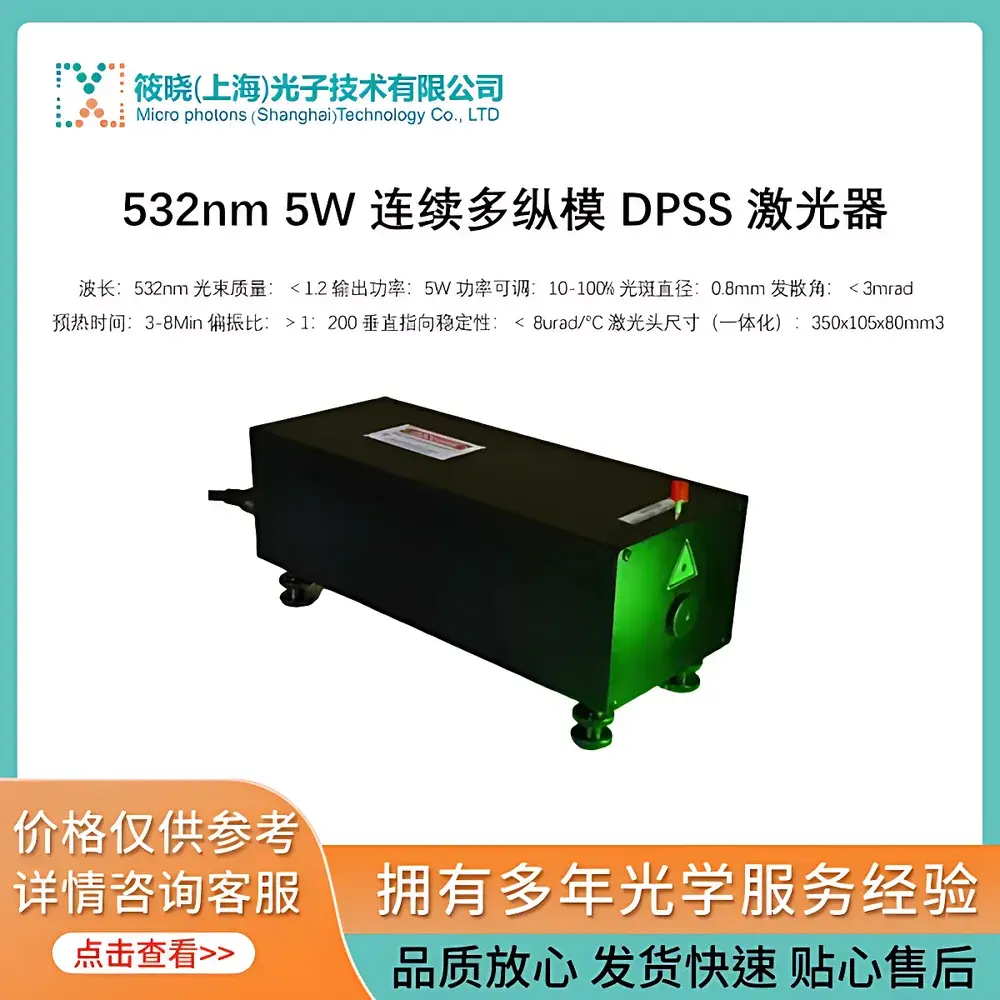
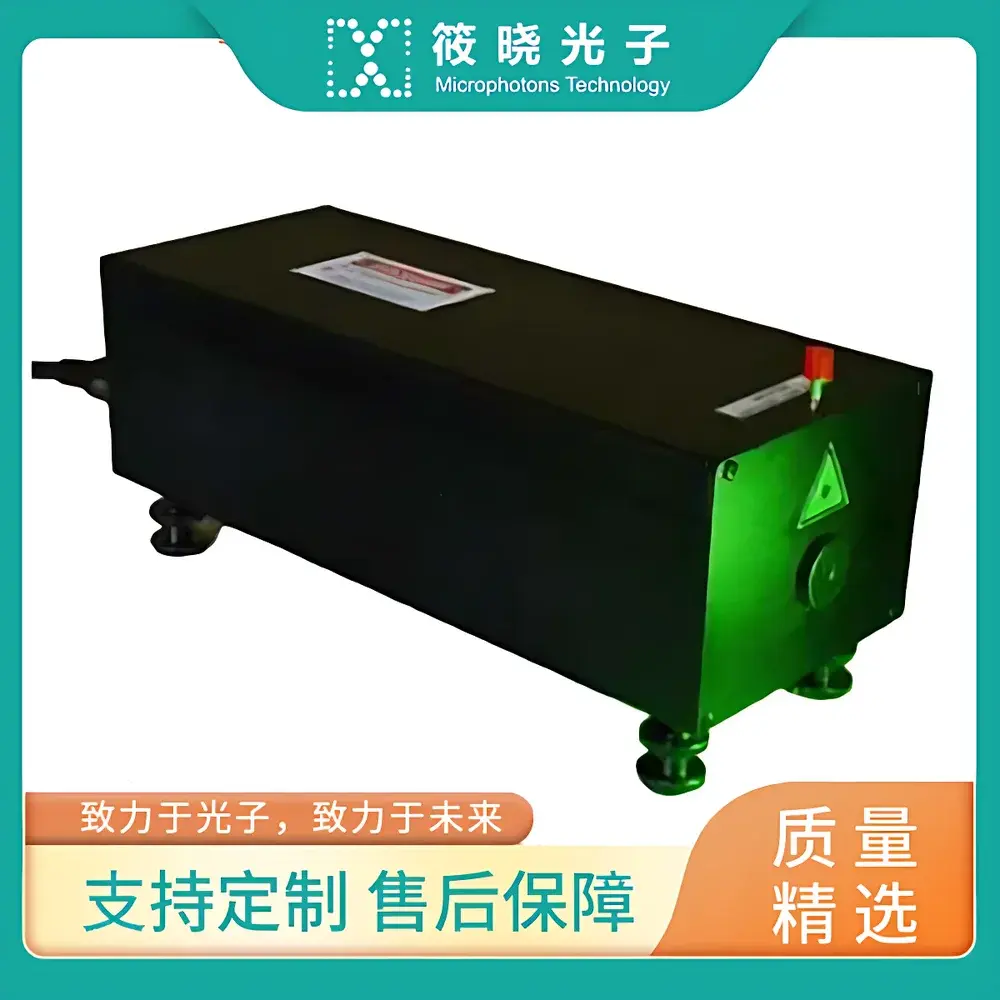
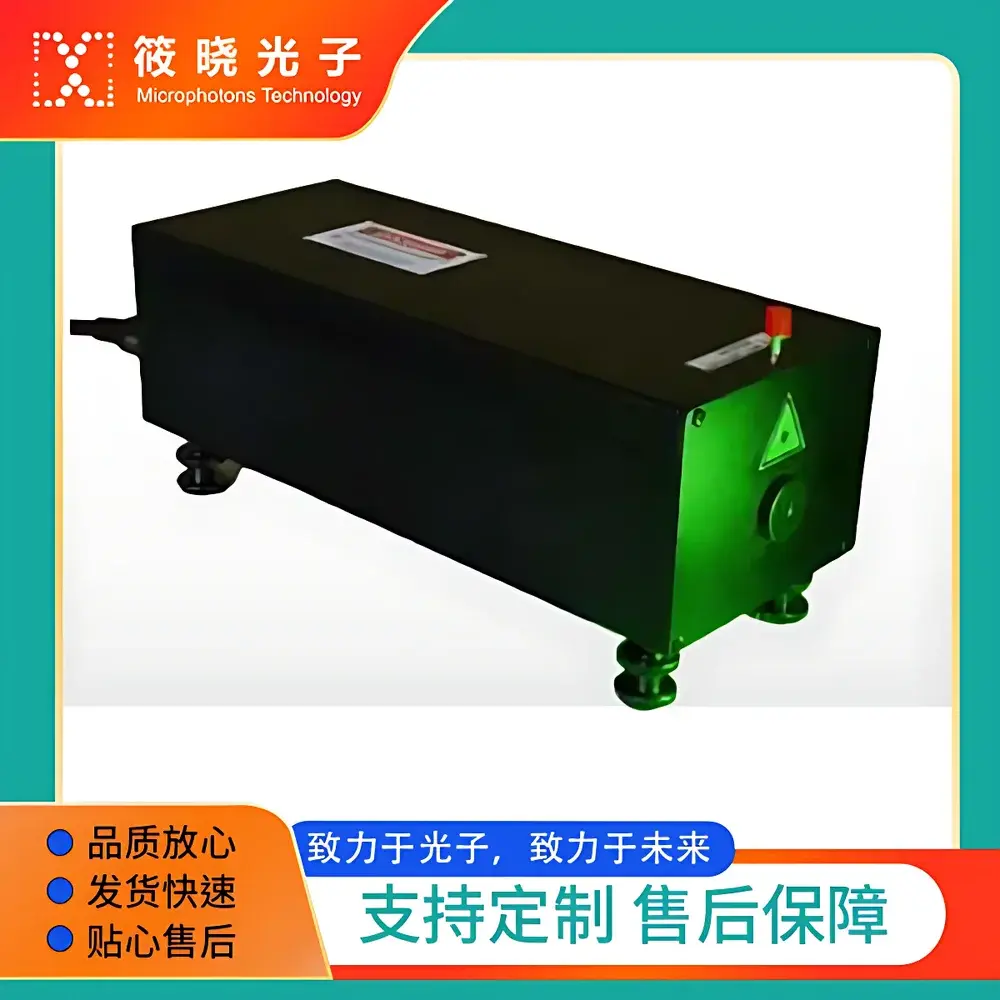
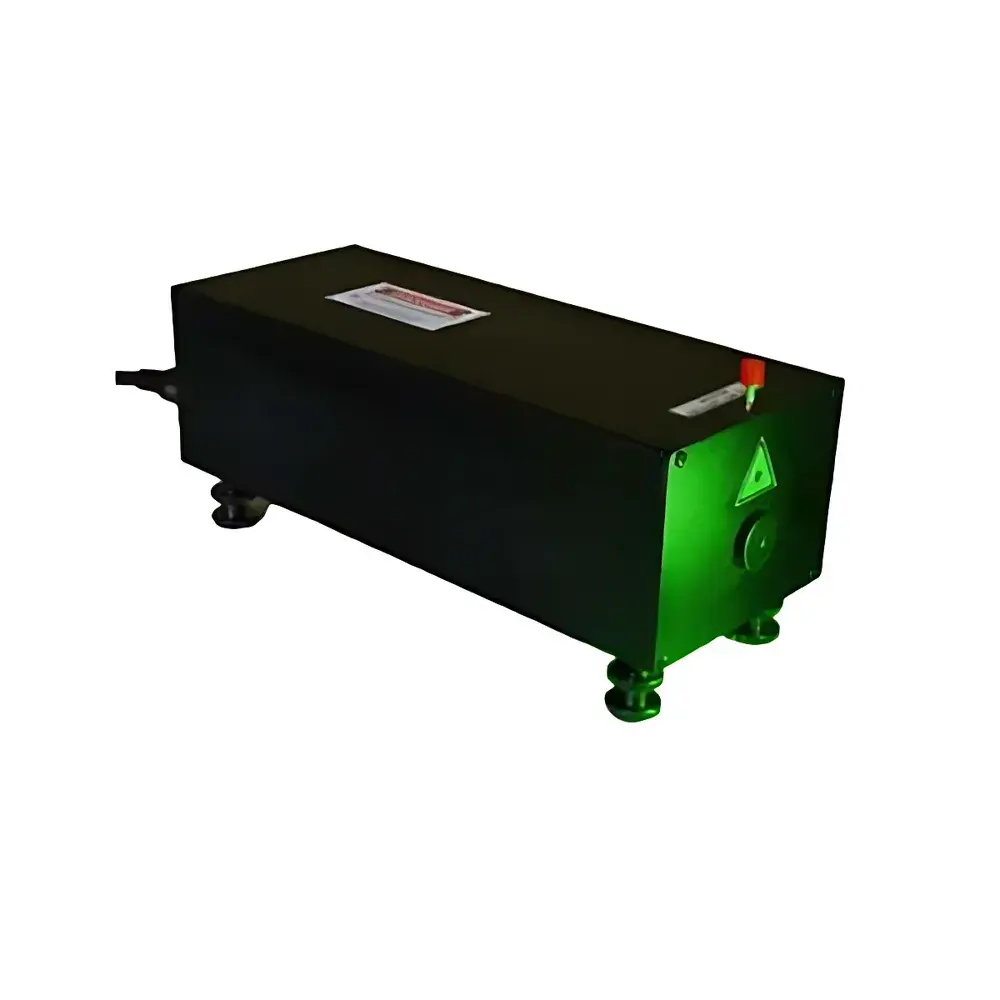
AlphaLas MP-532-5W-MM 532 nm 5 W Continuous-Wave Multi-Longitudinal-Mode Diode-Pumped Solid-State Laser
| Brand | AlphaLas |
|---|---|
| Origin | Germany |
| Model | MP-532-5W-MM |
| Output Wavelength | 532 nm |
| Output Power | 5 W (CW) |
| Laser Type | Diode-Pumped Solid-State (DPSS), Multi-Longitudinal-Mode |
| Cooling | Water-cooled |
| Beam Diameter (1/e²) | ~1.2 mm |
| Beam Divergence (full angle) | <1.5 mrad |
| Polarization Ratio | >100:1 |
| Power Stability (rms, over 8 h) | <1.5% |
| M² Factor | <1.3 |
| Warm-up Time | <10 min |
| Operating Temperature | 15–30 °C |
| Humidity | <80% RH (non-condensing) |
| Input Power | 220 V AC, 50/60 Hz |
| Dimensions (L×W×H) | 360 × 140 × 120 mm |
| Weight | ~6.5 kg |
Overview
The AlphaLas MP-532-5W-MM is a high-power, continuous-wave (CW), multi-longitudinal-mode diode-pumped solid-state (DPSS) laser engineered for industrial and scientific applications requiring stable green output at 532 nm. Based on intracavity frequency-doubling of a Nd:YVO₄ fundamental oscillator (1064 nm) using a nonlinear LBO crystal, this system delivers 5 W of TEM₀₀-compatible output with excellent spatial coherence and low beam pointing drift. Unlike single-frequency lasers, its multi-longitudinal-mode operation provides inherently higher power scalability and reduced susceptibility to optical feedback-induced instability—making it suitable for pumping optical parametric oscillators (OPOs), driving nonlinear frequency conversion stages, and powering high-throughput fluorescence excitation systems where spectral purity is secondary to power stability and reliability.
Key Features
- Stable 5 W CW output at 532 nm with RMS power stability better than ±1.5% over 8 hours under controlled ambient conditions
- Water-cooled thermal management architecture ensuring long-term operational consistency and minimal thermal lensing effects
- Integrated temperature-stabilized pump diode and crystal mount assembly for reproducible alignment and extended lifetime
- Beam quality characterized by M² < 1.3 and divergence < 1.5 mrad (full angle), enabling efficient coupling into multimode fibers or downstream optics
- High polarization extinction ratio (>100:1) supporting polarization-sensitive processes such as electro-optic modulation or harmonic generation
- Compliant with IEC 60825-1:2014 Class 4 laser safety requirements; includes interlock-ready connectors and key-switch enable circuitry
- Robust mechanical housing (aluminum alloy) with standardized 360 × 140 × 120 mm footprint for OEM integration into larger optical platforms
Sample Compatibility & Compliance
The MP-532-5W-MM is designed for use in environments adhering to ISO/IEC 17025-accredited laboratories and industrial settings operating under GLP/GMP frameworks. Its output wavelength and power profile are compatible with common photodetectors (e.g., Si and GaAs photodiodes), CCD/CMOS-based imaging sensors, and fluorescence dyes exhibiting strong absorption near 532 nm (e.g., FITC, Alexa Fluor 488, and Cy2). The laser meets CE marking requirements per Directive 2014/30/EU (EMC) and 2014/35/EU (LVD), and conforms to RoHS 2011/65/EU restrictions on hazardous substances. While not certified for medical device use under FDA 21 CFR Part 820, it is widely deployed in preclinical instrumentation subject to internal validation protocols aligned with ISO 13485 design controls.
Software & Data Management
This DPSS laser operates in analog control mode via 0–5 V input for power modulation and TTL-compatible digital signals for remote enable/disable functions. No proprietary software driver is required for basic operation; however, optional RS-232 or USB-to-serial interface modules (sold separately) support integration with LabVIEW, MATLAB, or Python-based automation scripts for scheduled power ramping, duty-cycle profiling, or synchronized triggering with cameras or spectrometers. All firmware updates and diagnostic logs adhere to traceable revision control practices, and operational parameters—including cumulative runtime, thermal sensor readings, and interlock status—are accessible through ASCII command sets compliant with SCPI-like syntax. Audit trails generated during calibration or maintenance events meet minimum documentation standards for ISO 9001:2015 clause 7.1.5.2.
Applications
- Pumping nanosecond and picosecond OPOs for tunable mid-IR spectroscopy (e.g., trace gas detection in environmental monitoring)
- Driving stimulated Raman scattering (SRS) microscopy systems requiring high average power at visible wavelengths
- Calibration source for radiometric and photometric transfer standards in national metrology institutes
- Material processing tasks including thin-film ablation, selective soldering, and laser-induced forward transfer (LIFT)
- Flow cytometry illumination where uniform excitation across heterogeneous cell populations is critical
- Interferometric vibration analysis and holographic interferometry setups demanding high spatial coherence and low noise floor
FAQ
What is the typical warm-up time before reaching rated output power?
The laser achieves stable output within ≤10 minutes after cold start, assuming ambient temperature remains within 15–30 °C and coolant flow rate meets manufacturer specifications (≥1.2 L/min at 20 °C inlet temperature).
Is the laser compatible with third-party water chillers?
Yes—provided the chiller maintains inlet water temperature between 18–22 °C, pressure ≥2 bar, and flow rate ≥1.2 L/min. AlphaLas recommends using chillers with PID-controlled temperature regulation and particle filtration (≤5 µm).
Does the system include built-in beam diagnostics?
No integrated beam profiler or power meter is included; however, the unit features a calibrated photodiode monitor output (BNC connector) delivering a voltage signal proportional to real-time output power (0–5 V = 0–5 W).
Can this laser be operated in pulsed mode via external modulation?
It supports analog power modulation up to 10 kHz bandwidth and TTL blanking at frequencies ≤50 kHz, but does not support Q-switched or gain-switched operation—its cavity design is optimized exclusively for CW performance.
What documentation is provided with shipment?
Each unit ships with a Declaration of Conformity, Factory Calibration Report (including power vs. current curve and beam profile scan), Safety Manual, and Mechanical Interface Drawing (PDF and STEP formats).




