
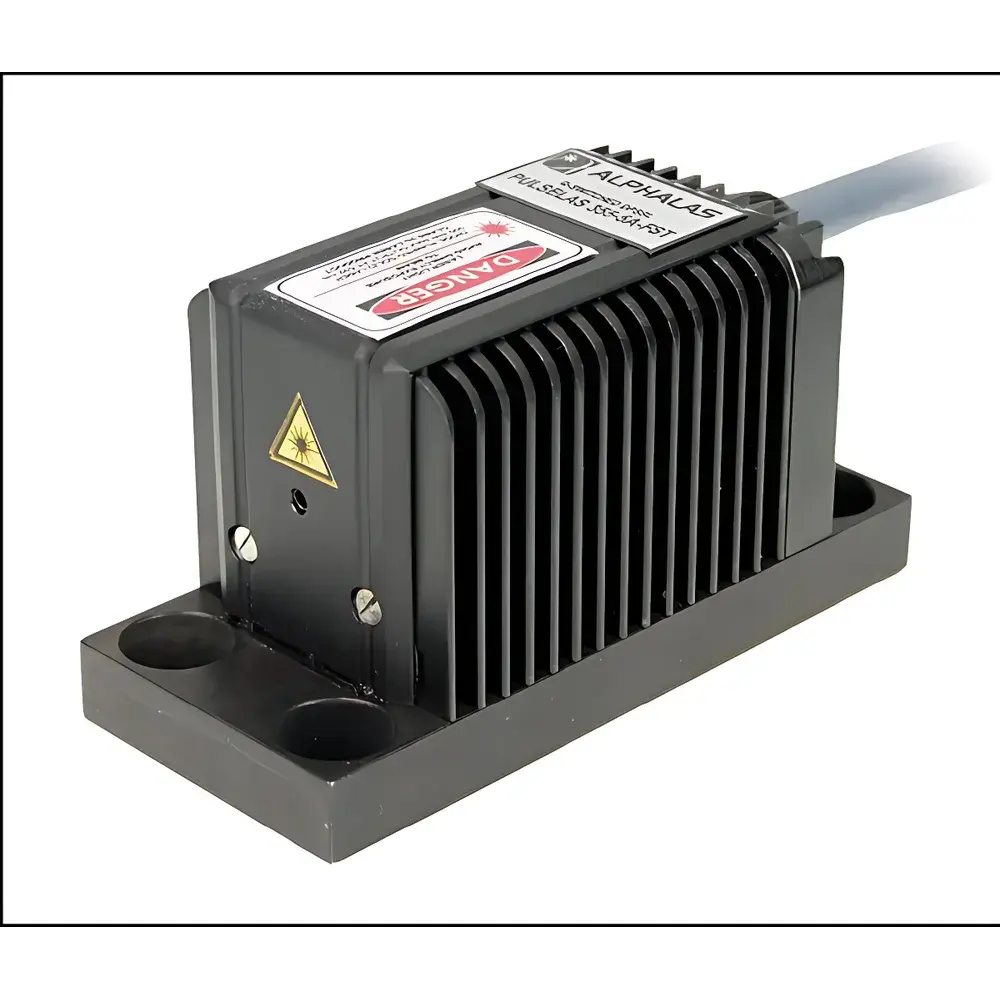
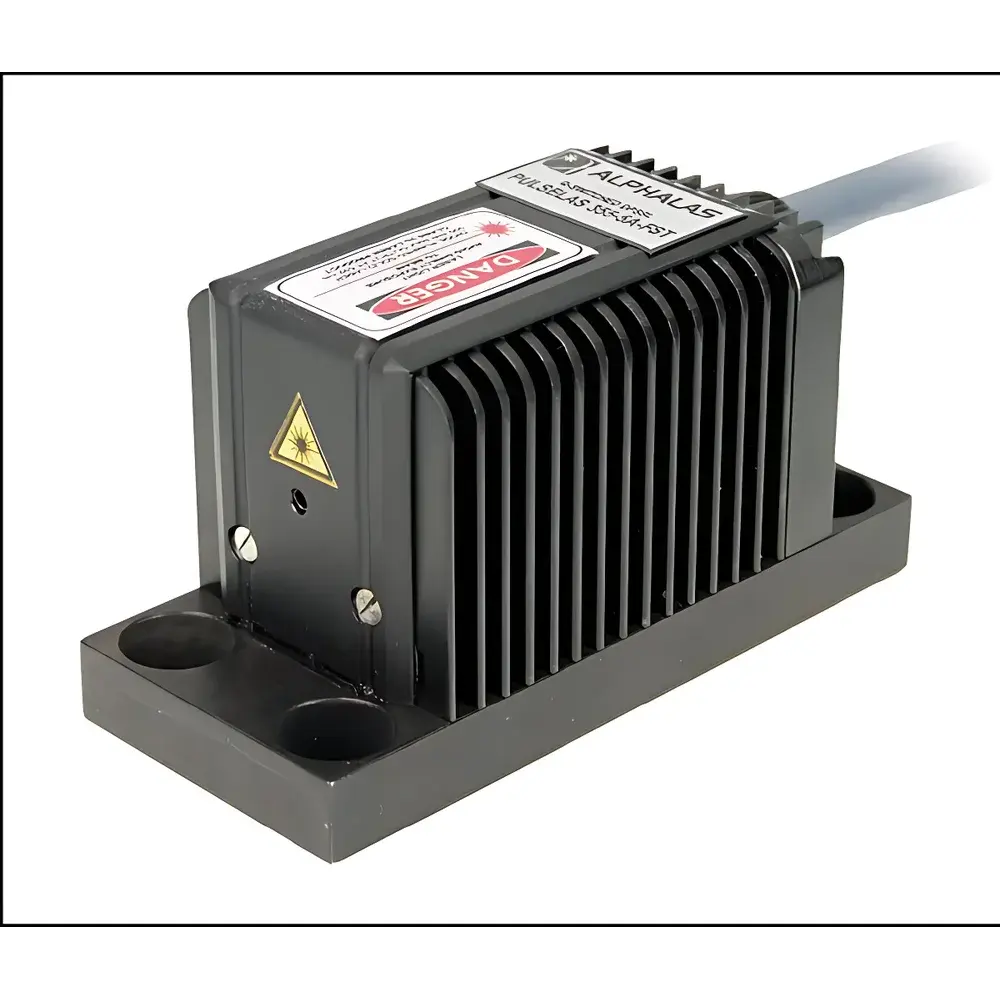
ALPHALAS Passive Q-Switched Microchip Solid-State Laser
| Brand | ALPHALAS |
|---|---|
| Origin | Germany |
| Model | 1064-200 |
| Wavelength | 1064 nm (customizable to 946 nm, 1342 nm, and frequency-doubled outputs) |
| Pulse Width | < 1 ns |
| Operating Mode | Passive Q-switching |
| Laser Type | Diode-pumped microchip solid-state laser |
| Illumination Configuration | External illumination |
| Compliance | CE-marked, RoHS-compliant |
| Cooling | Conductive (fanless, thermoelectrically stabilized) |
| Beam Quality | TEM₀₀ (M² < 1.1) |
| Repetition Rate | 1–100 kHz (model-dependent, standard 10–50 kHz) |
| Pulse Energy | Up to 50 µJ (at 1064 nm, 10 kHz) |
| Average Power | Up to 500 mW |
| Polarization | Linear, >100:1 extinction ratio |
Overview
The ALPHALAS Passive Q-Switched Microchip Solid-State Laser is a compact, diode-pumped, monolithic Nd:YAG (or Nd:YVO₄) laser engineered for high peak power, sub-nanosecond pulse generation with exceptional temporal stability and beam fidelity. Based on the passive Q-switching principle—utilizing a saturable absorber (e.g., Cr⁴⁺:YAG) integrated directly into the laser cavity—the system achieves self-starting, jitter-free pulsing without external electronic drivers or RF modulation. Its microchip architecture ensures minimal cavity length (< 5 mm), enabling intrinsic short-cavity dynamics that support pulse widths consistently below 1 ns (typically 700–900 ps FWHM) at 1064 nm. The laser operates in fundamental infrared emission but supports harmonic generation via external nonlinear crystals (e.g., KTP, LBO), enabling accessible outputs at 532 nm, 355 nm, and 266 nm. Designed for integration into OEM instrumentation and laboratory-grade optical setups, it delivers TEM₀₀ spatial mode quality (M² 100:1 extinction ratio), and conductive thermal management—eliminating forced-air cooling and vibration-sensitive components.
Key Features
- Sub-nanosecond pulse width (≤ 900 ps) with high pulse-to-pulse stability (rms jitter < 100 ps)
- Monolithic microchip design: robust, alignment-free, immune to mechanical drift and thermal lensing effects
- Passive Q-switching mechanism: no external RF driver, low EMI, ideal for sensitive measurement environments
- Wavelength flexibility: standard 1064 nm output; optional customization to 946 nm (Nd:YAG) or 1342 nm (Nd:YVO₄), with external SHG/THG modules available
- Fanless, thermoelectrically stabilized operation: suitable for vacuum chambers, microscopy stages, and portable spectroscopic platforms
- Integrated photodiode monitor and TTL sync output for precise external triggering and time-resolved data acquisition
- CE-marked and RoHS-compliant construction, designed to meet IEC 60825-1:2014 Class 4 laser safety requirements
Sample Compatibility & Compliance
This laser is compatible with standard optical breadboards, kinematic mounts, and fiber-coupling adapters (e.g., SMA905 or FC/APC interfaces via optional collimator-fiber launch systems). It interfaces seamlessly with streak cameras, SPAD arrays, TCSPC modules, and gated ICCDs used in time-resolved fluorescence, LIBS, and pump-probe spectroscopy. From a regulatory standpoint, the system conforms to EU Directive 2014/30/EU (EMC), 2014/35/EU (LVD), and EN 60825-1:2014 for laser product safety. Full traceable calibration documentation—including pulse width verification (autocorrelation), energy calibration (NIST-traceable pyroelectric sensor), and beam profile characterization (ISO 11146-1 compliant)—is provided with each unit. For GLP/GMP-aligned labs, audit-ready records—including firmware version logs, factory test reports, and component lot traceability—are available upon request.
Software & Data Management
While the laser operates autonomously without host software, ALPHALAS provides optional LabVIEW™ and Python SDKs (via USB-C or RS-232) for remote control of repetition rate, pulse enable/disable, and status monitoring (temperature, diode current, pulse count). All communication protocols adhere to SCPI command syntax, ensuring compatibility with existing automated test frameworks. Pulse timing metadata (TTL sync edge timestamps) can be logged alongside spectrometer or oscilloscope acquisitions using standard time-stamping hardware (e.g., National Instruments PXIe-6674T). Data export formats include CSV and HDF5, supporting interoperability with MATLAB®, OriginLab, and Python-based analysis pipelines (e.g., SciPy, NumPy, LMFIT). Firmware updates are performed via signed binary packages validated against SHA-256 checksums—meeting baseline requirements for FDA 21 CFR Part 11 electronic record integrity where applicable.
Applications
- Laser-induced breakdown spectroscopy (LIBS): high peak intensity enables efficient plasma generation from metals, ceramics, and geological samples
- Time-resolved fluorescence lifetime imaging (FLIM) and TCSPC: sub-ns pulses resolve nanosecond-scale decay kinetics in biological fluorophores and quantum dots
- Micro-machining and precision marking: ablation of diamond, sapphire, and tungsten carbide with minimal heat-affected zones
- Optical parametric oscillator (OPO) pumping: narrow linewidth and high spatial coherence support efficient wavelength conversion across UV–IR
- LIDAR and time-of-flight ranging: low timing jitter enables sub-millimeter distance resolution in atmospheric and industrial sensing
- Supercontinuum generation in photonic crystal fibers: high peak power initiates broadband spectral broadening for OCT and metrology
- DNA sequencing and single-molecule detection: synchronized excitation for confocal and TIRF microscopy platforms
FAQ
What is the typical pulse energy stability over 8 hours of continuous operation?
Pulse energy drift remains within ±2.5% (RMS) under constant ambient temperature (23 ± 1°C) and stable line voltage, verified per ISO 13697:2019 stability testing protocol.
Can this laser be integrated into a vacuum environment?
Yes—its conductive cooling architecture and absence of outgassing plastics or lubricants make it suitable for UHV-compatible integration (base pressure ≤10⁻⁶ mbar); optional stainless-steel housing upgrade available.
Is frequency doubling included as standard equipment?
No—SHG modules are optional accessories; standard configuration delivers fundamental 1064 nm output only. External harmonic generation requires separate crystal oven, phase-matching alignment stage, and dichroic separation optics.
Does the laser support external repetition rate modulation?
Yes—via analog voltage input (0–5 V) or TTL gating, enabling burst-mode operation and synchronization with motion stages or detector gates.
What maintenance is required during its operational lifetime?
None beyond periodic verification of optical window cleanliness and thermal interface paste integrity every 24 months; diode pump lifetime exceeds 20,000 hours under rated conditions.





