
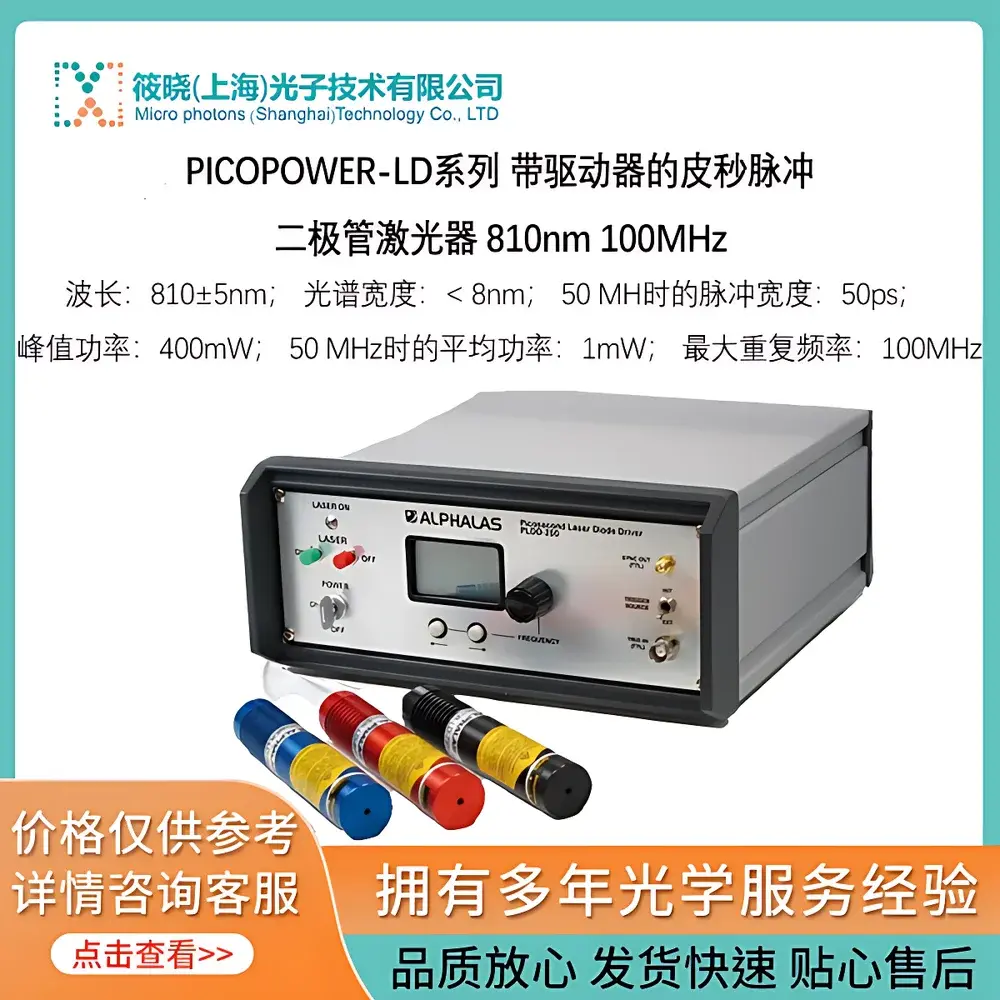
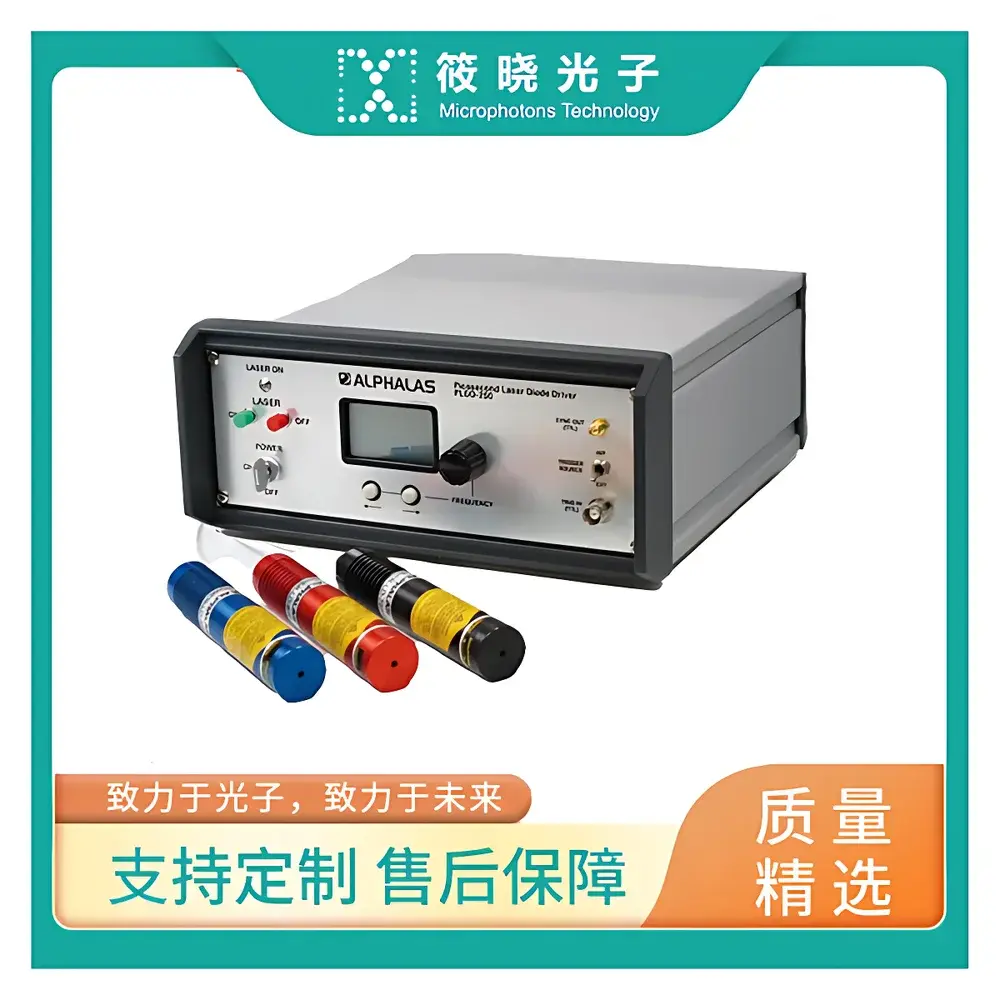
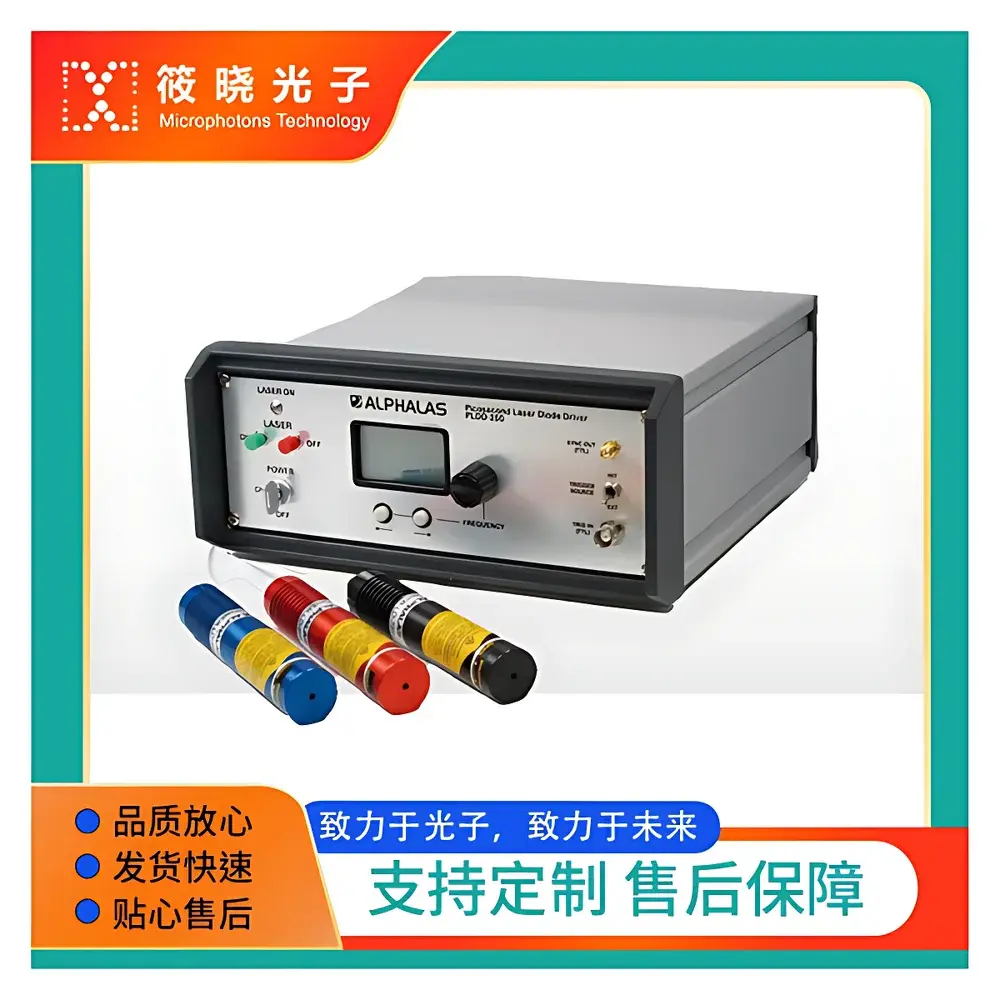
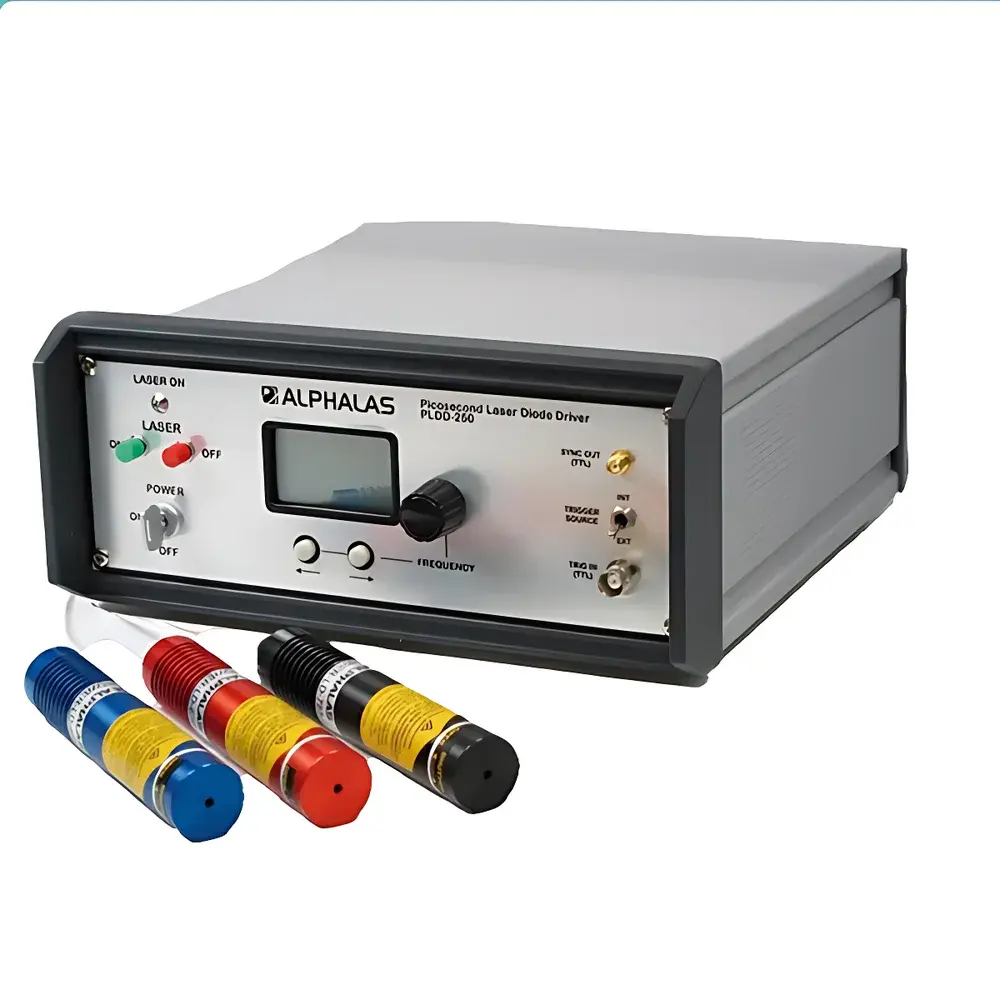
AlphaLas PICOPOWER-LD-810-FSB Picosecond Pulsed Diode Laser with Integrated Driver, 810 nm, 100 MHz Repetition Rate
| Brand | AlphaLas |
|---|---|
| Origin | Germany |
| Model | PICOPOWER-LD-810-FSB |
| Wavelength | 810 nm |
| Repetition Rate | 100 MHz |
| Pulse Width | <35 ps (typ.) |
| Output Type | Free-space collimated beam |
| Driver Integration | Fully integrated, TTL/CMOS-compatible trigger input |
| Compliance | CE, RoHS |
| Component Category | Optical Component |
Overview
The AlphaLas PICOPOWER-LD-810-FSB is a compact, turnkey picosecond pulsed diode laser system engineered for time-resolved optical measurements requiring high temporal precision and spectral stability. Operating at a center wavelength of 810 nm, it delivers sub-35 ps optical pulses at a fixed repetition rate of 100 MHz, generated via gain-switching of a specially optimized edge-emitting semiconductor laser diode. Unlike Q-switched or mode-locked solid-state lasers, this diode-based architecture eliminates the need for external cavity alignment, offers superior long-term amplitude stability (<1.5% RMS over 8 hours), and enables direct digital synchronization via TTL or CMOS logic signals. The integrated driver provides precise current control, temperature stabilization (TEC-cooled), and pulse shaping circuitry — all housed within a single, shielded 19″ rack-mountable enclosure (4U height). Designed for integration into ultrafast spectroscopy, time-correlated single-photon counting (TCSPC), fluorescence lifetime imaging (FLIM), and pump-probe experiments, the system meets stringent requirements for jitter performance (<5 ps RMS timing jitter relative to trigger) and pulse-to-pulse intensity reproducibility.
Key Features
- Sub-35 ps optical pulse width (FWHM), verified by autocorrelation under standard operating conditions
- Stable 100 MHz fundamental repetition rate with harmonic locking capability up to 2 GHz (via optional external divider)
- Fully integrated driver with adjustable bias current (0–120 mA), programmable pulse delay (0–100 ns, 10 ps resolution), and fast rise/fall times (<200 ps)
- TEC-controlled diode mount ensuring wavelength drift <±0.02 nm/°C and power drift <±0.5% over ambient temperature range 15–30 °C
- Free-space output with collimated beam (1.2 mm Ø, M² <1.3), equipped with SM1-threaded housing for standard optomechanical compatibility
- Built-in diagnostics: real-time monitoring of diode temperature, drive current, and optical power via analog voltage outputs (0–5 V)
- Compliant with IEC 60825-1:2014 Class 4 laser safety standards; includes interlock connector (24 V, fail-safe) and key switch
Sample Compatibility & Compliance
The PICOPOWER-LD-810-FSB is compatible with standard ultrafast optical components including dichroic mirrors (800–820 nm HR/HT), achromatic quarter-wave plates, and silicon or GaAs photodetectors with <50 ps rise time. Its spectral bandwidth (~0.8 nm FWHM) supports efficient coupling into single-mode fibers (e.g., 780 HP) using appropriate aspheric couplers. From a regulatory standpoint, the system conforms to EU Directive 2014/30/EU (EMC), 2011/65/EU (RoHS), and carries CE marking. It satisfies essential requirements for laboratory use under ISO/IEC 17025-accredited environments when operated within specified ambient conditions (non-condensing humidity ≤60%, no airborne particulates). While not certified to FDA 21 CFR Part 11, its analog monitoring outputs and deterministic trigger interface support integration into validated GxP workflows where electronic records are managed externally.
Software & Data Management
No proprietary GUI is bundled; operation is hardware-defined via front-panel controls and external digital inputs. All critical parameters — including enable state, pulse delay, and current setpoint — are accessible through 0–5 V analog interfaces and LVTTL-compatible digital lines (5 V tolerant). For automated sequencing, the laser integrates natively with National Instruments DAQ systems, Thorlabs Kinesis platforms, and LabVIEW-based TCSPC controllers (e.g., PicoQuant HydraHarp). Trigger latency is deterministic (2.1 ±0.3 ns from TTL edge to optical pulse onset), enabling sub-nanosecond synchronization across multi-channel acquisition systems. Firmware updates (if released) are delivered via USB-C port using vendor-provided command-line utilities; no cloud connectivity or remote access functionality is implemented — consistent with secure laboratory infrastructure policies.
Applications
This laser serves as a reliable excitation source in quantitative time-domain optical characterization. Key use cases include: time-resolved photoluminescence decay analysis of perovskite thin films; calibration of streak cameras and SPAD arrays; seeding of optical parametric amplifiers (OPAs) in broadband IR generation; and optical clock distribution in distributed ultrafast metrology setups. Its narrow spectral emission and low timing jitter make it particularly suitable for lifetime-resolved Raman spectroscopy where picosecond-scale discrimination between electronic and vibrational relaxation pathways is required. In industrial settings, it supports non-destructive testing of semiconductor wafer defects via time-of-flight diffraction contrast imaging.
FAQ
Is the laser output polarized?
Yes — the free-space beam exhibits >100:1 linear polarization ratio parallel to the diode junction plane.
Can repetition rate be adjusted below 100 MHz?
No — the system operates exclusively at 100 MHz; variable-rate operation requires external pulse picking (e.g., EO modulator + sync divider) and is not supported natively.
What is the maximum average optical power at the output aperture?
Typical output is 1.8–2.2 mW (CW-equivalent), depending on diode aging and thermal load; peak power exceeds 50 W.
Does the unit include beam delivery optics?
No — only collimated free-space output is provided; fiber coupling or focusing optics must be selected separately based on application requirements.
Is service support available outside the EU?
AlphaLas provides global technical documentation and firmware tools; hardware repair is coordinated through authorized service centers in North America and Asia-Pacific regions.




