
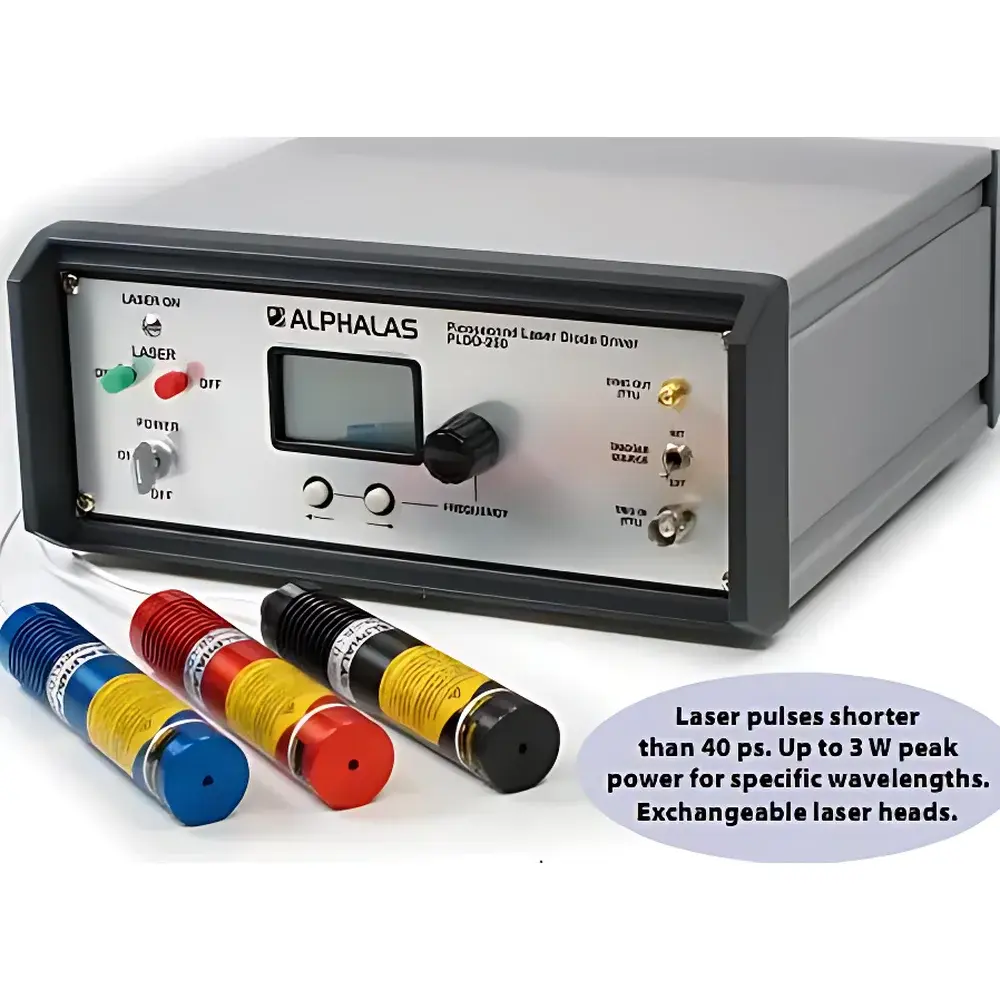
Alphalas PICOPOWER-LD Series Picosecond Pulse Diode Laser System
| Brand | Alphalas |
|---|---|
| Origin | Germany |
| Model | PICOPOWER-LD |
| Wavelength Options | 375, 405, 450, 488, 635, 670, 785, 976, 1030, 1064, 1300, 1550 nm (custom wavelengths available) |
| Pulse Width | <40–80 ps (wavelength-dependent) |
| Repetition Rate | 0.1 Hz to 20 MHz (optional up to 80 MHz) |
| Peak Power | Up to 3 W (wavelength- and configuration-dependent) |
| Average Power | 0.2–1.0 mW @ 20–40 MHz |
| Beam Divergence | 0.5–1.5 mrad |
| Output | Free-space collimated (TEM₀₀, elliptical) or fiber-coupled (SMF/PMF options) |
| Operating Temperature | 15–35 °C |
| Laser Head Dimensions | Ø25 × 125 mm |
| Driver Dimensions (PLDD-100-40) | 235 × 110 × 280 mm |
| Weight | Laser Head 120 g, Driver 2.6 kg |
| Compliance | CE, RoHS, IEC 60825-1:2014 (Laser Class 1M or 3B per wavelength) |
Overview
The Alphalas PICOPOWER-LD Series is a fully integrated picosecond pulse diode laser system engineered for time-resolved optical applications requiring precise temporal control, high peak power, and exceptional pulse-to-pulse stability. Unlike conventional nanosecond or continuous-wave sources, this system employs a patented high-current pulsed driver architecture that directly modulates laser diodes to generate sub-80 ps optical pulses—enabling access to ultrafast photophysical processes with minimal thermal load and jitter. The core measurement principle relies on direct electrical excitation of gain media in semiconductor laser diodes, eliminating the need for complex cavity Q-switching or mode-locking mechanisms. This results in a compact, robust, and maintenance-free source ideal for integration into laboratory-grade fluorescence lifetime spectrometers, pump-probe setups, time-of-flight instrumentation, and fiber-optic test benches. Each unit comprises a thermally stabilized laser head and the PLDD-100-40 digital driver with built-in frequency generator, TTL synchronization interfaces, and real-time display—designed for seamless operation in both benchtop and OEM environments.
Key Features
- Sub-40 ps pulse width at key wavelengths (e.g., 405 nm, 1300 nm, 1550 nm), with typical values ranging from <40 ps to <80 ps across the full spectral range
- Peak optical power up to 3 W—achievable at select wavelengths (e.g., 405 nm, 670 nm) under optimized drive conditions
- Digital frequency generator with 8-digit LED display; adjustable repetition rate from 0.1 Hz to 20 MHz standard, extendable to 40 MHz or 80 MHz upon request
- Integrated spatial filtering and collimation optics yielding TEM₀₀-like elliptical beam profiles with divergence <1.5 mrad (free-space output)
- Modular laser head design supporting rapid interchange of wavelength-specific modules—from deep UV (375 nm) to mid-IR (1550 nm)—with <1% wavelength tolerance
- Low-jitter external TTL trigger input and synchronized TTL output for multi-instrument timing alignment (e.g., with streak cameras or time-correlated single-photon counting systems)
- Fiber-coupling option available for SMF-28 or polarization-maintaining fiber (PMF), enabling compatibility with interferometric, OCT, or telecom-grade test platforms
- Comprehensive safety compliance: IEC 60825-1:2014 certified; laser classification ranges from Class 1M (collimated visible/NIR) to Class 3B (high-power configurations), documented per wavelength
Sample Compatibility & Compliance
The PICOPOWER-LD series is compatible with a broad range of optically active samples—including organic fluorophores, quantum dots, perovskite thin films, silicon photodetectors, and telecom-grade optical fibers—without requiring optical parametric amplification or external pulse compression. Its low average power (<1 mW at 40 MHz) minimizes photobleaching and thermal distortion in delicate biological or polymeric specimens. From a regulatory standpoint, the system meets CE marking requirements for electromagnetic compatibility (EMC Directive 2014/30/EU) and low-voltage safety (LVD Directive 2014/35/EU). All firmware-controlled parameters—including repetition rate, pulse enable/disable state, and internal trigger delay—are logged with timestamped audit trails, supporting GLP/GMP-aligned workflows where traceability is required. While not inherently FDA 21 CFR Part 11 compliant out-of-the-box, the driver’s digital interface supports integration with validated third-party data acquisition software for regulated environments.
Software & Data Management
The PLDD-100-40 driver operates autonomously via front-panel controls and does not require host PC software for basic functionality. However, RS-232 and USB-C interfaces enable remote parameter configuration—including frequency setpoint, burst mode activation, and TTL delay calibration—using ASCII command protocols documented in the technical manual. No proprietary runtime or license-based software is required. For automated test sequences, users may integrate the device into LabVIEW, Python (PySerial), or MATLAB environments using standard serial communication libraries. All operational states (e.g., temperature status, overcurrent protection events, frequency lock confirmation) are reported via status bits readable through the serial interface. Internal non-volatile memory retains user-defined settings across power cycles, ensuring repeatable startup conditions without reconfiguration.
Applications
- Time-resolved fluorescence spectroscopy: Excitation source for TCSPC systems measuring lifetimes from sub-100 ps to several nanoseconds in molecular probes, FRET pairs, and nanomaterials
- Pump-probe transient absorption: Synchronized dual-wavelength operation (e.g., 405 nm pump / 785 nm probe) for carrier dynamics studies in semiconductors and 2D materials
- Optoelectronic device characterization: Jitter-limited triggering of photodiodes, APDs, and SPAD arrays to quantify impulse response and timing resolution
- Optical time-domain reflectometry (OTDR): High-peak-power, narrow-pulse source for distributed fault detection and attenuation profiling in single-mode fiber networks
- Fiber laser seeding: Low-noise, high-repetition-rate seed source for MOPA architectures operating in C- and L-bands
- Optical coherence tomography (OCT): Broadband swept-source or time-domain OCT systems benefit from the stable pulse envelope and low timing jitter
- Ultrafast metrology: Calibration reference for autocorrelators, streak cameras, and electro-optic sampling systems
FAQ
What is the minimum achievable pulse width across the wavelength range?
Pulse width varies by emission wavelength and drive condition: ≤40 ps at 405 nm, 1300 nm, and 1550 nm; ≤60 ps at 375 nm, 450 nm, 488 nm, 670 nm, 785 nm, 1030 nm, and 1064 nm; ≤80 ps at 976 nm.
Can the system be synchronized with external equipment such as oscilloscopes or detectors?
Yes—TTL-compatible trigger input (≤20 MHz, 5 V logic) and TTL sync output are provided with <100 ps jitter relative to optical pulse onset.
Is fiber coupling available for all wavelengths?
Fiber coupling is standard for 635 nm, 1300 nm, and 1550 nm; optional for other wavelengths upon request—subject to coupling efficiency and modal matching constraints.
Does the driver support burst-mode operation?
Burst-mode functionality (user-defined pulse trains within a gate window) is supported via external TTL gating of the driver’s internal oscillator.
What cooling method is used in the laser head?
Passive conduction cooling only; no fans or TECs—ensuring silent, vibration-free operation suitable for interferometric applications.
Are calibration certificates and traceable power measurements included?
Each unit ships with factory calibration data (pulse width, average power, center wavelength) referenced to NIST-traceable standards; full ISO/IEC 17025 calibration reports are available as an optional service.





