
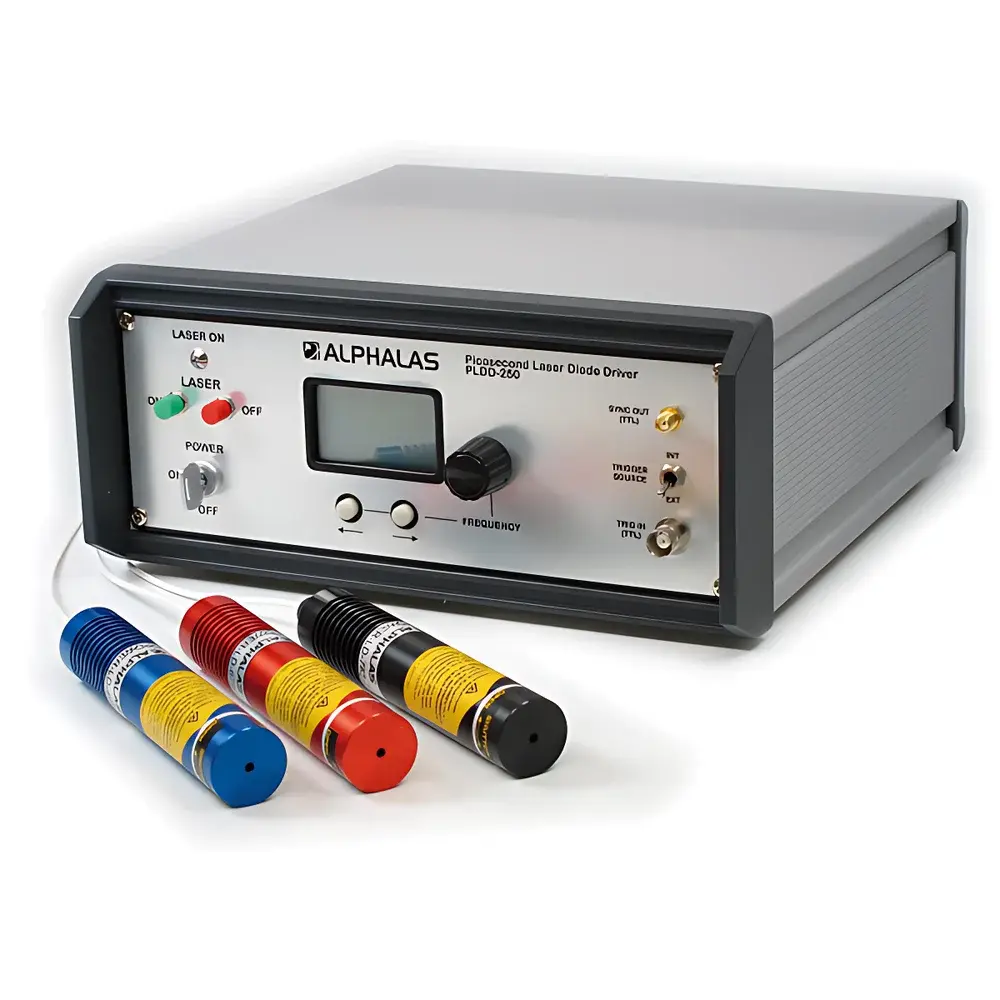
ALPHALAS PICOPOWER™-LD Series Picosecond Pulsed Diode Laser System with Integrated Driver
| Brand | ALPHALAS |
|---|---|
| Origin | Germany |
| Model | PICOPOWER™-LD |
| Wavelength Options | 375, 405, 450, 488, 635, 670, 785, 976, 1030, 1064, 1300, 1550 nm (custom wavelengths available) |
| Pulse Width | <40–80 ps (model-dependent) |
| Repetition Rate | 0.1 Hz to 20 MHz (optional up to 80 MHz) |
| Peak Power | up to 3 W (wavelength- and configuration-dependent) |
| Average Power | 0.2–1.0 mW @ 20–40 MHz |
| Beam Divergence | 0.5–1.5 mrad |
| Output | Free-space collimated or fiber-coupled (SM/PM fiber options) |
| Laser Head Dimensions | Ø25 × 125 mm |
| Driver Dimensions | 235 × 110 × 280 mm |
| Operating Temperature | 15–35 °C |
| Compliance | CE, RoHS, IEC 60825-1:2014 (Class 1M / 3B depending on wavelength & configuration) |
Overview
The ALPHALAS PICOPOWER™-LD Series is a fully integrated picosecond pulsed diode laser system engineered for time-resolved optical measurements requiring high temporal fidelity, excellent pulse-to-pulse stability, and broad spectral flexibility. Unlike conventional nanosecond or CW sources, this system leverages optimized laser diode architecture combined with a proprietary high-current, low-jitter driver (PLDD-100-40) to generate sub-80 ps optical pulses with deterministic timing and minimal timing jitter (<10 ps RMS). The core measurement principle relies on direct electrical pumping of gain-guided or index-guided semiconductor laser diodes, enabling precise control over pulse duration, repetition rate, and synchronization—critical for pump-probe spectroscopy, time-correlated single-photon counting (TCSPC), and ultrafast photodetector characterization. Designed and manufactured in Germany, the system meets stringent industrial and academic requirements for reproducibility, long-term drift stability (<±0.5% power over 8 h), and compatibility with vacuum-compatible or vibration-sensitive optical tables.
Key Features
- Sub-40 ps pulse width at multiple standard wavelengths (e.g., 405 nm, 785 nm, 1064 nm), with select models achieving <30 ps under optimized drive conditions
- Integrated digital frequency generator with 8-digit LED display; adjustable repetition rate from 0.1 Hz to 20 MHz (factory-upgradable to 40 MHz or 80 MHz)
- High peak power output—up to 3 W—enabling efficient excitation of low-quantum-yield fluorophores and nonlinear processes in bulk or fiber media
- Collimated free-space output with TEM00-like elliptical beam profile (M² < 1.3) and optional spatial filtering for improved beam quality
- Fiber-coupled variants available with SMF-28, HI1060, or PM980 fiber pigtails (FC/APC or FC/PC connectors); polarization extinction ratio >20 dB (PM versions)
- Full TTL synchronization suite: external trigger input (negative/positive edge selectable), sync TTL output with <500 ps delay uncertainty, and programmable delay lines (optional)
- Embedded diagnostics including real-time current/voltage monitoring, temperature feedback loop, and interlock-ready safety interface compliant with IEC 61508 SIL2
Sample Compatibility & Compliance
The PICOPOWER™-LD system supports diverse sample geometries and experimental configurations—including transmission, reflection, and confocal arrangements—without requiring optical re-alignment when switching between wavelengths or repetition rates. Its compact laser head (Ø25 × 125 mm) enables integration into OEM instruments, cryostats, or vacuum chambers (with optional feedthroughs). All units are CE-marked and conform to EN 60825-1:2014 for laser product safety, with classification ranging from Class 1M (enclosed operation) to Class 3B (open-beam use), dependent on selected wavelength, output power, and beam delivery mode. Documentation includes full Declaration of Conformity, traceable calibration certificates (NIST-traceable power meter verification), and compliance reports for ISO 9001:2015 manufacturing processes. For regulated environments (e.g., pharmaceutical QC labs), optional 21 CFR Part 11-compliant firmware modules support electronic signatures, audit trails, and user-access-level controls.
Software & Data Management
The system operates standalone via front-panel controls or integrates seamlessly with third-party platforms using ASCII-based serial (RS-232/USB-CDC) or TTL-level digital interfaces. ALPHALAS provides the open-source PicoControl GUI (Windows/Linux/macOS) supporting automated parameter sweeps, pulse train logging, and timestamped event capture synchronized to external DAQ systems (e.g., National Instruments PXIe). All operational parameters—including set frequency, measured average power, diode temperature, and driver status—are logged in CSV format with microsecond timestamp resolution. Raw data exports comply with ASTM E2913-20 (Standard Practice for Digital Data Acquisition in Time-Resolved Spectroscopy) and are compatible with MATLAB, Python (via PySerial or NIDAQmx), and LabVIEW. Firmware updates are delivered via signed binary packages with SHA-256 verification to ensure integrity and traceability.
Applications
- Fluorescence lifetime imaging microscopy (FLIM) and time-resolved fluorescence spectroscopy (TRFS), particularly for multi-exponential decay analysis in biological tissues and quantum dot systems
- Pump-probe transient absorption spectroscopy for carrier dynamics studies in perovskites, 2D materials, and organic semiconductors
- Characterization of photodetector impulse response, jitter, and linearity in high-speed optoelectronics (e.g., APDs, SPADs, SiPMs)
- Optical time-domain reflectometry (OTDR) for fiber fault localization with <1 cm spatial resolution at 1550 nm
- Seed source for fiber amplifiers and mode-locked oscillators requiring low-noise, high-repetition-rate seeding
- Time-of-flight (ToF) LiDAR development and calibration, especially in eye-safe SWIR bands (1300/1550 nm)
- Optical coherence tomography (OCT) systems requiring short-coherence-length illumination with tunable duty cycle
FAQ
What is the minimum pulse width achievable across all wavelengths?
Pulse width varies by model and operating condition: 405 nm and 785 nm heads achieve <40 ps (FWHM) under optimal bias; 1064 nm and 1550 nm variants typically deliver <50–80 ps. Custom designs can reach <30 ps at specific wavelengths.
Can the laser be synchronized to an external clock with sub-nanosecond jitter?
Yes—the PLDD-100-40 driver accepts external TTL triggers with <500 ps jitter (RMS) and provides a buffered sync output with matched delay path for master-slave instrumentation setups.
Is fiber coupling available for all wavelengths listed?
Free-space output is standard. Fiber coupling is offered for 405, 450, 488, 635, 670, 785, 1064, 1300, and 1550 nm; 375 nm and 976 nm require custom engineering due to fiber transmission limits and thermal management constraints.
Does the system support continuous wave (CW) modulation mode?
No—it is exclusively designed for pulsed operation. However, quasi-CW behavior can be approximated at maximum repetition rate (e.g., 80 MHz) with appropriate averaging.
What maintenance is required during routine operation?
No consumables or periodic alignment is needed. Recommended preventive maintenance includes annual verification of output power stability, thermal sensor calibration, and inspection of fiber connector cleanliness (if fiber-coupled).




