
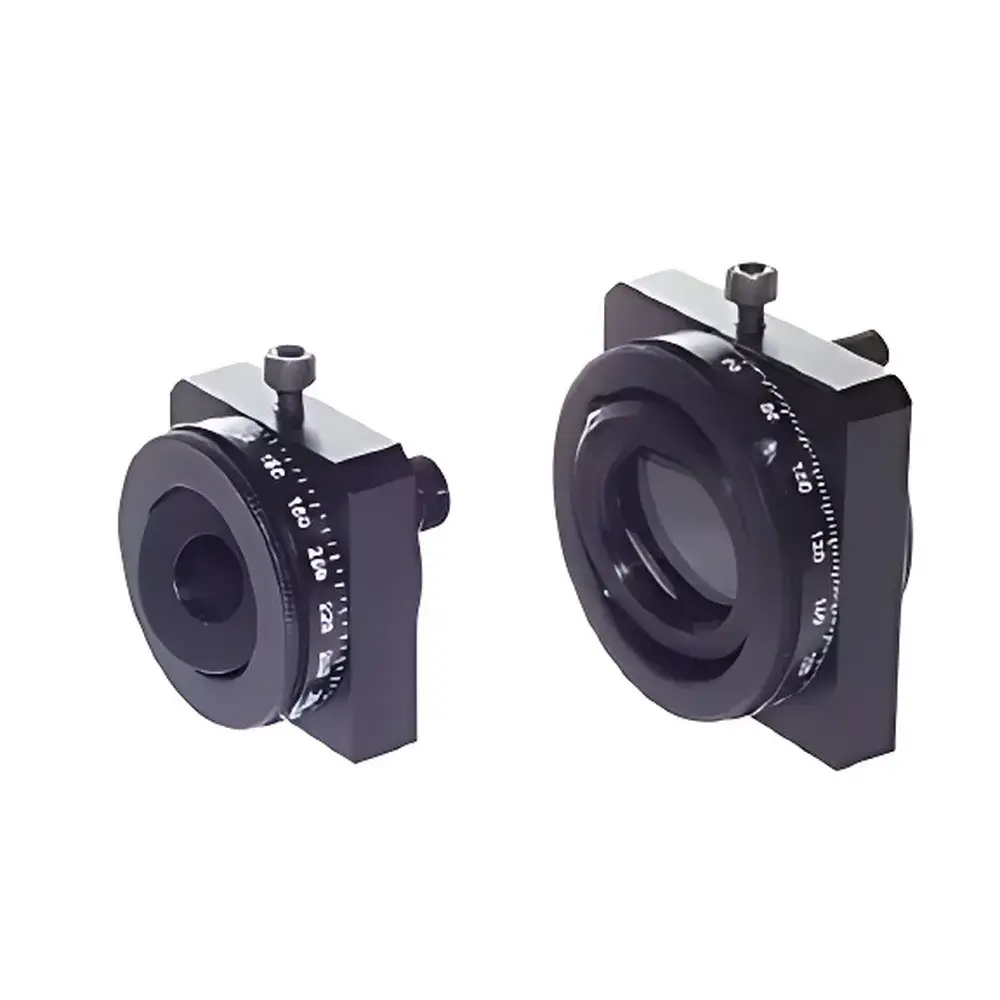
AlphaLas PO-TWP Tunable True-Zero-Order Phase Retardation Waveplate (UV–Far-IR)
| Brand | AlphaLas |
|---|---|
| Origin | Germany |
| Model | PO-TWP |
| Spectral Range (UVIR) | 150 nm – 6.5 µm |
| Spectral Range (FIR) | 1 µm – 19 µm |
| Aperture Options | Ø11 mm, Ø24 mm, Ø16 mm |
| Thickness | 2.0–5.0 mm |
| Retardation Modes | λ/4, λ/2, continuous 0–360°, dual-wavelength (e.g., λ/2 @ fundamental & λ @ SHG), fs-optimized AR-coated variants |
| Mounting | Precision kinematic tilt/rotation stage included |
Overview
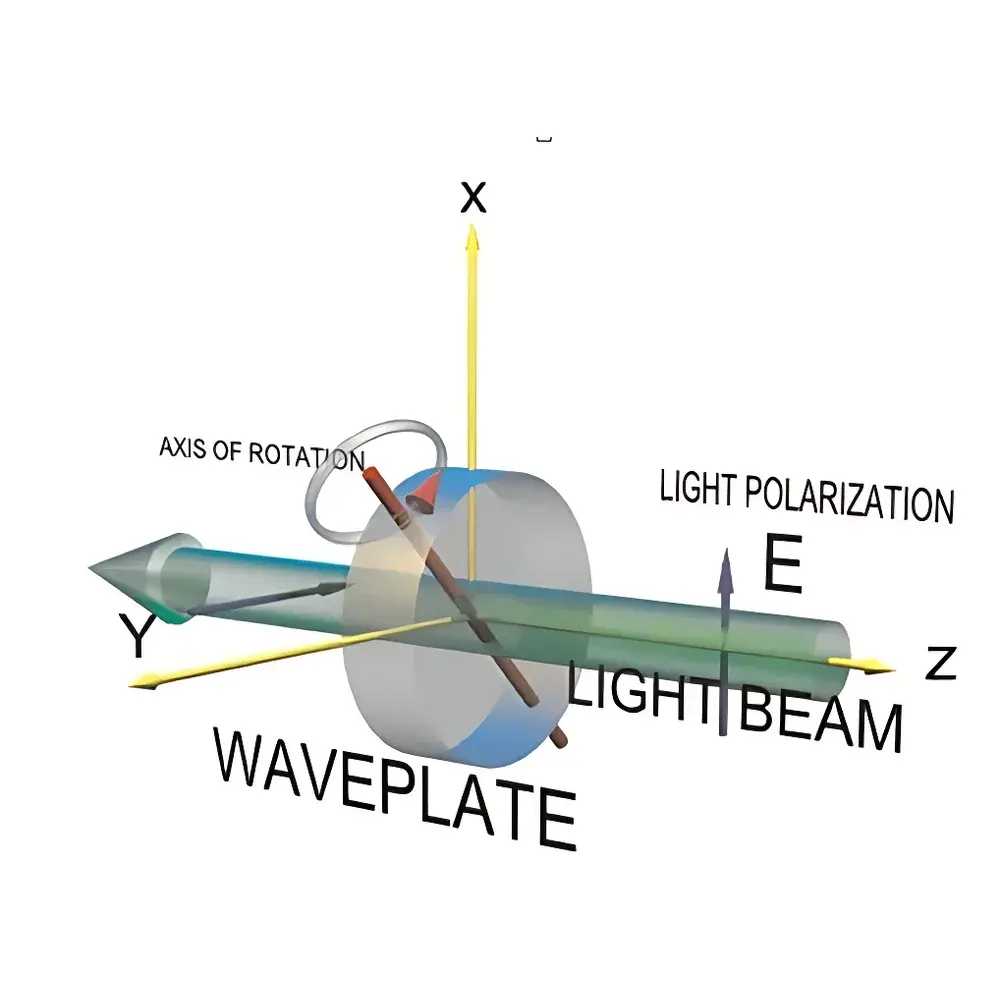
The AlphaLas PO-TWP Tunable True-Zero-Order Phase Retardation Waveplate is an engineered optical component designed for precision polarization control across an exceptionally broad spectral domain—from vacuum ultraviolet (150 nm) through visible and near-infrared to far-infrared (up to 19 µm). Unlike conventional fixed-retardation waveplates or thermally sensitive polymer-based alternatives, the PO-TWP employs a patented Savart-plate-inspired architecture: two optically contacted birefringent crystal plates cut at precise angles relative to their optical axes. This geometry enables true zero-order retardation—eliminating wavelength-dependent order ambiguity and ensuring high phase fidelity over multi-octave bandwidths. Phase delay is adjusted mechanically via controlled angular tilt (typically 3°–25°) of the assembly, a method that inherently suppresses retro-reflection into upstream laser cavities—a critical requirement in ultrafast oscillator, OPO, and frequency-conversion setups where feedback-induced instability must be avoided.
Key Features
- True zero-order performance across UV–FIR: no ambiguity in retardation order; minimal temperature sensitivity and high temporal stability.
- Single-component spectral coverage: replaces dozens of discrete quarter-wave or half-wave plates—reducing alignment complexity and system footprint.
- Three operational configurations: (1) discrete λ/4 or λ/2 modes (PO-TWP-L4/L2 series), (2) continuously tunable 0°–360° retardation (PO-TWP-MP series), and (3) dual-wavelength operation optimized for harmonic generation (e.g., λ/2 @ fundamental + λ @ SHG; PO-TWP-DW series).
- Femtosecond-laser-optimized variants: AR-coated sapphire (400–820 nm) and MgF₂ (1064 nm) substrates with sub-10 fs pulse distortion tolerance and LIDT > 1 J/cm² (100 fs, 800 nm).
- Integrated kinematic mount: precision-machined aluminum stage with micrometer-driven tilt adjustment (±0.1° resolution) and orthogonal rotation capability for full Stokes vector manipulation.
- No moving parts within optical path: all adjustment is external; no internal stress-induced birefringence or hysteresis.
Sample Compatibility & Compliance
The PO-TWP is compatible with collimated free-space beams up to Ø24 mm and supports both CW and pulsed laser systems—including Ti:sapphire oscillators, Yb-fiber amplifiers, OPOs, and quantum cascade lasers. Its birefringent substrate materials (e.g., crystalline quartz, MgF₂, sapphire) meet ISO 10110 surface quality standards (scratch-dig 20–10), and AR coatings comply with MIL-C-48497A specifications for adhesion and environmental durability. While not a regulated medical or safety device, its design adheres to best practices outlined in ISO/TR 20477:2018 (laser optics handling) and supports GLP-compliant polarization calibration workflows when used with traceable reference polarimeters (e.g., Thorlabs PAX1000, Meadowlark Optics EO-1000).
Software & Data Management
No proprietary software is required for basic operation—mechanical tilt is manually calibrated using supplied retardation-vs-angle lookup curves (validated per NIST-traceable polarimetric measurement at multiple wavelengths). For automated integration, the optional motorized tilt stage (PO-TWP-MOT) interfaces via RS-232 or USB to LabVIEW™, Python (PyVISA), or MATLAB® environments. All calibration data—including wavelength-specific retardation maps, temperature coefficients (dδ/dT < 0.005°/°C), and damage threshold reports—are provided in CSV and PDF formats compliant with ISO/IEC 17025 documentation requirements for metrological traceability.
Applications
- Polarization-resolved spectroscopy: real-time monitoring of dichroism, circular birefringence, and magneto-optic Kerr effects from 150 nm to 19 µm.
- Ultrafast laser diagnostics: dispersion-compensated pulse shaping, ellipticity control in CPA systems, and polarization gating for attosecond pulse generation.
- Nonlinear frequency conversion: precise alignment of input polarization states for type-I/type-II phase matching in BBO, LBO, and GaSe OPOs and DFG sources.
- Quantum optics experiments: preparation and analysis of arbitrary polarization-entangled photon pairs using tunable retardation in interferometric Bell-state analyzers.
- Industrial process monitoring: in-situ polarization feedback control in laser welding, thin-film deposition, and semiconductor wafer inspection systems operating in NIR–MIR bands.
FAQ
What distinguishes “true zero-order” from “multi-order” or “compound zero-order” waveplates?
True zero-order devices consist of a single birefringent layer with net retardation equal to exactly λ/4 or λ/2—no stacking or cementing. This eliminates spectral ripple, thermal drift, and angle-dependent phase errors common in compound designs.
Can the PO-TWP be used with femtosecond pulses without introducing group delay dispersion (GDD)?
Yes—when configured with sapphire or MgF₂ substrates and broadband AR coatings, GDD remains below ±5 fs² across 400–800 nm, verified by white-light interferometry and FROG characterization.
Is vacuum-UV (150 nm) operation supported without degradation?
UVIR-series models use synthetic fused silica or CaF₂ substrates with VUV-grade polishing and handling protocols; transmission >75% at 150 nm is achievable under UHV conditions (<10⁻⁶ mbar) with appropriate beam conditioning.
How is calibration traceability ensured for quantitative polarimetry?
Each unit ships with a factory-measured retardation curve (±0.3° uncertainty) referenced to NIST SRM 2088 (polarization standard), and optional on-site recalibration services are available under ISO/IEC 17025 accreditation.
Are custom AR coatings or substrate materials available?
Yes—AlphaLas offers bespoke anti-reflection coatings (e.g., 266/532/1064 nm triple-band, 3–5 µm MIR, or 8–12 µm FIR), as well as ZnSe, Ge, or KRS-5 substrates for extended far-IR applications upon request.






